
Wyze and Blink are the two brands that define budget home security cameras. Both keep hardware costs low, and both have free tiers that actually work. However, after owning cameras from both lineups across multiple generations, the answer is that these two brands are built around completely different priorities: and that makes choosing between them straightforward once you know what matters most for your installation. Wyze wins on hardware capability across nearly every category. Blink wins decisively on battery life for wire-free outdoor cameras. Everything else follows from those two facts.
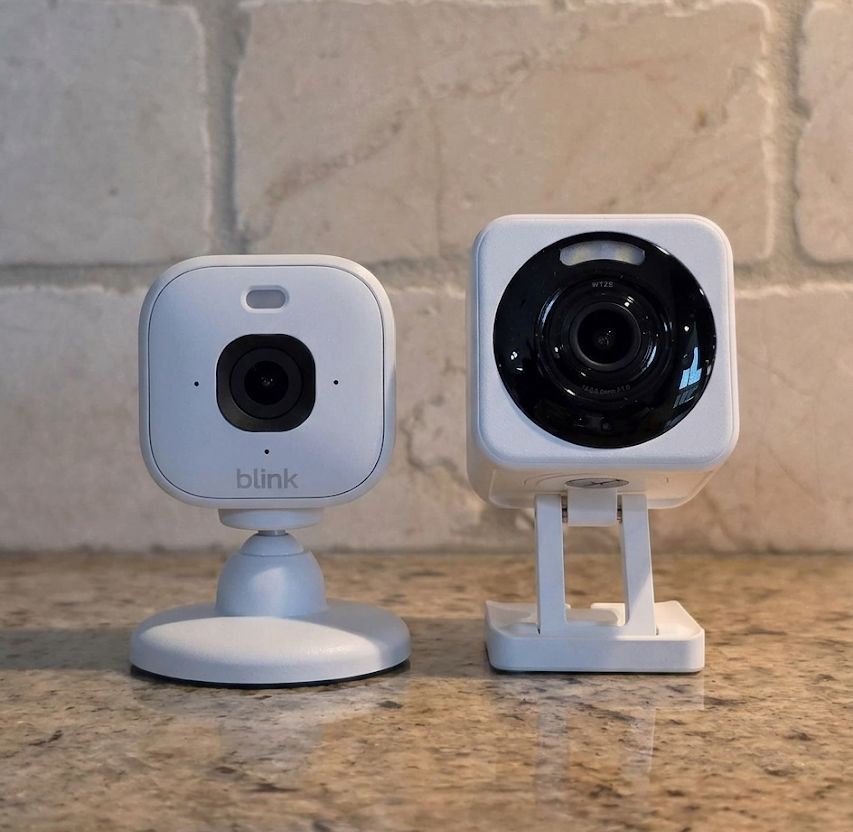
Wired indoor cameras: Wyze wins clearly
The head-to-head here is the Wyze Cam v4 against the Blink Mini 2K+. Both are compact wired indoor cameras at similar price points. Wyze wins this matchup without much contest.
| Wyze Cam v4 | Blink Mini 2K+ | |
|---|---|---|
| Resolution | 2.5K QHD | 2.5K (2560×1440) |
| Night vision | Color spotlight + IR | Color + IR |
| Local storage | microSD in camera | Sync Module 2 required |
| Weather rating | IP65 (indoor/outdoor) | IP65 (outdoor adapter sold separately) |
| Siren | Yes | No |
| Wi-Fi | Wi-Fi 6 dual-band | 2.4GHz only |
| Free AI detection | Person detection free | Subscription required |
Both cameras share the same 2.5K resolution, so that’s a wash. The Wyze Cam v4 wins on built-in siren, Wi-Fi 6, and a microSD slot that records locally without any additional hardware. The Blink Mini 2K+ has a wider field of view and noise-cancelling audio that is genuinely good, better than the v4’s microphone in direct comparison. However, those two advantages don’t outweigh the gap in every other specification. For wired use, the v4 is the stronger camera.
Furthermore, the Wyze Cam v4’s IP65 rating means it works outdoors without any additional purchase. The Blink Mini 2K+ is also IP65 rated but requires Blink’s Weather Resistant Power Adapter, sold separately, for outdoor use. Without it the USB port is unprotected and outdoor mounting isn’t recommended. That adds cost and a cable management consideration that the Wyze Cam v4 avoids entirely.
Wired indoor winner: Wyze Cam v4
Pan/tilt cameras: Wyze wins by a wide margin
This comparison is not particularly close. The Wyze Cam Pan v4 is a purpose-built 4K pan/tilt camera with a proper motorized head, 360-degree horizontal rotation, IP65 weather resistance, on-device AI tracking, and Wi-Fi 6. It is one of the best pan/tilt cameras available at any budget price point.
Blink’s pan/tilt offering is the Mini Pan-Tilt: which is not actually a pan/tilt camera. It is a motorized mount that holds the Blink Mini. The Mini itself is a fixed-lens 1080p indoor camera; the mount adds remote pan and tilt capability, but the underlying camera is still the same entry-level Mini hardware. The result is a two-piece system with 1080p resolution, indoor-only use, no local storage without a Sync Module, and motion tracking that lags noticeably behind the Wyze Pan v4’s on-device AI system in real-world use.
| Wyze Cam Pan v4 | Blink Mini Pan-Tilt | |
|---|---|---|
| Resolution | 4K UHD | 1080p |
| Design | Integrated camera + motor | Motorized mount + Mini camera |
| Weather rating | IP65 | Indoor only |
| Motion tracking | On-device AI tracking | Basic motor follow |
| Local storage | microSD in camera | Sync Module required |
| Wi-Fi | Wi-Fi 6 dual-band | 2.4GHz only |
The pan/tilt comparison illustrates the broader difference between these two brands. Wyze builds purpose-designed hardware for each category. Blink’s approach is to extend existing hardware with accessories. In the pan/tilt category specifically, that approach results in a significant capability gap. The Wyze Cam Pan v4’s motion tracking is smooth and reliable from real-world experience; the Blink Mini Pan-Tilt mount works, but it feels like what it is: a clip-on accessory rather than a dedicated product.
Pan/tilt winner: Wyze Cam Pan v4: not close
Battery/wire-free outdoor cameras: Blink wins on battery life
This is the one category where Blink has a genuine, meaningful advantage. The Blink Outdoor 2K+ is rated up to two years on two AA lithium batteries under standard use. In real-world conditions with moderate activity, that rating holds up. You install it, forget about it, and change the batteries once every year and a half to two years.
The Wyze Battery Cam Pro is rated at six months, and in practice, six months is optimistic under typical motion activity. For a camera mounted near a driveway or front door with regular trigger events, three to four months between charges is more realistic. That means charging or swapping batteries three to four times per year versus once every two years for Blink. For cameras mounted in hard-to-reach locations: high eaves, garage exteriors, back fences: that difference matters significantly.
| Blink Outdoor 2K+ | Wyze Battery Cam Pro | |
|---|---|---|
| Battery life | Up to 2 years (AA lithium) | Up to 6 months (rechargeable) |
| Resolution | 2K | 2.5K |
| Night vision | IR only | Color spotlight + IR |
| Hub required | Yes (Sync Module) | No |
| Local storage | Sync Module 2 + USB drive | microSD in camera |
| Color night vision | No | Yes |
The Wyze Battery Cam Pro does have better resolution, color night vision via its spotlight, and no hub requirement. However, those spec advantages don’t outweigh the practical reality of battery maintenance at difficult mounting locations. For wire-free cameras, the whole point is avoiding the need to run power. If you’re climbing a ladder to recharge a battery every few months, Blink’s AA lithium approach: replace batteries once every couple of years at a cost of a few dollars: is a fundamentally better fit for most installations.
In addition, Blink’s use of standard AA lithium batteries rather than a proprietary rechargeable pack means you can keep a set of spare batteries on hand and swap them in 60 seconds. There is no cable, no waiting for a charge cycle, no taking the camera offline for hours.
Wire-free outdoor winner: Blink Outdoor 2K+: battery life is the deciding factor
Local storage: Wyze wins on simplicity
Every Wyze camera except the Cam Outdoor v1/v2 has a microSD card slot built directly into the camera. Insert a card and the camera records continuously to local storage with no additional hardware, no hub, and no subscription. On a Wyze Cam v4 with a 128GB card, that’s weeks of continuous footage stored locally.
Blink’s local storage approach is different. The cameras themselves have no storage. To record locally, you need a Sync Module 2 or Sync Module XR connected to a USB flash drive. The Sync Module sits in your home connected to Wi-Fi and power, and all camera footage routes through it. It works reliably, but it adds a piece of hardware to the equation, requires a USB drive purchase, and means your local storage is in a centralized hub rather than distributed across cameras.
For a single-camera installation, Blink’s method is a minor inconvenience. For a multi-camera setup, Wyze’s per-camera microSD approach is more flexible: each camera stores its own footage independently, and there is no single point of failure.
Local storage winner: Wyze
Subscriptions: both reasonable, Wyze free tier is more useful
Neither brand requires a subscription for basic use, but the free tiers work differently.
Wyze’s free tier includes 12-second cloud clips with 14-day history, live streaming, two-way audio, basic motion alerts, and free person detection. With a microSD card, you additionally get continuous local recording at no cost. For many single-camera users, the free tier is sufficient indefinitely. The full tier breakdown is in the Wyze subscription plans guide.
Blink’s free tier provides live view and local storage via Sync Module. Cloud clip storage, the ability to save and review motion events remotely, requires a paid subscription or the Sync Module local storage setup. Without either, recorded clips are not saved at all. Furthermore, AI detection on Blink requires a subscription regardless of local storage setup. For the full plan comparison see the Blink subscription plans guide.
Wyze Cam Plus starts at around $2.99 per month per camera and unlocks full-length event recording, all AI detection categories, and extended cloud history. Cam Unlimited covers every Wyze camera on an account for a flat annual fee, which makes it genuinely cost-effective for multi-camera homes.
Blink’s subscription plans start at a similar price point per camera. In addition, the Sync Module 2 approach provides a subscription-free path to clip storage that Wyze doesn’t offer without a microSD card: so for buyers who want cloud-free local storage without buying a card for each camera, Blink’s hub method is actually the cleaner solution.
Subscriptions: Wyze free tier is more useful out of the box; Blink’s Sync Module local storage is a competitive alternative for subscription-free buyers
Which brand should you buy?
The answer depends almost entirely on where you need to put the cameras.
For wired indoor cameras, choose Wyze. The Cam v4 matches the Blink Mini 2K+ on resolution but outspecifies it on weather resistance, local storage, siren, and connectivity. There is no close comparison.
For pan/tilt coverage, choose Wyze. The Cam Pan v4 is a purpose-built 4K camera with on-device AI tracking. Blink’s pan/tilt option is a motorized mount accessory for a 1080p indoor camera. They are not in the same category.
For wire-free outdoor cameras, choose Blink. Two-year battery life on standard AA lithiums is a practical advantage that outweighs Blink’s spec deficits in most outdoor installations, particularly at hard-to-reach mounting locations.
For mixed installations: wired indoor cameras plus wire-free outdoor: the honest answer is that using both brands is a reasonable approach. Wyze for the wired cameras, Blink for the battery-powered outdoor positions. The apps are separate, but both are well-supported and reliable.
Wyze vs Blink: The Verdict
Wyze wins on hardware capability across wired cameras, pan/tilt, local storage, and free tier usefulness. Blink wins on battery life for wire-free outdoor cameras: and that advantage is large enough that it decides the category outright. Choose Wyze if most of your cameras are wired. Choose Blink if battery life at outdoor locations is the priority. For mixed installations, using both brands is a practical solution.
For individual camera reviews see the Wyze Cam v4 review and the Blink Outdoor 4 review. For the full brand overviews see the Wyze camera hub and the Blink camera hub.