
The Blink Wired Floodlight Camera is one of the more straightforward products in the home security space — a hardwired floodlight and 1080p camera in a single unit at a realistic price. It doesn’t have the 2K resolution or advanced AI of some competitors, but what it does have is 2600 lumens of lighting, reliable motion detection, and a no-nonsense setup. I’ve been running one on my shed, and this is what it’s actually like to use.
The Blink Wired Floodlight Camera is available on Amazon in white or black.
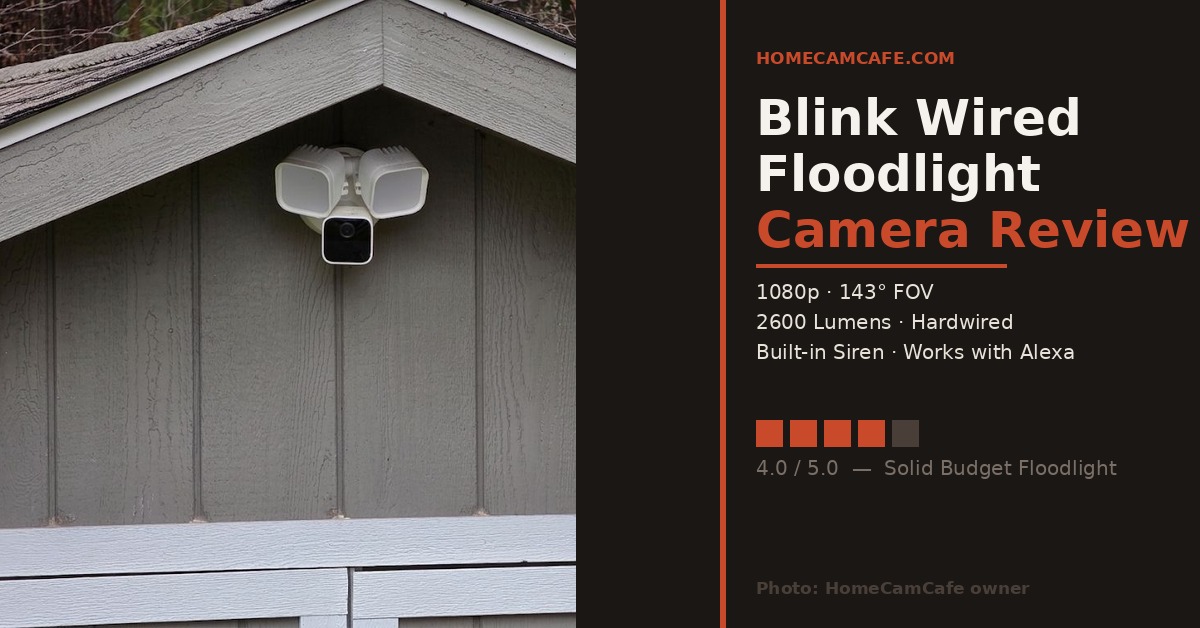
The Blink Wired Floodlight Camera installed on a shed — a natural fit for outbuildings, garages, and driveways.
Quick Specs
1080p HD (up to 30fps)
143° diagonal
2600 lumens (2 panels)
Color (with floodlight)
Hardwired (replaces existing fixture)
802.11 b/g/n @ 2.4 GHz
Not required
Yes
Cloud (subscription) or local (Sync Module 2 + USB)
~$100
Design and Installation
The Blink Wired Floodlight Camera has a clean, purpose-built design featuring two adjustable LED panels flanking a central camera module, all mounted on a shared base that wires directly into your home’s electrical system. It replaces an existing outdoor light fixture or floodlight, so installation requires connecting to a junction box rather than running new wiring. Blink includes everything you need in the box: mounting hardware, wire connectors, and clear instructions on which wire connects to which.
The camera module and each light panel can be independently adjusted and locked into position, which means you can aim the camera at the area you want to monitor while pointing the lights where they’ll do the most good. This is a more flexible arrangement than units where the camera and lights are fixed in the same direction. Installation on the shed took about 15 minutes — straightforward for anyone comfortable with basic electrical work.
One mounting consideration worth planning before installation: the standard junction box position determines where the camera points, and the wired floodlight is not designed for soffit or ceiling installation without an adapter. If you need to mount it under an eave or in a non-standard position, see the Blink Floodlight Mount Guide for the available options.
Installation note: The Blink Wired Floodlight Camera must be mounted to a 4-inch round, UL-listed, weatherproof electrical junction box. If your existing fixture uses a different box configuration, you may need an adapter before installation.
Unlike most Blink cameras, the Wired Floodlight Camera connects directly to your Wi-Fi without requiring a Sync Module. This simplifies setup considerably — you just wire it in, power it up, and add it in the Blink app. The camera connects to your network in the same way as a standalone device.
Floodlight Performance
The 2600 lumens output is the headline feature here and it delivers. When the lights trigger, they light up a substantial area — more than enough to cover a driveway, backyard, or the front of an outbuilding. Two separate LED panels give you a wider spread than a single spotlight, and they’re bright enough to be genuinely useful as security deterrence rather than just supplemental illumination.
The lights are motion-activated by default but can also be controlled manually from the Blink app at any time. Furthermore, you can set schedules, adjust sensitivity, and define specific motion zones to avoid triggering on traffic or animals in low-priority areas. In practice on the shed, the motion detection has been reliable — it catches what it should and the floodlight response is immediate when triggered.
The clip below is footage we captured ourselves with this exact camera: a family of bears passing through at night, triggering the floodlight and full color night vision in real time. It’s a good illustration of how quickly the light responds to motion and how much detail the camera picks up once the area is lit.
Video Quality
The camera shoots 1080p at up to 30fps, which is functional but increasingly a limitation at the $100 price point. Daytime footage is clear enough to identify people and vehicles within the camera’s range. At night, the color night vision is entirely dependent on the floodlights — when they’re on, you get a well-lit color image; when they’re off, the image is darker and less detailed than cameras with dedicated color night vision sensors.
The 143° field of view is wide enough to cover a driveway or backyard without obvious blind spots. Two-way audio works adequately for basic communication. The built-in siren can be triggered manually from the app — a useful deterrent option when you need more than a floodlight response.
One honest limitation: at $100, competitors like the Ring Floodlight Cam and some Eufy models are pushing 2K resolution. Blink’s 1080p output is serviceable but if video detail is your priority — license plate capture, facial identification at distance — you’ll feel the gap.
App and Storage
The Blink app handles all camera controls — live view, motion zone configuration, light scheduling, siren activation, and clip playback. The interface is clean and consistent with other Blink products, so if you already use Blink cameras elsewhere you’ll feel at home.
Storage is where the Blink ecosystem shows its limitations. Without a subscription, clips are not saved — you get live view and motion alerts but no recorded history. A Blink Subscription Plan at $3/month per camera (or $10/month for unlimited cameras) unlocks cloud storage and person detection. Alternatively, local storage is available via a Sync Module 2 and USB drive, each sold separately — adding roughly $35 to the total cost.
Person detection is powered by Amazon’s AZ2 Neural Edge Processor built into the camera, which means it processes video locally rather than sending everything to the cloud. However, the person detection alerts still require a subscription to activate — the hardware is there, but the feature is gated.
Who Should Buy the Blink Wired Floodlight Camera
The Blink Wired Floodlight Camera makes the most sense for homeowners who already have an outdoor junction box and want a combined floodlight and camera without spending $150–$250 on a Ring or Arlo equivalent. It’s a particularly natural fit for sheds, garages, side yards, and driveways — locations where you want powerful lighting and basic camera coverage without complex wiring.
For those already invested in the Blink ecosystem, the Blink Wired Floodlight Camera will leverage your existing Blink Subscription Plan which we dove into awhile back.
It’s less suited for buyers who want subscription-free clip storage out of the box, or anyone prioritizing 2K resolution. For those use cases, a battery-powered camera with local microSD storage — like the Reolink Argus 4 Pro — may be a better fit despite lacking the integrated floodlight.
Verdict — 4.0 / 5.0
The Blink Wired Floodlight Camera does its core job well — 2600 lumens is genuinely bright, motion detection is reliable, and the integrated camera covers a wide field without requiring a separate mount. The 1080p resolution and subscription-gated clip storage are real limitations at $100, but for a hardwired floodlight with smart camera capability at this price, it’s a solid value. If you already have a junction box and want a no-fuss combined light and camera, this is a practical choice.
Pros: 2600 lumens · Reliable motion detection · No Sync Module needed · Independent light/camera adjustment · Built-in siren
Cons: 1080p only · Clip storage requires subscription · Person detection requires subscription · 2.4 GHz only
Frequently Asked Questions
Does the Blink Wired Floodlight Camera require a Sync Module?
No. Unlike most battery powered Blink cameras, the Wired Floodlight Camera connects directly to your Wi-Fi network without a Sync Module. However, if you want local storage via a USB drive, you’ll need to add a Sync Module 2 separately.
Does the Blink Wired Floodlight Camera require a subscription?
No subscription is required for live view, motion alerts, and manual floodlight control. However, clip storage and person detection both require a Blink Subscription Plan, which starts at $3/month per camera. Without a subscription or a Sync Module 2, no clips are saved.
How bright is 2600 lumens?
2600 lumens is comparable to a standard outdoor floodlight fixture — bright enough to illuminate a full driveway or backyard. For reference, a typical 100-watt incandescent bulb produces around 1600 lumens. The two-panel design spreads light across a wider area than a single-point spotlight.
Is the Blink Wired Floodlight Camera weatherproof?
Yes. The camera is designed for outdoor use and is built to withstand rain, dust, and normal temperature variation. Blink does not publish a specific IP rating for this model, but it is marketed and designed as a fully outdoor device.
What’s the difference between the Blink Wired Floodlight and the Blink Outdoor 4 Floodlight?
The Wired Floodlight Camera is a single integrated unit that hardwires into your home’s electrical system. The Outdoor 4 Floodlight is a separate accessory mount designed to hold a Blink Outdoor 4 camera — it’s battery-powered and doesn’t require wiring. The Wired version produces 2600 lumens; the Outdoor 4 Floodlight produces 700 lumens. If you want maximum brightness and have an existing junction box, the Wired version is the better choice.