
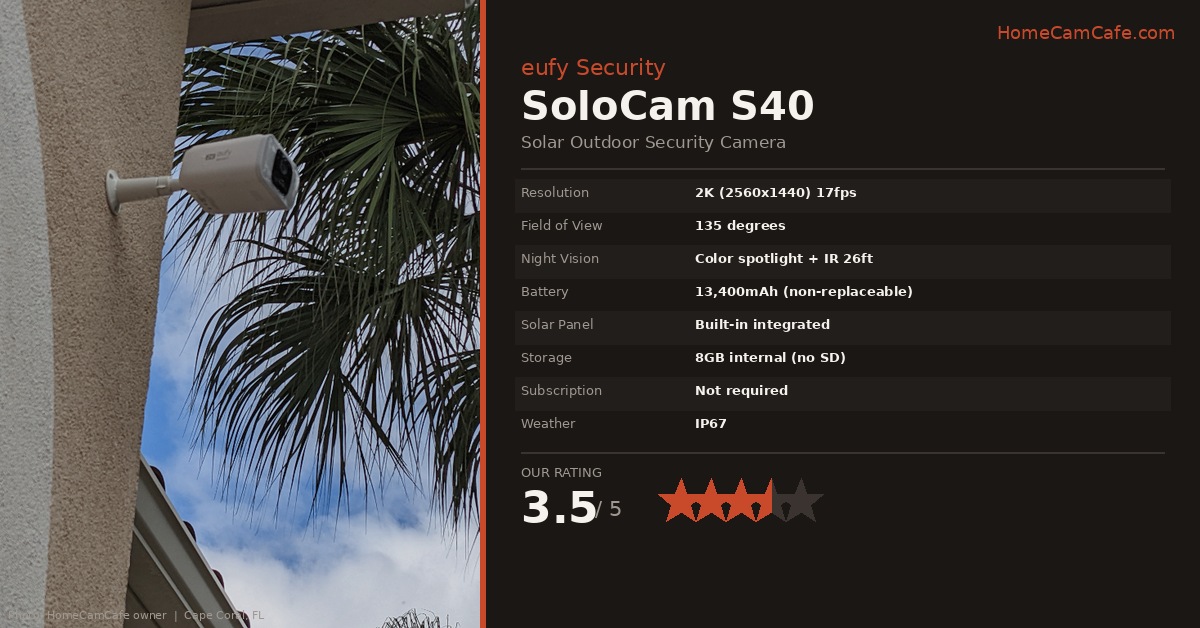
The eufy SoloCam S40 was one of the first solar outdoor cameras to take the integrated-everything approach seriously — no hub required, no subscription, no wires, and no battery swapping. I’ve had this camera running outdoors in Southwest Florida through extreme summer heat, high humidity, and heavy rain. It holds up well in the field. That said, the solar camera market has matured significantly since this camera launched, and there are meaningful tradeoffs worth understanding before buying. Note: the SoloCam S40 is also sold under the name SoloCam S230 — it’s the same camera.
Check the current price on Amazon
What Is the eufy SoloCam S40?
The SoloCam S40 — also sold as the SoloCam S230, which is the same camera under a newer name — is eufy’s flagship integrated solar outdoor camera. Everything is built into one unit: the solar panel, the 13,400mAh battery, the 2K camera, the spotlight, and 8GB of local storage. There is no hub required, no microSD card to buy, and no subscription to pay. It connects directly to your home’s 2.4GHz Wi-Fi network.
The design philosophy is genuinely appealing: mount it once, point it at the sun, and forget about it. In practice, that proposition holds up reasonably well — but the integrated design that makes it simple also introduces the camera’s biggest long-term limitation, which we’ll cover in detail.
Setup
Setup is handled through the eufy Security app on iOS or Android. Download the app, tap the plus sign, select SoloCam Solar, connect to your Wi-Fi network, and follow the guided steps. The process takes under ten minutes. There is no hub or base station to configure first — the camera connects directly to your router, which keeps the setup genuinely simple.
One practical note before mounting: eufy recommends letting the camera charge via the USB-C port for a full cycle before installation. The solar panel alone won’t be enough to bring a depleted battery to full charge quickly, so starting with a charged battery ensures the camera is operational from day one.
Placement matters significantly for a solar camera. The panel needs unobstructed access to direct sunlight for at least two hours daily. Mounting under an eave or in a shaded area will compromise charging. Plan your mounting location with the sun’s path in mind before drilling.
Video Quality
The 2K (2560×1440) image is clear and detailed. Daytime footage shows accurate colors and sharp detail at the 135° field of view — wide enough to cover a driveway, yard entrance, or backyard effectively. The 8x digital zoom lets you get a closer look at specific areas of the frame from the app.
Night vision has two modes. Color night vision uses the built-in 600-lumen spotlight to illuminate the scene — the result is full-color footage after dark that makes identifying vehicles, clothing, and faces significantly easier than black-and-white IR. The tradeoff is battery drain; color night vision should be used thoughtfully on a solar camera where power management matters. Standard IR night vision reaches up to 26 feet in black and white and is the more battery-efficient choice for high-traffic areas where the spotlight would trigger constantly.
Video is recorded at 17 frames per second rather than the more common 20–30fps. In practice this is barely noticeable for event-based monitoring, but fast-moving subjects like running people or passing vehicles can appear slightly less smooth than on higher frame-rate cameras.
Detection and App Features
The eufy Security app is well-developed and genuinely feature-rich compared to many cameras at this price. Motion alerts include person-only detection — the on-device AI filters out animals, vehicles, and non-human movement to reduce false alerts. In practice this works well for keeping notifications meaningful.
Activity zones are highly flexible. Rather than predefined grid squares, eufy gives you a hexagon with draggable edges — you can shape the detection zone to exactly the area you want monitored. This is more precise than most cameras offer and particularly useful for excluding a busy road or neighboring property from triggering alerts.
Detection sensitivity runs across seven levels. Starting at level four is a sensible default — adjust up for more sensitivity or down if you’re getting too many triggers. The 90dB siren is a notable extra: it can be triggered manually from the app or set to activate automatically on person detection, which serves as a real deterrent. It startled me on first encounter with the default settings — worth knowing it’s active out of the box and adjustable in the security settings.
Notifications can be configured from a simple text alert to one that includes a thumbnail image of the event, which is considerably more useful for quickly assessing whether something warrants attention.
Storage — The Good News
The SoloCam S40 stores all footage locally on 8GB of built-in eMMC memory — no subscription required, no microSD card to buy or manage. Based on 30 ten-second motion events per day, eufy estimates this holds approximately 30 days of footage before the oldest clips are overwritten. All data is encrypted with AES-128 encryption and stays on the camera itself.
The absence of any required subscription is a genuine differentiator. Over two or three years of ownership, the savings compared to a $5–10/month subscription camera are significant. There is no cloud option forced on you — though eufy offers optional cloud backup if you want off-device redundancy.
The Integrated Solar Panel — The Key Limitation
This is the most important section for anyone considering this camera long-term.
The solar panel on the SoloCam S40 is built directly into the camera body — it is not a separate panel connected by a cable. This means it cannot be repositioned to catch more sun, cannot be replaced if it degrades, and cannot be supplemented with a larger external panel if your location doesn’t get enough direct sunlight.
Additionally, the 13,400mAh battery is non-replaceable. If either the battery or the solar panel reaches end of life, the only option is replacing the entire camera.
In contrast, cameras like the Reolink Argus 4 Pro ship with a separate detachable solar panel on a cable. You can angle the panel independently from the camera for optimal sun exposure, replace it if it fails, or upgrade to a larger panel. That’s a more practical long-term design.
For buyers in reliably sunny locations who plan to use the camera for two to three years, this limitation may never matter. For buyers in cloudier climates or who expect to use the camera for five or more years, it’s a meaningful consideration.
☀️ Solar Placement Tip
Before mounting, observe the sun’s path across your intended mounting location over a full day. The panel needs a minimum of two hours of direct — not indirect — sunlight. South-facing walls get the most sun in the northern hemisphere. Mounting under an eave that shades the panel during peak hours will compromise performance regardless of how sunny your climate is.
Hardware and Build Quality
The SoloCam S40 is a substantial camera — 1.1 pounds with a noticeably heavy feel compared to typical battery cameras. The weight comes from the large 13,400mAh battery pack. IP67 weatherproofing means it’s fully protected against dust and capable of withstanding temporary submersion, well beyond what most outdoor cameras require. It handles Southwest Florida summers — extreme heat, near-daily downpours, and high humidity — without complaint.
Mounting requires screws into a solid surface. The weight makes adhesive mounting impractical. However, the back of the camera has a standard 1/4″-20 threaded tripod mount hole, which opens up a wide range of compatible mounts beyond the included hardware.
Two-way audio is supported via a built-in mic and speaker. Audio quality is decent for basic communication — adequate for talking to someone at your door or alerting a visitor, though not high-fidelity. Sound levels are adjustable in the app.
What the SoloCam S40 Is Missing
- Integrated solar panel cannot be replaced or supplemented
- Non-replaceable battery: End-of-life battery means end-of-life camera
- No continuous recording: Event-based clips only
- 2.4GHz Wi-Fi only: No 5GHz support
- No Apple HomeKit: Alexa and Google Assistant only
- Storage not expandable: 8GB built-in only, no microSD slot
- 17fps: Below the 20–30fps standard on newer cameras
Quick Specs
| Spec | Detail |
|---|---|
| Resolution | 2K (2560×1440), 17fps |
| Field of View | 135° |
| Night Vision | Color (spotlight) or IR up to 26ft |
| Spotlight | 600 lumens, adjustable color temp |
| Solar Panel | Built-in, integrated (not replaceable) |
| Battery | 13,400mAh (non-replaceable) |
| Local Storage | 8GB eMMC built-in (not expandable) |
| Subscription | Not required |
| Weatherproofing | IP67 |
| Wi-Fi | 2.4GHz only |
| Smart Home | Amazon Alexa, Google Assistant |
| Siren | 90dB built-in |
| Operating Temp | -4°F to 122°F |
Our Verdict
eufy SoloCam S40 — 3.5 / 5
The SoloCam S40 is a genuinely capable solar outdoor camera. The 2K image is clear, the app is excellent, no subscription is required, and the solar charging works as advertised in sunny climates — I’ve run this camera through Southwest Florida summers without any issues. However, the integrated non-replaceable solar panel is a real long-term concern. If the panel degrades or the battery fails, the camera is done. Competing cameras like the Reolink Argus 4 Pro use separate detachable panels and offer 4K resolution for similar money, which is a more practical design. The S40 is a solid buy for its current price — just go in with eyes open on the integrated panel tradeoff.
Best for: Sunny climates, buyers who want a fully self-contained unit, no-subscription priority | Skip if: You want a replaceable panel, 4K resolution, or long-term repairability
Check the current price for the eufy SoloCam S40/S230 on Amazon →
For a solar camera with a separate detachable panel and 4K resolution, see our Reolink Argus 4 Pro review. For our full outdoor camera rankings, see the Best Outdoor Security Cameras guide.