
Mounting a security camera on a fence or railing is one of the most effective ways to cover a property line, driveway entrance, or backyard perimeter — but it comes with a few challenges that a standard wall mount doesn’t. Fences and railings aren’t always solid, may not support drilling, and need weatherproof hardware that won’t rust or loosen over time. This guide covers the right approach for every common surface type, with specific mount recommendations that work with today’s most popular cameras.
Before You Mount: Key Considerations
Before picking a mount, there are a few things worth thinking through. First, consider whether the camera needs power. A wired camera mounted on a fence far from the house creates a cable management challenge — you’ll need to run outdoor-rated cable along the fence line or choose a battery or solar-powered camera instead. Second, think about the angle. Fence and railing mounts position cameras lower than a typical soffit or eave install, which changes your field of view. Finally, consider whether you want a no-drill solution or whether you’re comfortable making permanent holes in your fence material.
Always purchase the highest resolution camera possible. If still struggling for a clear view, review our tips on how to see further with a security camera article.
Camera recommendation: For fence and railing installs, a battery or solar-powered camera eliminates the cable problem entirely. The Tapo C615F solar floodlight camera is specifically built for this use case — solar-powered, wire-free, with pan/tilt coverage and a built-in floodlight. No cable runs required.
Mounting on a Wood Fence
Wood fences are the most forgiving surface to work with. Most security cameras come with a standard wall mount that screws directly into wood, so you can often use the included hardware without buying anything extra. The key is to mount into a fence post rather than a fence board — posts are structural and won’t flex or crack under the weight of a camera. Fence boards, by contrast, can split over time especially in climates with significant temperature swings.
Use exterior-grade screws and add a weatherproof silicone bead around any cable entry points to prevent water from working into the wood. Additionally, if your camera has a long mounting base, pre-drill the holes to avoid splitting the post.
Best approach: Mount directly into a fence post using the camera’s included bracket and exterior-grade screws. No additional hardware needed in most cases.
Mounting on a Metal or Vinyl Railing
Metal and vinyl railings — common on decks, stairs, and porches — require a different approach. Drilling into metal railing is possible but risks rust at the penetration point over time, and drilling vinyl can crack it if done carelessly. Furthermore, many renters and homeowners don’t want to make permanent modifications to railings at all.
The best solution here is a no-drill pole or railing clamp mount. The Holicfun No-Drill Security Camera Pole Mount is a strong choice — it uses stainless steel band clamps that wrap around round or square posts from 2 to 17 inches in diameter, includes adapters for Ring and Blink cameras, and offers 360-degree swivel and 180-degree tilt adjustment. No holes, no rust risk, and it works on deck posts, fence posts, and downspouts alike.
For thinner railings where a band clamp won’t work cleanly, a gooseneck clamp mount is a good alternative. The Holicfun Clip Mount uses a spring-loaded clamp that grips surfaces up to 1.6 inches thick and provides a flexible 15cm gooseneck arm for angle adjustment. It’s compatible with Ring, Blink, eufy, Wyze, Arlo, and Google Nest cameras.
Mounting on a Chain Link Fence
Chain link fences present a unique challenge — there’s no flat surface to mount to, and the mesh itself isn’t rigid enough to hold a camera securely. The right approach is to mount to the top rail or one of the vertical line posts rather than to the mesh. Most chain link fences have a horizontal top rail and vertical posts at regular intervals — both are solid metal tubes that work well with a pole clamp mount.
Use the same no-drill pole mount approach as with a metal railing. The Holicfun pole mount works well on chain link fence posts and top rails. Position the camera at the top of the fence line for the best downward viewing angle across your property.
Mounting on a Vinyl Fence
Vinyl fences are hollow and brittle compared to wood — drilling into a vinyl fence board almost always results in cracking eventually, and the hollow interior provides no solid material for a screw to grip. As a result, the only reliable approach is to mount to a vinyl fence post, which is typically filled with a wood or metal insert for structural support.
Pre-drill carefully and use short screws that won’t punch through the insert. Alternatively, a no-drill pole clamp mount on the post avoids the issue entirely and is reversible if you ever need to move the camera.
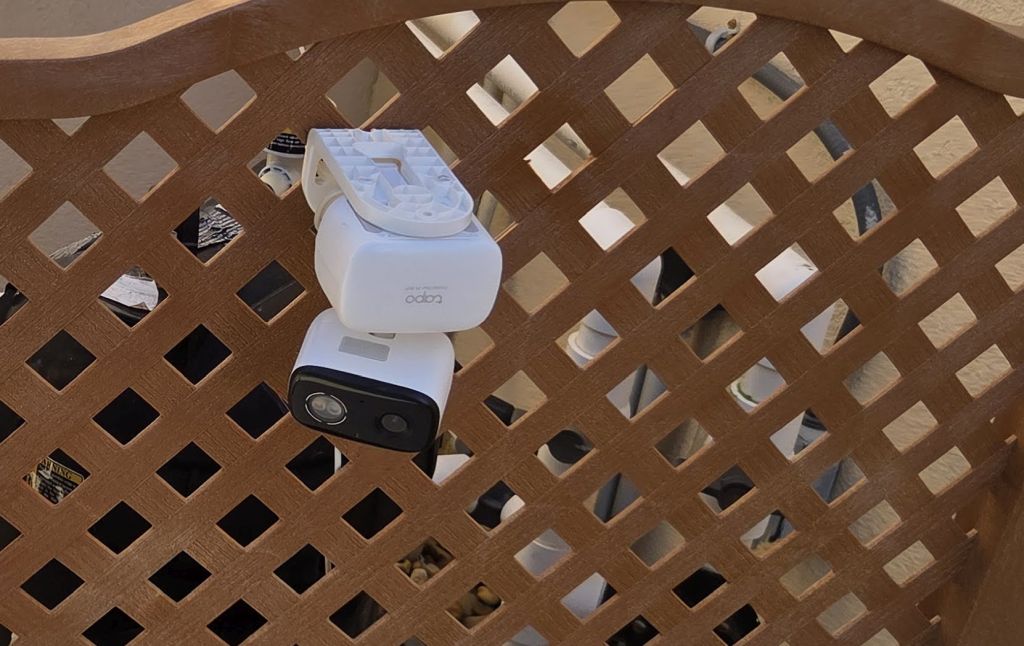
The photo that accompanies this article is a Tapo C216 Tracking Camera which has a somewhat unique stock mount that allows running zip ties through it. The zip ties thread through the mounting holes on the stock base and attach tightly through the lattice pattern on the fence. It’s a pan and tilt camera so it is perfct for watching the entire perimeter.
Which Camera Works Best for Fence and Railing Installs?
For fence and railing installs, wire-free cameras are almost always the better choice. Running power cables along a fence line is messy, requires outdoor-rated conduit in many cases, and creates points of failure at every connection. Battery and solar-powered cameras eliminate that problem entirely.
The Tapo C425 is a strong choice for a fence install — it’s a wire-free pan/tilt camera with 360° coverage, free AI detection, and local microSD storage with no subscription required. The pan/tilt capability is especially useful on a fence where a fixed camera might miss activity to the side. For a no-subscription outdoor camera with solid 2K video, the Tapo C120 is a more affordable fixed option that works well on a fence post mount.
For a full overview of outdoor cameras that work well, see our best outdoor security cameras roundup. If you’re specifically looking at floodlight cameras for perimeter coverage, our Tapo C615F review covers the best solar floodlight option available at this price.
Quick Reference
Wood fence post — use the camera’s included bracket with exterior screws, mount into the post not the boards. Metal or vinyl railing — use a no-drill pole clamp mount like the Holicfun. Chain link — mount to the top rail or a vertical post, not the mesh. Vinyl fence — mount to the post only, pre-drill carefully or use a no-drill clamp. For all fence and railing installs, a battery or solar-powered camera eliminates cable management entirely and is strongly recommended.
Frequently Asked Questions
Can I mount a security camera on a fence without drilling?
Yes. No-drill pole clamp mounts use stainless steel band clamps that wrap around fence posts and railings without requiring any holes. They work on round or square posts from 2 to 17 inches in diameter and are compatible with most popular camera brands including Ring, Blink, eufy, Wyze, and Arlo.
What is the best height to mount a security camera on a fence?
For most residential fences, mounting at or near the top of the fence — typically 6 to 8 feet — gives the best combination of coverage and downward angle. Too low and the camera captures ground-level footage with limited range; too high and facial identification becomes difficult. Aim for a slight downward tilt of 15 to 30 degrees for the best field of view.
Will a fence-mounted camera get stolen?
Fence-mounted cameras are more accessible than soffit or eave-mounted cameras, so theft risk is slightly higher. To reduce this risk, use a mount with a security screw or locking mechanism, position the camera high enough to require a ladder to reach, and choose a camera with a built-in siren or alarm that triggers if tampered with.
Do I need a special camera for outdoor fence mounting?
Any outdoor-rated camera with an IP65 or IP66 weather resistance rating is suitable for fence mounting. The more important consideration for fence installs is power — a battery or solar-powered camera avoids the need to run cables along the fence line, which is both difficult and unsightly.
Can I mount a camera on a shared fence?
If the fence is on a shared property line, check local laws and your HOA rules before installing. In most jurisdictions, you have the right to mount a camera on your side of the fence as long as it’s aimed at your property. However, a camera that captures a neighbor’s yard may raise privacy concerns — aim accordingly and check local regulations if unsure.