
The Tapo C400 and the Blink Outdoor 4 are two of the most competitively priced wire-free outdoor cameras available. Both shoot 1080p, both run on batteries, and both work without a mandatory subscription for basic recording. The differences between them are meaningful — particularly on battery life, night vision, and how local storage works — and those differences point clearly to different buyers. Having owned both cameras, here is how they actually compare.
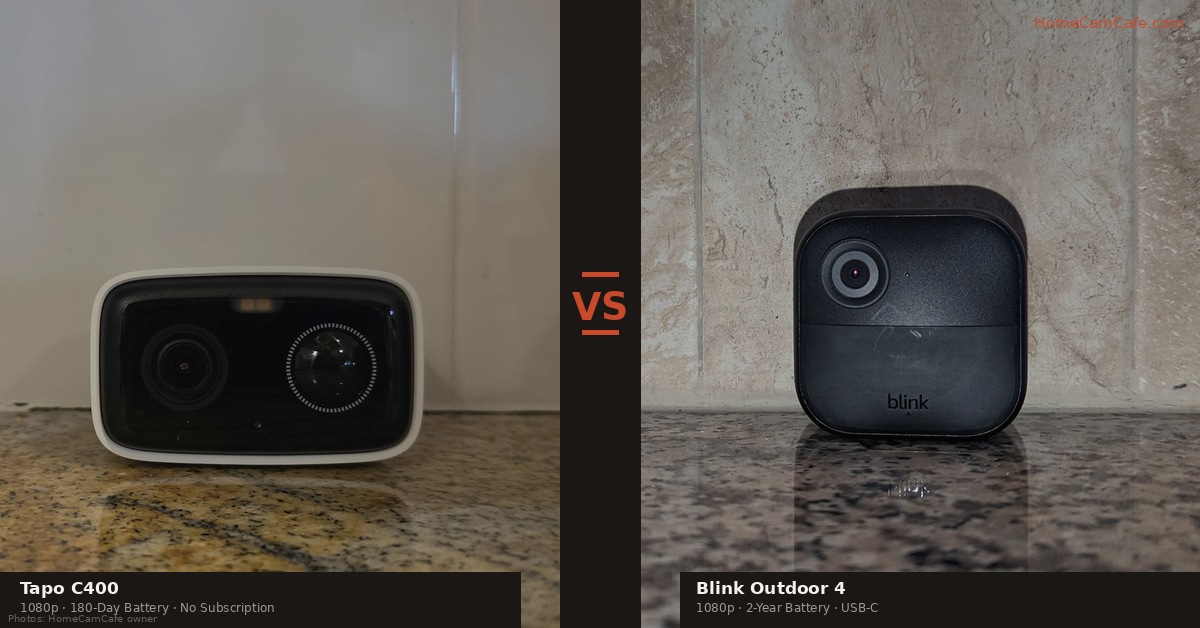
Quick Specs Comparison
| Tapo C400 | Blink Outdoor 4 | |
|---|---|---|
| Resolution | 1080p | 1080p |
| Field of View | 110° diagonal | 143° diagonal |
| Battery Life | Up to 180 days | Up to 2 years |
| Battery Type | Built-in 5200mAh (USB-C) | 2 AA lithium (replaceable) |
| Night Vision | Color spotlight + IR | IR only (black and white) |
| Local Storage | microSD up to 512GB | USB via Sync Module 2 |
| Free AI Detection | Person, vehicle, pet | Subscription required |
| Solar Option | Yes — C400 Kit | Yes — sold separately |
| Subscription | Not required | Required for AI detection |
Battery Life: Blink Wins by a Wide Margin
This is the most significant difference between the two cameras. The Blink Outdoor 4 is rated for up to two years on a pair of standard AA lithium batteries — and real-world testing confirms that figure is achievable under normal residential use. With the optional Battery Extension Pack the rating extends to four years. The Tapo C400 is rated for up to 180 days on its built-in 5200mAh rechargeable battery — about six months under standard use.
The battery type distinction matters beyond just the numbers. The Blink uses replaceable AA batteries — when they run low, swap them in 30 seconds and continue. The C400 uses a built-in rechargeable battery that requires removing the camera and charging via USB-C, similar to a phone. For cameras in hard-to-reach locations, the Blink’s replaceable battery approach is considerably more convenient. However, keep in mind, Blink uses lithium batteries, these are not inexpensive.
The C400 does have a solar panel option via the Tapo C400 Kit which eliminates charging concerns entirely in a good sun location. Blink also sells a solar panel accessory for the Outdoor 4, though it must be purchased separately.
Night Vision: Tapo C400 Wins Clearly
The C400 has dual spotlights that activate on motion to produce full-color night footage. The Blink Outdoor 4 uses infrared night vision only — black and white footage after dark, no color capability regardless of settings. For cameras covering an entry point, driveway, or anywhere you want to identify colors, clothing, or vehicle details at night, the C400’s color night vision is a meaningful advantage.
The Blink’s IR night vision is functional — it illuminates the scene clearly enough for motion detection and general identification at typical residential distances. But for anyone who wants color footage at night, the Blink Outdoor 4 simply does not offer it.
Field of View: Blink Wins
The Blink Outdoor 4’s 143° diagonal field of view is noticeably wider than the C400’s 110°. For covering a wide driveway, front yard, or any broad outdoor area with a single camera, the Blink covers more territory. The C400’s narrower angle is more focused — better for monitoring a specific entry point or gate where a wide angle would capture too much irrelevant area.
AI Detection and Subscription
This is where the two cameras diverge most significantly on cost. The C400 provides free person, vehicle, and pet detection with no subscription — the AI runs locally and alerts work out of the box. The Blink Outdoor 4 requires a paid Blink subscription for person detection — without it, the camera triggers on any motion without distinguishing people from trees, shadows, or passing cars. Basic plan pricing starts at $3.99/month per camera as of October 2025.
For buyers who want to avoid any ongoing fees, the C400 is the clear choice. For buyers already in the Blink ecosystem who are comfortable with the subscription, the Outdoor 4’s value proposition holds up — but the ongoing cost is worth factoring into the total price comparison.
Local Storage
The C400 has a microSD card slot that supports cards up to 512GB — standalone local recording with no hub required. The Blink Outdoor 4 requires a Sync Module 2 or Sync Module XR for local storage via USB drive — the camera itself has no onboard storage slot. Most Blink camera purchases include a Sync Module, but it is an additional device that needs to be powered and connected to your router.
Which One Should You Buy?
Buy the Blink Outdoor 4 if battery life is the top priority — especially for cameras in hard-to-reach locations where charging access is limited, or if you prefer replaceable batteries over rechargeable. The wider field of view is also an advantage for broad coverage areas. Factor in the subscription cost if AI detection matters to you.
Buy the Tapo C400 if color night vision is important, if you want free AI detection with no ongoing fees, or if you prefer standalone microSD storage without a hub. The solar kit option also makes it competitive on battery longevity for cameras in good sun locations.
Bottom Line
The Blink Outdoor 4 wins on battery life and field of view. The Tapo C400 wins on color night vision and free AI detection. The subscription requirement for Blink person detection is the deciding factor for most buyers — if avoiding ongoing fees matters, the C400 is the stronger value. If battery longevity is the priority and a subscription is acceptable, the Blink Outdoor 4 is hard to beat at its price point.
For the full individual reviews see the Tapo C400 review and the Blink Outdoor 4 review.
This comparison is part of our TP-Link Tapo Security Camera Reviews and Blink Security Camera Reviews guides.