
The Wyze Cam Outdoor review question most people start with is a simple one: can a budget wire-free camera actually hold up outside? After spending time with this camera, the short answer is yes — with a few caveats worth knowing before you buy.
Check the current price on Amazon
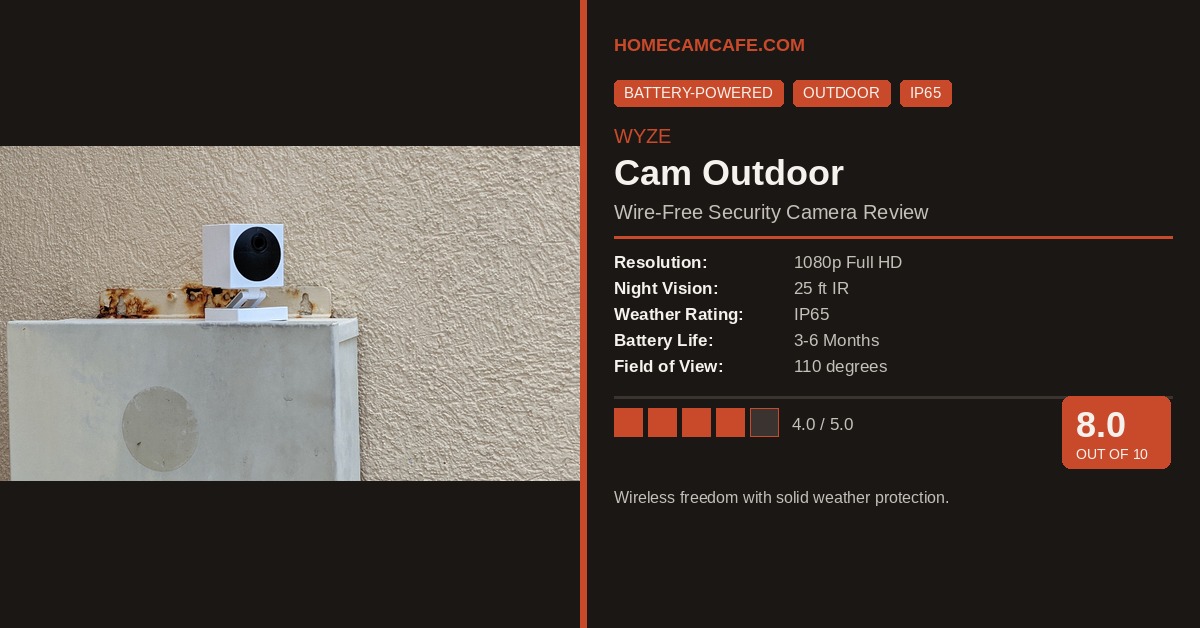
The Wyze Cam Outdoor is a battery-powered wire-free camera that connects through a base station rather than directly to your router. That hub-based approach is a deliberate design choice, and it shapes everything from setup to daily performance. For anyone who has previously used indoor Wyze cameras, this is a notably different experience.
To get started, new buyers need to pick up the Wyze Cam Outdoor starter kit, which includes the camera and base station together. If you already own a base station, Wyze also sells the camera as a standalone add-on unit for expanding an existing system. One base station supports up to four cameras, which is a reasonable ceiling for most homes.
Quick Specs
| Resolution | 1080p Full HD (1920 x 1080) |
| Frame Rate | 20 fps day / 10 fps night |
| Field of View | 110 degrees |
| Night Vision | IR, up to 25 ft (8 IR lamps) |
| Weather Rating | IP65 |
| Battery Life | 3 to 6 months (per Wyze) |
| Connectivity | Via base station (802.11 b/g/n, 2.4 GHz) |
| Audio | Two-way |
| Local Storage | microSD slot (camera and base station) |
| Cloud Storage | Free 14-day event clips |
| Dimensions | 2.3 x 2.3 x 2.8 inches |
| Weight | 9.8 oz |
| Operating Temp | -4 to 120 degrees F |
| Smart Home | Alexa, Google Assistant, IFTTT |
Setup and App
Setup runs through the Wyze app on iOS or Android. There is no web browser access for live viewing, so a phone or tablet is required. Documentation in the box is minimal, though the app does walk you through each step.
The process starts with the base station. Plug it in, tap the plus sign in the app, and follow the combination of on-screen and voice prompts. The base station connects to your router either through an Ethernet cable or wirelessly over 802.11 b/g/n. For setups covering multiple cameras across a larger area, wireless placement of the base station is generally more flexible.
Once the base station is online, adding the camera follows the same process. The whole thing takes roughly ten minutes. After setup, motion alerts, sensitivity levels, and Detection Zones are all configurable within the app. Detection Zones are particularly worth enabling on a battery-powered camera. Reducing unnecessary alerts also reduces how frequently the camera wakes up, which in turn extends battery life meaningfully.
Video quality is selectable between HD, SD, and 360p, with an Auto setting that adjusts based on connection stability. Event clips are stored to the cloud free for 14 days. These are short 12-second clips triggered by motion or sound rather than continuous recordings. For continuous recording, a microSD card in either the camera or the base station is the path forward.
Video and Night Vision
The 1080p sensor records at 20 frames per second during the day and drops to 10 fps at night. In daylight, the image is clear and detailed. The 110-degree field of view is average for the category. For wide-area coverage, placing the camera in a corner position gets more of the scene in frame.
Night vision is handled by eight IR lamps with a stated range of 25 feet. In practice, the IR footage is clear and well-exposed at that distance. Beyond 25 feet, detail drops off noticeably, so placement at tighter ranges gives the best results.
Hardware and Battery
The camera is compact at 2.3 x 2.3 x 2.8 inches, though at 9.8 ounces it is noticeably heavier than wired Wyze cameras because of the internal battery pack. The square body sits on an adjustable two-legged stand. The legs bend at the midpoint to raise or lower the camera angle, and the head tilts and pivots independently. The range of adjustment is good.
The rechargeable batteries are internal and charge via the included micro USB cable. While charging, the camera is offline. Wyze states the batteries last three to six months under normal use, and a battery level indicator in the app lets you track charge remaining. That three to six month range is realistic, though heavier activity from frequent motion events will push usage toward the lower end.
IP65 weather resistance means the camera is rated for rain, dust, and temperature extremes. The supported range of -4 to 120 degrees Fahrenheit covers most climates without issue.
Two-way audio is supported. As is typical across Wyze’s lineup, audio quality is functional but not a strength. The microphone picks up conversation at close range and the speaker is audible, but neither end of the audio is particularly crisp.
Mounting
Mounting is a genuine strength for this camera. The included magnetic mounting base handles flat surface placement quickly and with no tools required. For a camera that might be repositioned seasonally or as needs change, the magnetic base is genuinely convenient.
However, the more useful option is hidden underneath. Pull off the magnetic base and you will find a standard 1/4-20 threaded tripod mount. This opens up compatibility with a wide range of third-party mounts and tripods. That means the Wyze Cam Outdoor can be mounted in configurations that most competing cameras at this price point simply cannot match. For more on what is available, see our guide to choosing the right security camera mount.
Travel Mode
The system includes a travel mode designed for locations without internet access. With a microSD card inserted into the base station, the cameras communicate directly to the hub and record any detected motion locally to the card for later review. This is a thoughtful feature for cabins, temporary sites, or anywhere connectivity is unreliable.
Verdict
The Wyze Cam Outdoor delivers strong value for a wire-free outdoor camera. The hub requirement adds a setup step compared to direct Wi-Fi cameras, but it also gives the system excellent range flexibility. The 1/4-20 tripod thread is a standout feature that gives this camera far more mounting options than the competition at this price. Battery life is solid with Detection Zones enabled, and 14 days of free cloud storage remains a meaningful advantage over cameras that charge for cloud access.
The main trade-offs are audio quality and the fact that the camera must come down to charge. For most outdoor use cases, those are minor compared to what you get for the cost.
Score: 8.0 / 10
For related Wyze content see the Wyze Cam v3 review and the guide to selecting the right microSD card for a security camera. For all Wyze coverage see the Wyze hub.