
Floodlight cameras combine two things that belong together: powerful outdoor lighting and a security camera in a single unit. The result is a camera that lights up a wide area the moment something moves and typically covers more ground than a standard outdoor camera. Most are hardwired for maximum brightness and continuous power, but solar-powered options now bring pan/tilt floodlight coverage to locations where wiring isn’t practical. Our best floodlight camera guide covers options across four categories: best overall, best without a subscription, best budget, and best wire-free.
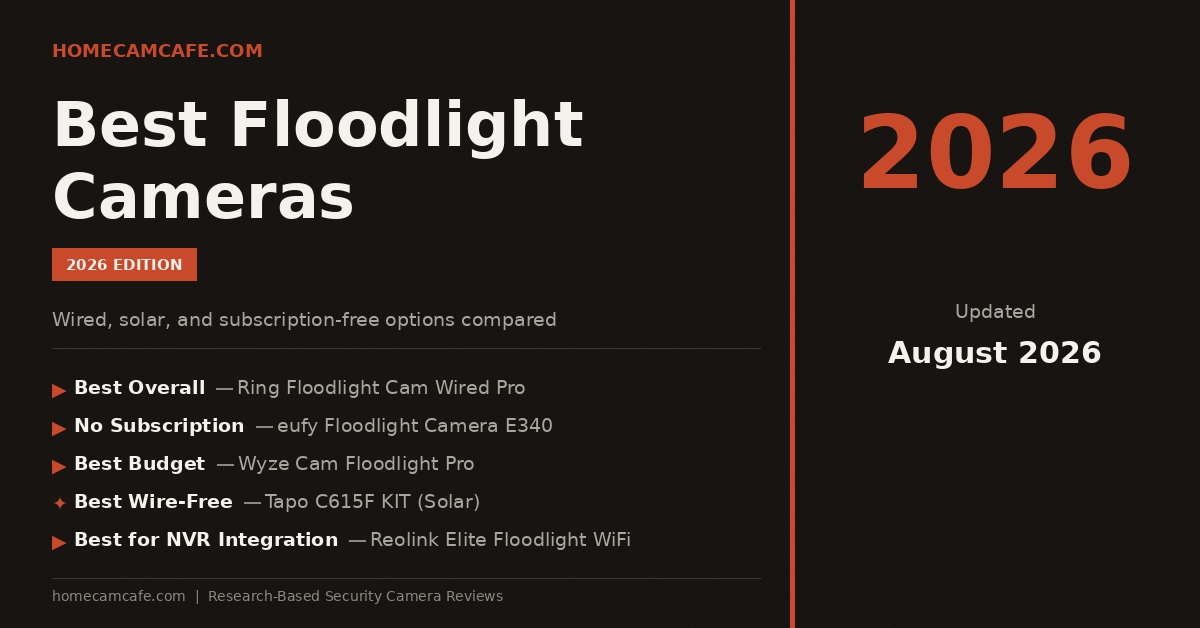
| Category | Pick | Resolution | Lumens | Subscription |
|---|---|---|---|---|
| Best Overall | Ring Floodlight Cam Wired Pro | 2K HDR | 2,000 | Optional |
| Best Without Subscription | eufy Floodlight Camera E340 | 3K + 2K dual | 2,000 | Not required |
| Best Budget | Wyze Cam Floodlight Pro | 2.5K | 3,000 | Optional |
| Best Wire-Free | Tapo C615F KIT | 2K | 800 | Not required |
| Best for NVR Integration | Reolink Elite Floodlight WiFi | 4K, 8MP dual-lens | 3,000 | Not required |
What to Look For in a Floodlight Camera
Wired vs. wire-free: Most floodlight cameras are hardwired. They replace an existing outdoor light fixture and run on continuous power. This means no battery to charge and no gaps in coverage. Wire-free floodlight cameras exist but trade significant brightness for installation flexibility. If you have an existing junction box, a wired model is almost always the better choice.
Lumens: Most wired floodlight cameras fall in the 2,000–3,000 lumen range, which is bright enough to illuminate a full driveway or backyard. Wire-free models are typically much dimmer (700–1,000 lumens) because brightness drains batteries quickly.
Subscription requirements: This varies significantly by brand. Ring requires a subscription to save clips; eufy and Wyze store footage locally without any recurring fee. If subscription-free storage matters, eufy is the clear category leader, though Wyze’s free tier with a microSD card is a close second at a lower price point.
1. Ring Floodlight Cam Wired Pro: Best Overall
The Ring Floodlight Cam Wired Pro is the most capable hardwired floodlight camera available at a reasonable price. It delivers 2K HDR video, dual-band Wi-Fi (2.4 and 5 GHz), a 110dB siren, and Ring’s 3D Motion Detection, a radar-powered system that measures the distance and angle of objects in front of the camera and dramatically reduces false alerts from passing cars or moving branches.
Bird’s Eye View is another standout feature: it gives an aerial map showing the path a visitor took across a property, adding context to motion alerts that standard cameras can’t provide. Furthermore, the Audio+ two-way talk includes noise cancellation and an array microphone for cleaner conversation quality than most competitors offer.
The 2,000-lumen output is adequate for driveways and yards. Installation is straightforward for anyone comfortable with basic electrical wiring. For Ring ecosystem users, especially those with a Ring Video Doorbell or other Ring devices, the integration within the Ring app is a meaningful bonus. The main limitation is the subscription requirement for saving clips. A Ring Home subscription starts at $4.99/month per device. Without it, live view and motion alerts work but no footage is stored.
For more detail, see our full Ring Floodlight Cam Pro review.
2. eufy Floodlight Camera E340: Best Without Subscription
The eufy E340 is the most compelling subscription-free floodlight camera on the market. It uses a dual-camera setup, a 3K wide-angle lens paired with a 2K telephoto lens, combined with a motorized pan-and-tilt mechanism that provides full 360° horizontal coverage. A single camera can monitor an entire driveway, backyard, or the front of a property without blind spots.
What separates it from other floodlight cameras is the storage model. Insert a microSD card (up to 128GB) and the E340 records continuously, 24/7, with no subscription required, not even for person, vehicle, and pet detection, which is powered by on-device AI. For comparison, Ring gates clip storage and person detection behind monthly plans. eufy does not.
The 2,000-lumen floodlight activates on motion, and the AI tracking system moves the camera to follow detected subjects. Wi-Fi 6 dual-band connectivity ensures stable streaming. The trade-offs: continuous recording at maximum resolution fills a 128GB card in about six days, so footage overwrites regularly unless a eufy HomeBase is added for expanded storage. The E340 also does not support Apple HomeKit.
3. Wyze Cam Floodlight Pro: Best Budget
The Wyze Cam Floodlight Pro earns the budget pick by outperforming cameras that cost significantly more. At under $60, it delivers 2.5K resolution, the widest field of view on this list at 180 degrees, and the brightest output at 3,000 lumens across three independently adjustable panels. Dual-band Wi-Fi (2.4 and 5 GHz), onboard AI motion detection, a 105dB siren, color night vision, and a microSD slot for local recording round out a spec sheet that would be impressive at twice the price.
The three-panel design is useful in practice, since each panel articulates independently, so the coverage can be aimed precisely toward a driveway, a side yard, or spread evenly across a wide area. The AI detection distinguishes between people, vehicles, and animals and activates the floodlights only for the categories selected in the app, which eliminates most nuisance activations. No subscription is required for AI detection or local recording. Cam Plus at $2.99/month per camera adds cloud clip history and browser access via Wyze Web View if needed.
Installation requires a standard junction box, the same connection used by any existing outdoor light fixture. Wyze includes quality hardware and even a screwdriver in the box, making this one of the more thoughtful out-of-box install experiences in the category. For a full owner review, see our Wyze Cam Floodlight Pro review.
Already in the Blink ecosystem? The Blink Wired Floodlight Camera is worth considering. It connects directly to Wi-Fi without a Sync Module, delivers 2,600 lumens, and integrates cleanly with existing Blink cameras and doorbells. See our full Blink Wired Floodlight review for details.
4. Tapo C615F KIT: Best Wire-Free
The Tapo C615F KIT solves a problem that wired floodlight cameras can’t: how to get floodlight coverage with pan/tilt tracking somewhere that doesn’t have power. The answer is solar. The C615F combines a 2K pan/tilt camera, an 800-lumen floodlight, 360° AI motion tracking, and a solar panel into a single wire-free kit that mounts anywhere without a junction box or electrical wiring.
The 10,400mAh battery is rated for up to 140 days without solar input, and with the included solar panel providing continuous charging, the battery stays topped off indefinitely under normal sunlight. Tapo rates just 45 minutes of direct sun per day as sufficient. Furthermore, unlike most wire-free cameras, the C615F includes 360° AI tracking that follows people, vehicles, and pets across the frame as they move. Person, vehicle, and pet detection are all free. Local microSD storage up to 512GB is also free.
The main trade-off versus wired floodlights is brightness: 800 lumens is effective for the camera’s color night vision and as a deterrent, but won’t fully illuminate a large open yard the way a 2,000 to 3,000 lumen wired unit does. For a full owner review, see our Tapo C615F review.
5. Reolink Elite Floodlight WiFi: Best for NVR Integration
The Reolink Elite Floodlight WiFi is the strongest pick on this list for anyone already running Reolink hardware. The camera uses two stitched lenses to deliver a seamless 180-degree 4K panorama, and the Reolink app lets you tap into either half of that panorama afterward to pull up a zoomed, more detailed view without losing quality, similar to the dual-lens system on the Reolink Duo 3 PoE. In testing, a Reolink NVR recognized the camera immediately over WiFi and added it to an unused channel without any manual setup, which is not something every brand in this roundup can claim.
Installation is also among the easiest of any hardwired floodlight camera tested on this site, helped by a built-in bubble level on the mounting plate that keeps the floodlight from sitting crooked once it goes up.
The 3,000-lumen floodlight is adjustable for color temperature, and daytime video quality is a clear standout. On the other hand, WiFi signal strength ran a step weaker than a comparable Blink floodlight at the same mounting location, and microSD card playback is noticeably slower than other Reolink cameras. There is also no Reolink Cloud option on this model, so recording relies entirely on microSD, an NVR, a Home Hub, or FTP, though that also means there is never a subscription to consider in the first place.
For the full breakdown, see our full Reolink Elite Floodlight WiFi review.
Which Floodlight Camera Should You Buy?
For most homeowners with an existing outdoor junction box, the decision comes down to ecosystem and subscription preference. The Ring Floodlight Cam Wired Pro is the strongest all-around package, with better motion detection technology, better audio, and the most capable app ecosystem, but it requires a subscription for full functionality. If avoiding subscriptions entirely is the priority, the eufy E340 offers more camera coverage and fully free local storage.
For buyers who want the most camera for the money, the Wyze Cam Floodlight Pro is the standout. At under $60, nothing on this list matches its combination of resolution, field of view, lumen output, and AI detection. The free tier with a microSD card handles most use cases without any ongoing cost. And if hardwiring isn’t an option, the Tapo C615F KIT is the clear wire-free choice: solar-powered, 360° AI tracking, free detection, and no subscription.
For households already invested in a Reolink camera system, the Elite Floodlight WiFi is worth strong consideration alongside the other picks here. NVR pairing was effortless, the dual-lens panorama with tap-to-zoom playback is a useful feature not found elsewhere on this list, and like the eufy E340, there is no subscription to consider, since Reolink Cloud is not even offered on this model.
Our Picks at a Glance
Best Overall: Ring Floodlight Cam Wired Pro, 2K HDR, 3D motion detection, best ecosystem
Best Without Subscription: eufy Floodlight Camera E340, dual cameras, 360° pan/tilt, free local storage
Best Budget: Wyze Cam Floodlight Pro, 3,000 lumens, 180° FOV, 2.5K, free AI detection
Best Wire-Free: Tapo C615F KIT, solar-powered, 360° pan/tilt AI tracking, no subscription
Best for NVR Integration: Reolink Elite Floodlight WiFi, dual-lens 4K panorama with instant NVR pairing and no subscription option at all
Frequently Asked Questions
Do floodlight cameras need to be hardwired?
Most of the best floodlight cameras are hardwired. They replace an existing outdoor light fixture and run on constant power from your home’s electrical system, providing continuous recording, higher brightness, and no battery concerns. Battery-powered floodlight cameras exist but produce significantly less light and require periodic recharging.
Which floodlight camera works without a subscription?
The eufy Floodlight Camera E340 is the best fully subscription-free option, storing footage locally with free AI detection. The Wyze Cam Floodlight Pro is nearly as good, with free AI detection and local microSD recording and no subscription required. Ring requires a subscription for clip storage and person detection. The Reolink Elite Floodlight WiFi also has no subscription option at all, with storage handled entirely through microSD, an NVR, a Home Hub, or FTP.
How many lumens do I need for a floodlight camera?
For a standard driveway or backyard, 2,000 lumens is sufficient to provide useful illumination and trigger color night vision. The Wyze Cam Floodlight Pro’s 3,000 lumens is the brightest on this list and the best choice for large open areas. The Tapo C615F KIT at 800 lumens is effective for its camera’s night vision and deterrence, but won’t fully illuminate a large open yard, a worthwhile trade-off for wire-free solar installation.
Can a floodlight camera replace a regular outdoor security camera?
Yes, and for many locations it’s a better choice. A floodlight camera handles both security lighting and surveillance in one unit, with no separate mount or wiring run required. The main limitation is that floodlight cameras are typically larger and more visible than compact outdoor cameras, which suits deterrence-focused placement but may not suit discreet monitoring applications.