
Choosing a Blink camera battery replacement is less complicated than the search results make it seem. For battery-powered Blink cameras, the safest choice is the same one Blink specifies: 1.5-volt non-rechargeable lithium batteries. Energizer Ultimate Lithium is the best default, but the number and size of batteries depend on your camera model.
Quick answer
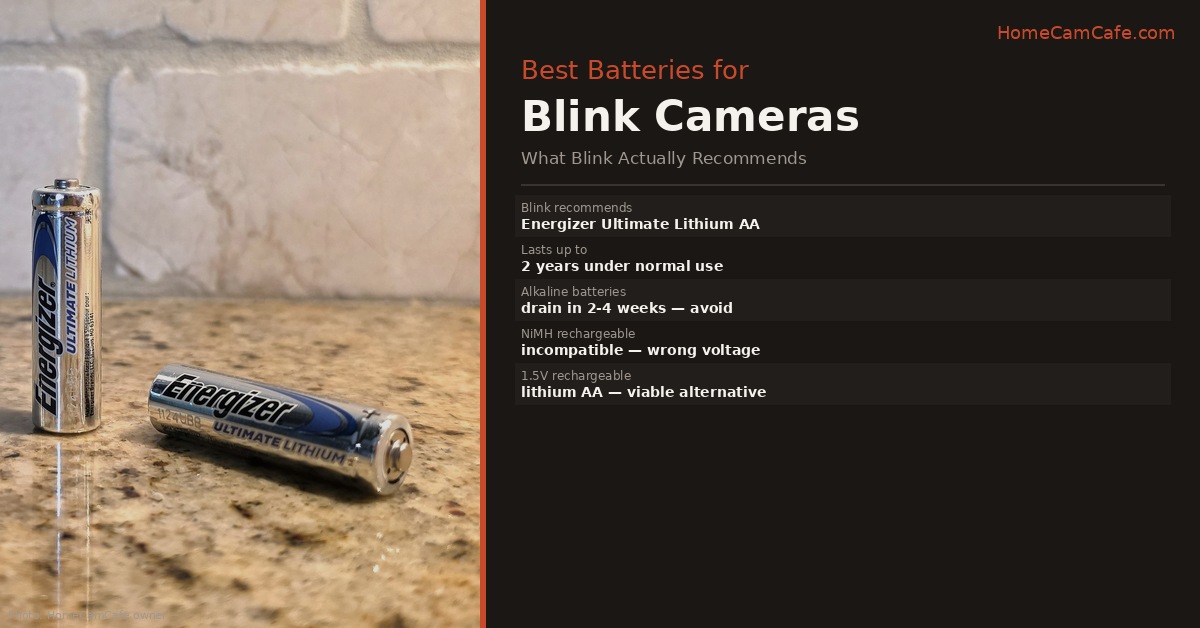
Buy Energizer Ultimate Lithium AA batteries for Blink Outdoor, Indoor, XT, XT2, and battery-powered doorbell models. Do not buy alkaline, NiMH, or rechargeable lithium AAs as your normal replacement. Check the model table below before ordering because newer Blink doorbells use three AAs, not two.
What Batteries Does Blink Recommend?
Blink specifies size AA, 1.5-volt, non-rechargeable lithium batteries for its battery-powered cameras and doorbells. That description matters. “AA” identifies the physical size, “1.5V” identifies the nominal voltage, and “non-rechargeable lithium” identifies the chemistry the camera’s power system was designed around.
Energizer Ultimate Lithium AA batteries are the easiest recommendation because they match that specification and are the lithium cells Blink names in its guidance. They also perform well in cold weather and have a long storage life, both useful traits for outdoor security cameras and spare batteries kept on a shelf.
You do not need a Blink-branded battery. You do need to match the complete specification. A battery labeled “lithium” is not automatically suitable if it is rechargeable or uses an internal voltage regulator.
How Many Batteries Does Each Blink Camera Use?
The old shortcut that every Blink camera uses two AA batteries is no longer accurate. Blink’s current doorbells use three cells, and the Outdoor 4 Floodlight has a separate battery supply for its lights.
| Blink model | Replacement batteries | Important note |
|---|---|---|
| Outdoor 2K+ and Outdoor 4 | 2 AA 1.5V non-rechargeable lithium | Replace both cells together |
| Outdoor 4 Floodlight | 2 AA for the camera, 4 D cells for the floodlight | The camera and light have separate battery supplies |
| Outdoor and Indoor (3rd Gen) | 2 AA 1.5V non-rechargeable lithium | The Indoor model can also use its power adapter |
| XT and XT2 | 2 AA 1.5V non-rechargeable lithium | Legacy models use the same basic AA specification |
| Battery Doorbell 2K+ | 3 AA 1.5V non-rechargeable lithium | Do not assume the older two-cell count |
| Video Doorbell (2nd Gen) | 3 AA 1.5V non-rechargeable lithium | All three should be replaced as a set |
| Original Video Doorbell | 2 AA 1.5V non-rechargeable lithium | Wiring does not eliminate its battery requirement |
| Mini, Mini 2, Mini 2K+, Mini Pan-Tilt, and wired models | No user-replaceable camera batteries | These models use continuous power |
Model names can look similar, especially with Blink’s two doorbell generations. Confirm the name in the Blink app or on the label inside the battery compartment before buying a large pack.
Why Energizer Ultimate Lithium Is the Best Default
Energizer Ultimate Lithium is not the only battery that can match Blink’s specification, but it removes most of the guesswork. It is a 1.5V non-rechargeable lithium AA from an established manufacturer, and it is the line most closely associated with Blink’s own battery guidance.
Its advantages for a security camera are practical:
- Better performance under short, heavy loads. Recording, infrared illumination, Live View, and wireless communication create bursts of power demand.
- Strong cold-weather behavior. Lithium cells generally retain useful performance at low temperatures better than alkaline cells.
- Long shelf life. You can keep an unopened spare set without worrying that it will be nearly depleted when needed.
- Lower leakage risk than alkaline. No battery is immune to damage or defects, but lithium primary cells are a better fit for long unattended service.
Lower-Cost Lithium Alternatives
Energizer is the safest default, but it is not the only non-rechargeable lithium AA that matches Blink’s basic voltage and chemistry requirements. I have used BEVIGOR batteries successfully in my own Blink cameras, making them the strongest lower-cost alternative here. Granicell is another option worth considering, although I have not tested that brand.
| Battery | Best for | Our take |
|---|---|---|
| Energizer Ultimate Lithium | Maximum confidence | Blink’s named battery line and our first choice |
| BEVIGOR lithium AA | Owner-tested budget pick | Worked well in my Blink cameras |
| Granicell lithium AA | Smaller trial pack | Meets the basic specification but has a shorter track record |
The BEVIGOR 12-pack contains 1.5V single-use lithium AAs and is my budget pick. I have used BEVIGOR batteries in Blink cameras and found them reliable. I have not run a controlled side-by-side endurance test against Energizer, so I cannot claim identical runtime. The listing identifies them as 3,000 mAh cells, but that seller-supplied rating is not an independent performance measurement.
The Granicell 8-pack also consists of 1.5V non-rechargeable lithium AAs and is marketed specifically for Blink cameras. Its listing claims 3,500 mAh, but Granicell is a newer option with less long-term buyer history. I would use it first in an easy-to-reach camera rather than the camera above a second-story eave.
These alternatives meet Blink’s basic published battery type, but Blink specifically names Energizer lithium batteries. That is why the cheaper brands belong in the article as budget choices, not as co-winners. Battery prices also change frequently, so compare the current cost per cell rather than assuming the largest pack is always the best value.
Blink’s “up to two years” claim is a test-based maximum, not a replacement schedule. A lightly used camera with a strong connection may approach it. A busy camera used for frequent Live View sessions may need new batteries much sooner.
Can You Use Alkaline Batteries in a Blink Camera?
Alkaline AAs may power some Blink cameras, but they are not the recommended replacement. Their voltage and usable capacity drop differently under load, particularly in cold weather. That can mean earlier low-battery warnings, missed operation, or a much shorter service interval than with the specified lithium cells.
An alkaline set can be useful for a brief indoor test when nothing else is available. It should not be the permanent choice for a camera mounted outside or in a hard-to-reach location. Avoid mixing alkaline and lithium batteries in the same device.
There is no reliable universal claim such as “alkaline lasts two to four weeks.” Runtime depends on the camera, temperature, signal quality, settings, and the number of recorded events. The defensible conclusion is simpler: alkaline is outside Blink’s recommended battery specification and its life is less predictable.
Can You Use Rechargeable AA Batteries?
Blink does not recommend rechargeable batteries for these models. That includes both common 1.2V NiMH cells and rechargeable lithium AAs advertised as 1.5V.
NiMH cells have a lower nominal voltage than the batteries Blink specifies. Regulated 1.5V rechargeable lithium batteries solve the number printed on the label, but they still use different discharge and protection electronics. They may run the camera, yet battery-status reporting can be inaccurate and performance is not supported by Blink.
That distinction matters in a security device. “It turns on” is not the same as “it matches the manufacturer’s supported power source.” If predictable alerts and unattended operation matter, use non-rechargeable lithium cells rather than experimenting with rechargeables.
Why Blink Battery Life Varies
Battery chemistry is only one part of runtime. The following conditions can shorten the interval between replacements:
- Frequent motion events. A camera aimed at a street, moving branches, or a busy walkway wakes more often.
- Long clips and short retrigger intervals. More recording time means more radio and image-sensor activity.
- Live View use. Watching the camera live keeps its most power-hungry systems active.
- Higher video quality. More processing and data transmission can increase consumption.
- Weak wireless connections. Repeated communication attempts can waste power. Check both the camera-to-Sync Module and Wi-Fi indicators where applicable.
- Extreme temperatures. Cold conditions reduce available battery performance, even with lithium cells.
Do not cripple useful security settings solely to chase the longest possible battery life. First correct obvious sources of false motion alerts, improve wireless placement, and shorten unnecessary Live View sessions. Then adjust clip length and retrigger time if the camera still drains faster than expected.
Battery Extension Pack or Continuous Power?
For a compatible Outdoor 4 or Outdoor 2K+ in a difficult mounting location, Blink’s Battery Extension Pack can reduce ladder trips. Blink rates the accessory for up to four years of battery life under its test conditions. The real interval still depends on activity, settings, signal strength, and temperature.
Continuous power can make more sense for a camera with heavy daily use and access to a protected outlet. Outdoor power setups must use compatible equipment and weather-resistant installation. Our guide to running a Blink camera without batteries explains the tradeoffs for older models.
Blink Battery Buying Checklist
Before placing an order, check these five points:
- Confirm the exact camera or doorbell generation.
- Buy 1.5V non-rechargeable lithium cells in the required size.
- Buy enough for a complete set: usually two or three AAs, plus separate D cells for a compatible floodlight mount.
- Use cells from the same brand, type, and package. Never mix old and new batteries.
- Keep one unopened replacement set indoors as a spare.
When the batteries are due, follow our illustrated guide to changing batteries in a Blink camera. Replace the full set even if only one cell appears weak.
Frequently Asked Questions About Blink Camera Battery Replacements
What are the best replacement batteries for Blink cameras?
Energizer Ultimate Lithium AA 1.5V non-rechargeable batteries are the best default for battery-powered Blink cameras and doorbells. They match Blink’s specified chemistry and voltage. Verify how many your model needs before ordering.
Can I use regular alkaline AA batteries in a Blink camera?
They may power the camera temporarily, but Blink does not recommend them. Their runtime is less predictable, especially under high use or in cold weather.
Can I use rechargeable lithium batteries if they say 1.5V?
They are not Blink’s supported replacement. The internal regulation and discharge behavior differ from non-rechargeable lithium cells and may cause inaccurate battery reporting or inconsistent operation.
Why does my Blink app say “OK” instead of showing a battery percentage?
Blink generally reports battery condition rather than a precise percentage. Battery voltage does not translate cleanly into an exact remaining-runtime figure because usage and temperature have such a large effect. Treat a low-battery alert as the signal to replace the complete set.
How long should Blink batteries last?
Some Blink models are advertised for up to two years under defined test conditions. Your result may be shorter based on motion activity, Live View use, clip settings, connection quality, and temperature.
Continue with our Blink battery-changing guide, compare models in the Blink Security Camera Hub, or review options for powering a Blink camera without batteries.
Bottom line
For most Blink camera battery replacements, buy Energizer Ultimate Lithium AA 1.5V non-rechargeable batteries and replace the complete set together. Check the model first because newer battery doorbells use three AAs, while plug-in and wired Blink cameras do not use replaceable camera batteries. Skip alkaline and rechargeable alternatives when reliability matters.