
Blink cameras are known for exceptional battery life, with up to two years on a single set of AAs under normal use. However, “normal use” has limits. Frequent live view sessions, a busy driveway generating dozens of motion events per day, or a camera mounted somewhere inconvenient to reach with a ladder all chip away at that figure quickly.
The good news is that there are two practical ways to run a Blink camera without batteries: continuous USB power from a standard outlet, or a solar panel that powers the camera directly from sunlight. This guide covers both options across every current and recent Blink model, along with the important limitations to know before routing a cable through an exterior wall.
Why Battery Life Varies So Much
Blink’s two-year battery estimate is based on roughly 40,000 seconds of total recording across the camera’s life, which works out to about 110 seconds per day, or a handful of short motion clips. The Blink Outdoor 4 improves on this with an estimated four-year battery life under similar conditions, partly because the Blink Battery Extension Pack is available to roughly double capacity.
For buyers who want to avoid battery management entirely, especially for cameras mounted high or in hard-to-reach locations, continuous USB power is the practical alternative. It costs nothing beyond the cable and adapter, and Blink officially supports it on all camera models.
Option 1: USB Power Adapter
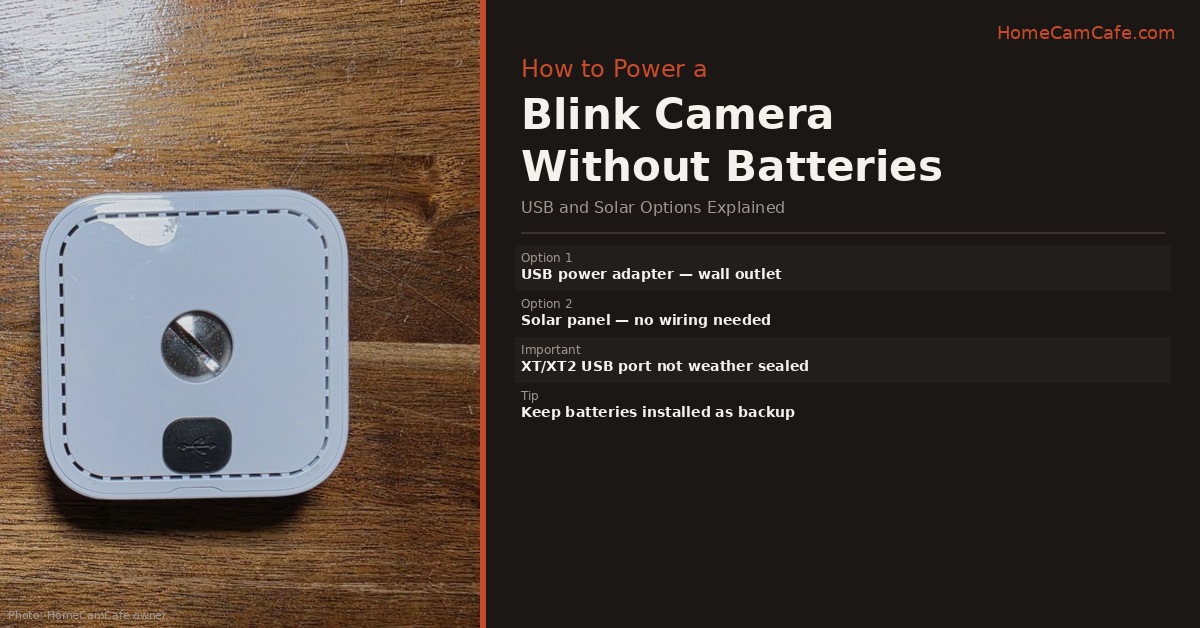
Every Blink camera, including the original Blink, Blink XT, Blink XT2, Blink Outdoor (3rd Gen), Blink Outdoor 4, and Blink Outdoor 2K+ has a USB port. On the Blink XT and XT2, it is located on the back of the camera directly below the battery compartment latch, covered by a rubber flap. On the Outdoor 3rd Gen Outdoor 4, and Outdoor 2K+ it is also on the back, under a protective cover. Plugging a USB cable into this port and connecting it to a 5V/1A USB power adapter provides continuous power without relying on batteries.
When the camera is running on USB power, the batteries act as a backup. If the power goes out, the camera automatically switches to battery power, provided the Sync Module and Wi-Fi router also have backup power. Otherwise, the camera goes offline regardless. One important quirk: the battery indicator in the Blink app will show batteries as “OK” even if they are depleted, because the USB connection masks the true battery state. It is worth checking the actual batteries periodically if relying on them as a backup.
USB Port Compatibility: Micro-USB vs USB-C
This is the most important thing to get right before buying a cable. Blink changed connector types with their 4th generation cameras:
| Camera Model | USB Type | Official Cable |
|---|---|---|
| Blink XT / XT2 | Micro-USB | Any micro-USB cable (indoor only, see below) |
| Blink Outdoor (3rd Gen) | Micro-USB | Blink IP55 weatherproof cable (sold separately) |
| Blink Outdoor 4 / Mini 2 / Outdoor 2K+ | USB-C | Blink Weather Resistant 13ft Adapter |
The official Blink Weather Resistant Power Adapter is USB-C and is specifically designed for the Outdoor 4, Outdoor 2K+, and Mini 2. It is 13 feet long, weather-rated for outdoor use, and sold by Blink directly. It is not compatible with older micro-USB models, as the connector simply does not fit. For 3rd Gen cameras, Blink makes a separate IP55-rated micro-USB cable. Do not use the 4th Gen adapter on a 3rd Gen camera or vice versa.
Option 2: Solar Panel
For Blink cameras mounted outdoors where running a cable is impractical, a solar panel is the cleaner long-term solution. The solar panel connects to the camera’s USB port and powers it directly from sunlight, in the same way a USB wall adapter would. The batteries remain installed but are not being actively charged by the solar panel. They serve as a fallback if the panel loses power due to extended cloud cover or shading, at which point the camera draws from the batteries until the sun returns or the batteries deplete.
Blink Solaris: The Official First-Party Option
Blink now sells their own solar panel accessory, the Blink Solaris Solar Panel, designed specifically for the Outdoor 4 and Outdoor 2K+. In contrast to third-party panels that connect via a separate cable, the Solaris clicks directly onto the camera mount as a single integrated unit. It includes a built-in rechargeable battery pack, is IP65 weather-rated, and according to Blink requires as little as 45 minutes of direct sunlight per day to sustain its charge. Battery level and charging status are both visible in the Blink app.
However, early reviews are mixed, and the jury is out. The Solaris is a new product, so the review count is still thin. That said, it is worth checking current ratings before purchasing. If reviews have not improved since this was written, the third-party options below are a well-proven alternative.
Third-Party Solar Panels
For the Blink Outdoor 4 and Outdoor 2K+, look for a 5W USB-C solar panel for Blink Outdoor 4 with at least a 13-foot cable and IP65 weatherproofing. For older micro-USB models, search for a Blink Outdoor 3rd Gen solar panel specifically, as the USB-C panels are not compatible with earlier models.
For the Outdoor 3rd Gen and XT2, third-party micro-USB solar panels are widely available. Confirm the output is 5V/1A before purchasing, as panels with lower output will not keep up with the camera’s power draw during active use.
Another option worth considering is an all-in-one solar panel and camera mount. These combine the panel and the camera bracket into a single unit, which results in a considerably cleaner install compared to mounting the panel and camera separately.
Solar vs USB power: Solar is the better choice for cameras in good sun locations where no outlet is nearby. USB power is the better choice for cameras under a covered area, in a garage, or anywhere sun exposure is limited. Both eliminate battery swaps, so the right choice depends on your mounting location.
The Critical Outdoor Warning: XT and XT2
This applies specifically to the Blink XT and Blink XT2, the older models with a rubber flap over the micro-USB port. When that flap is open and a cable is connected, the camera is no longer weather-resistant. Blink explicitly states this: removing the rubberized USB cover on the XT and XT2 compromises the outdoor rating. Water can enter through the open port and damage the camera permanently.
For XT and XT2 cameras mounted outdoors with USB power, two practical options exist. First, position the camera in a location that is genuinely protected from rain, such as under a deep overhang, inside a covered porch, or beneath a roof line where no rain reaches the back of the camera. Second, use a weatherproof enclosure around the cable connection point. In most situations, the cleaner solution is to use the XT and XT2 with USB power indoors only, and switch to a current Outdoor 4 with the official weather-resistant adapter for any camera that needs both continuous power and outdoor exposure.
Using Batteries as a Backup
Running USB power and keeping batteries installed simultaneously is the recommended setup. Blink’s own guidance confirms this: if power is lost, the camera continues running on available battery power until the batteries drain, or until the Sync Module and router also lose power, at which point the camera goes offline regardless.
The main thing to watch is the battery indicator. Per Blink’s support documentation, the app will display battery status as “OK” while the camera is connected to USB, even if the actual batteries inside are low or depleted. As a result, the indicator is not a reliable check when USB power is active. Test the batteries independently when setting up the USB connection and replace them if they are old. Otherwise, a power outage will reveal dead batteries at exactly the wrong moment.
Related Blink Guides
Bottom Line
USB power is a clean solution for any Blink camera that is draining batteries faster than expected. For the Outdoor 4 and Mini 2, Blink’s official weather-resistant USB-C adapter handles outdoor installations properly. For solar, the new Blink Solaris is worth considering for the Outdoor 4 and Outdoor 2K+, though it is worth checking current reviews before committing. For the XT and XT2, USB power is best limited to indoor use since connecting a cable opens the port and removes the weather seal. Keep batteries installed regardless, as they serve as backup power during outages, and fresh batteries at setup are worth the peace of mind.
For more on Blink power and battery topics, see How to Change Batteries in a Blink Camera and Best Batteries for Blink Cameras. For the full brand overview, see the Blink Camera Reviews hub.