
Finding the best solar security camera means balancing three things that often pull against each other: enough panel output to stay charged year round, enough resolution and coverage to actually be useful, and a price that makes sense for the number of cameras a property needs. We have owned and installed four of the six cameras below ourselves, and additionally researched the remaining two against current specs and verified listings. Every model here includes a solar panel in the box or as a confirmed bundle option, so none of these require buying charging hardware separately.
| Camera | Best For | Resolution / Coverage | Battery (No Sun) | Wi-Fi | Storage |
|---|---|---|---|---|---|
| Tapo C675D | Best Overall | 4K fixed (169°) + 4K pan/tilt (360°) | 10,000mAh class | 2.4GHz | microSD, local |
| Reolink Argus PT Ultra | Best Auto-Tracking | 4K (8MP) · 355° pan / 140° tilt | ~20 min sun/day to maintain | Dual-band 2.4/5GHz Wi-Fi 6 | Motion-triggered only |
| Tapo C615F KIT | Best Solar Floodlight | 2K pan/tilt + 800-lumen floodlight | 140 days | 2.4GHz | microSD up to 512GB, local |
| eufy SoloCam S340 | Best Dual-Camera Value | 3K wide + telephoto, 8x hybrid zoom | Not specified | 2.4GHz only | 8GB built-in, local |
| Tapo C400 KIT | Best Budget | 1080p fixed, 110° field of view | 180 days | 2.4GHz | microSD, local |
| eufy SoloCam S220 | Best Compact Pick | 2K fixed | Not specified · ~3 hrs sun/day needed | 2.4GHz only | 8GB built-in, local |
Best Solar Security Camera Overall: Tapo C675D
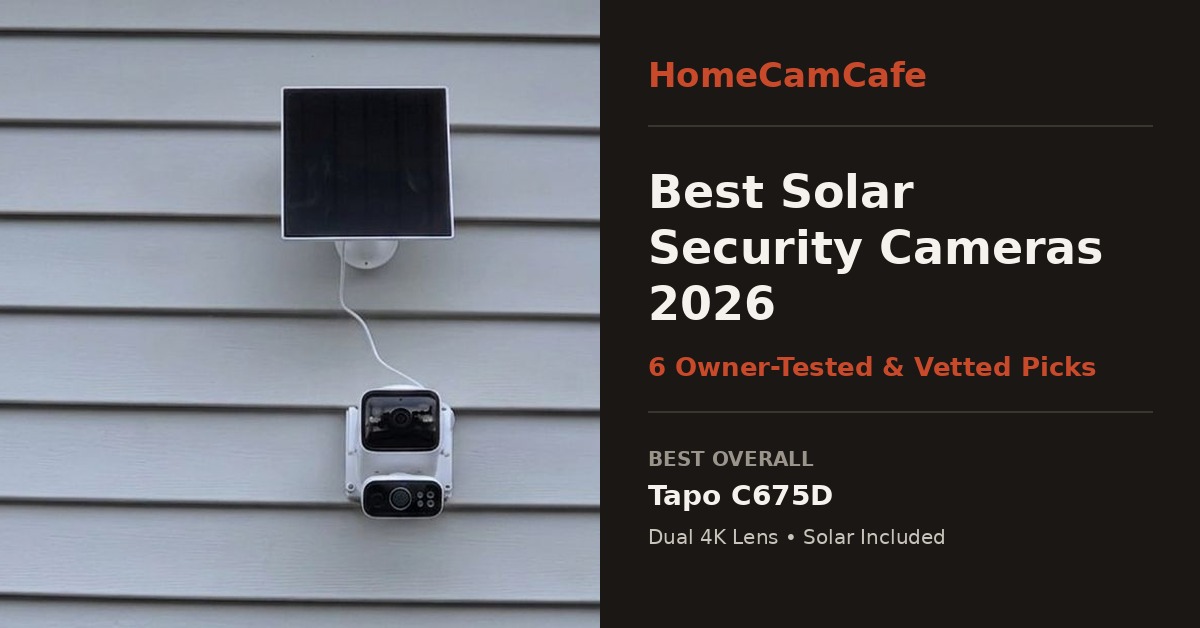
The Tapo C675D pairs a fixed 169° wide-angle 4K lens with a second 360° pan/tilt 4K lens on the same housing, so one camera simultaneously covers the full scene and tracks whatever moves within it. In our testing, the extended motion detection proved to be the most sensitive we have measured at this price point, picking up movement well beyond its advertised range once local recording was enabled.
The included A202 solar panel keeps the 10,000mAh-class battery topped off in normal sun. The one limitation is the mounting hardware, which uses a separate bracket for the panel rather than an all-in-one design, so the two pieces need to be positioned independently during install rather than mounted as a single unit. In our full testing, detailed in the Tapo C675D review, the fixed lens handled wide daytime coverage well while the pan/tilt lens picked up detail at distance that a single-lens camera would have missed entirely.
Night vision on both lenses held up better than expected for a battery-powered camera, with color night vision staying usable well past dusk before switching to infrared. For a single camera that covers the most ground with the least compromise, this is our top pick.
Best for Auto-Tracking: Reolink Argus PT Ultra
The Reolink Argus PT Ultra delivers true 4K resolution and covers 355° of pan and 140° of tilt, and its auto-tracking follows people, vehicles, and pets across that full range automatically rather than waiting for a manual pan command. Dual-band 2.4/5GHz Wi-Fi 6 is a genuine advantage over the single-band 2.4GHz connections most solar cameras are limited to, which matters in homes with congested Wi-Fi.
The detachable solar panel needs only about 20 minutes of direct sun per day to maintain charge. One trade-off worth knowing: this model does not support continuous recording, since Reolink limits that feature on battery cameras to preserve runtime, so it is best suited to motion-triggered coverage rather than 24/7 capture. The auto-tracking is also smart enough to hand off from one detection zone to the next as a subject moves, which is a feature most solar cameras in this price range simply do not offer.
For a large yard, a long driveway, or a property line where a single fixed camera would only ever catch part of the action, the combination of range and tracking makes this the camera to reach for.
Best Solar Floodlight: Tapo C615F KIT
For anyone who wants floodlight coverage without running new electrical wiring, the Tapo C615F KIT is the strongest solar option available. It combines a 2K pan/tilt camera, an 800-lumen floodlight, and 360° AI tracking, all powered by an included solar panel connected via a 13-foot extension cable that lets the panel and camera be mounted separately for optimal sun exposure.
The 10,400mAh battery is rated for up to 140 days without any sun at all, and Tapo states just 45 minutes of daily direct sunlight is enough to keep it running indefinitely. Person, vehicle, and pet detection are free, and local microSD storage supports cards up to 512GB with no subscription required. In our full Tapo C615F review, the floodlight triggered reliably on motion without the delay we have seen on cheaper floodlight cameras, and the 360° tracking kept the light aimed at the moving subject rather than lighting a fixed area.
The 800 lumens will not fully light a large open yard the way a 2,000+ lumen wired floodlight does, but for wire-free installations it is the best combination of light and coverage we have tested.
Best Dual-Camera Value: eufy SoloCam S340
The eufy SoloCam S340 uses a dual-lens setup similar in concept to the Tapo C675D, combining a 3K wide-angle view with a telephoto lens and 8x hybrid zoom, all in a single 360° pan/tilt housing. The removable solar panel keeps the built-in 8GB of local storage running without a subscription, and installation is genuinely quick since the compact body mounts with a single hole.
The main limitation is 2.4GHz-only Wi-Fi, so placement near a strong signal matters more than it does with dual-band competitors. We put it through its paces in our eufy SoloCam S340 review, where the 8x hybrid zoom held up surprisingly well on the telephoto lens, keeping faces and license plates identifiable at distances the wide lens alone would have blurred. For buyers who want dual-lens coverage without stepping up to a full HomeBase system, this is the strongest standalone option in the lineup.
Best Budget: Tapo C400 KIT
The Tapo C400 Solar Kit takes the standard Tapo C400 and bundles it with a solar panel, giving buyers the same reliable 1080p video, free person and vehicle detection, and 110° field of view at a genuinely budget-friendly price. It is a fixed-angle camera rather than pan/tilt, so it suits a driveway entrance, front door, or backyard corner better than a wide open space.
The 5200mAh battery is rated for up to 180 days between charges even without solar input, which makes the panel more of a convenience than a necessity here rather than a requirement for basic operation. As covered in our full Tapo C400 review, detection accuracy stayed consistent even in lower light, and false alerts from moving branches or passing shadows were rare once the detection zone was set up correctly. For anyone outfitting several entry points at once without needing pan/tilt tracking on every camera, this is the most cost-effective way to go fully solar.
Best Compact Pick: eufy SoloCam S220
The eufy SoloCam S220 is the smallest and simplest camera on this list, and that is the point. Its built-in 0.9W solar panel needs only around three hours of daily sunlight to keep it running, and the tiny footprint makes it easy to tuck into tight mounting spots that would look awkward with a larger camera.
2K resolution and built-in 8GB storage cover the basics well for a side gate, shed, or secondary entry point where a full-featured pan/tilt camera would be overkill. It is fixed-angle and 2.4GHz Wi-Fi only, so it is not the camera for a primary sightline, but the small size means it disappears into a mounting spot rather than standing out, which matters for anyone who wants coverage without a bulky camera on display. As a low-profile secondary camera to round out a wider setup, it is hard to beat.
How to Choose a Solar Security Camera
Sun exposure matters more than panel wattage. A small panel that gets a few hours of direct, unobstructed sun will keep a camera charged more reliably than a larger panel mounted under an eave or facing a tree line. Before choosing a location, watch how the sun actually crosses that spot for a day or two, since morning shade and afternoon sun (or the reverse) can make a real difference in how much charge a panel collects.
Fixed-angle cameras like the Tapo C400 and eufy S220 are the right call for a single doorway, driveway entrance, or side gate, where the field of view rarely needs to change. Pan/tilt models like the Tapo C675D, Tapo C615F, eufy S340, and Reolink Argus PT Ultra make more sense for open yards, long driveways, or corners of a property where a fixed lens would leave blind spots. It is worth matching the camera to the space rather than defaulting to the most capable model available, since a pan/tilt camera watching a narrow doorway is paying for coverage it will never use.
Every camera on this list stores footage locally with no subscription required, which is worth confirming on any camera under consideration. Local storage via microSD keeps ongoing costs at zero, while cloud subscriptions, where offered, remain optional rather than mandatory. Additionally, Wi-Fi band matters more than it might seem. Dual-band 2.4/5GHz connections, like the one on the Reolink Argus PT Ultra, tend to hold up better in homes with several other devices competing for bandwidth, while 2.4GHz-only cameras still work well but benefit from being placed closer to the router or a mesh node.
Solar Security Camera FAQ
Do solar security cameras work at night?
Yes. The solar panel only charges the battery during daylight hours, and the camera itself runs on stored battery power once the sun goes down, the same way it would on any battery-powered camera. Every model on this list includes night vision, so darkness does not affect recording. What solar power does affect is how much charge is available for the next day, since a camera that records heavily overnight draws down the battery faster than one used mainly for daytime motion alerts.
Do solar security cameras work in winter?
Most of the time, yes, but winter reduces the charging margin. Shorter days mean less total sunlight, a lower sun angle can leave a panel partially shaded even in a spot that gets full sun in summer, and snow sitting on the panel blocks charging entirely until it is cleared. Cold temperatures can also reduce battery efficiency slightly. None of this typically stops a solar camera from working, but it is worth checking panel placement each season rather than assuming a summer setup will perform the same way in December.
How long do solar security cameras last without sunlight?
It depends on the camera’s battery capacity and how much motion it records, but most models on this list are rated for well over a month on a full charge with no sun at all. The Tapo C615F KIT, for example, is rated for up to 140 days without sunlight, and the Tapo C400 Solar Kit can run up to 180 days on battery alone. Panel exposure simply extends that runtime indefinitely rather than being a requirement for basic operation.
Do solar security cameras need Wi-Fi to work?
Recording and local storage will continue even during a Wi-Fi outage, since the camera and battery operate independently of the network. However, live viewing, push notifications, and cloud backup all require a Wi-Fi connection. If reliable connectivity is a concern for a given location, a dual-band camera like the Reolink Argus PT Ultra holds up better in a congested network than a 2.4GHz-only model.
Bottom Line
For most homeowners covering a single high-traffic area, the Tapo C675D’s dual-lens design and proven extended motion range make it the strongest all-around pick. Buyers who want floodlight coverage should look at the Tapo C615F KIT instead, and anyone outfitting several low-priority spots at once will get the most cameras for the money from the Tapo C400 Solar Kit or eufy SoloCam S220.
Regardless of which camera you choose, panel placement matters more than panel wattage. A small panel in full sun will outperform a larger one in partial shade, so plan mounting location around sun exposure first and camera angle second.
For the full individual reviews see the Tapo C675D review, the Tapo C615F review, the eufy SoloCam S340 review, and the Tapo C400 review. For brand-specific guides see the Tapo hub, the eufy hub, and the Reolink hub.