
The Tapo C675D (sold as the TP-Link Tapo C675D KIT) is a dual-lens solar-powered outdoor security camera that combines two 4K cameras in a single housing: a fixed 169° wide-angle lens on top and a 360° pan/tilt telephoto zoom lens below. The concept is compelling because one camera simultaneously covers the full scene while automatically tracking and zooming in on whatever moves within it. In our outdoor testing, it largely delivers on that promise.
Once properly configured with local storage, the extended motion detection on the Tapo C675D is the best we have tested at any price point. The 4K video quality on both lenses is excellent, and the Tapo A202 solar panel is included in the box. The one meaningful negative is the mounting system, which uses a separate bracket for the solar panel rather than the integrated all-in-one configuration found on comparable cameras like the Tapo C645D and C660. It is an outstanding solar camera held back from a perfect score by a fixable hardware decision.
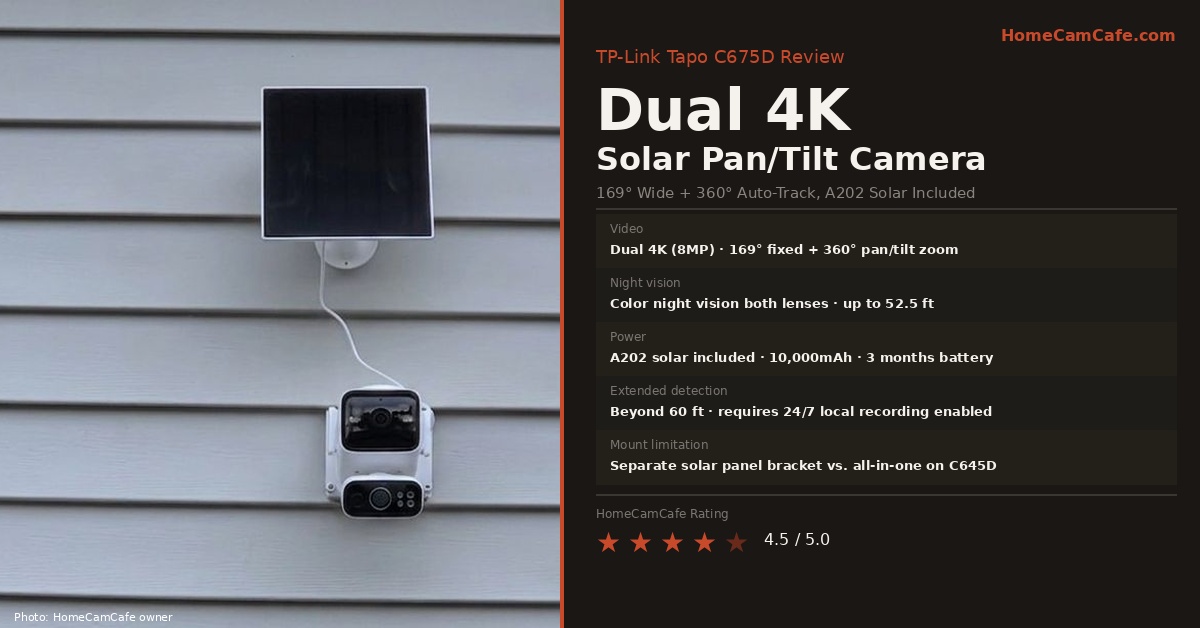
Tapo C675D Review: The Short Version
HomeCamCafe Rating: 4.5 / 5.0
Bottom line: The Tapo C675D KIT is the most capable battery-solar camera we have tested. Its three-layer PIR, radar, and AI detection system reliably spots people across the street at roughly 100 feet when 24/7 Continuous Capture and a microSD card are active. Both 4K lenses record sharp detail, and the bottom telephoto lens tracks subjects while the top wide lens keeps the full yard in view. Only the two-piece camera and solar bracket setup keeps it from a 5 out of 5.
Tapo C675D Specifications
| Spec | Detail |
|---|---|
| Lens 1 (fixed) | 4K 8MP · 169° field of view · 15fps |
| Lens 2 (pan/tilt) | 4K 8MP · 360° pan / 97° tilt · 6mm zoom · 15fps |
| Digital zoom | 18x on both lenses |
| Night vision | Color night vision both lenses · up to 52.5 ft |
| Detection system | PIR + Radar + AI · 29 ft standard · up to 60 ft spec with 24/7 mode (~100 ft observed) |
| AI detection | People, vehicles, pets · free, no subscription |
| Battery | 10,000mAh · up to 3 months per charge |
| Solar panel included | Tapo A202 (4.5W) · 90 min direct sun required daily |
| Local storage | MicroSD up to 512GB (sold separately) |
| 24/7 continuous capture | Interval snapshots every 1 to 60 seconds |
| Weather rating | IP65 |
| Wi-Fi | 2.4GHz and 5GHz |
| Smart home | Alexa and Google Assistant |
| App | Tapo (iOS / Android) |
Extended Motion Detection Reaches 100 Feet (With One Key Setting)
The extended motion detection on the Tapo C675D is the strongest we have tested at any price point, and it requires a specific setup to work correctly. Unlike most battery cameras that rely on a passive infrared (PIR) sensor alone, the C675D combines a PIR sensor with radar detection and on-device AI. That three-layer system is the primary reason its real-world detection range so significantly exceeds competing battery cameras.
Out of the box, the standard PIR detection range is 29 feet. However, when 24/7 Continuous Capture is enabled in the Tapo app, the radar and AI layers kick into full operation and extend the rated range to 60 feet per Tapo’s specification. In our real-world testing, we have seen it detect people walking on the far side of a street roughly 100 feet away and do it reliably and consistently. This performance blows past the advertised range.
The critical setup step: 24/7 Continuous Capture must be enabled, and local recording to a microSD card appears to be required for the extended detection mode to function. Without a microSD card installed and 24/7 mode active, the camera operates on standard PIR detection at the shorter 29-foot range. Once properly configured, the sensitivity and reach are exceptional and far beyond what competing solar cameras deliver.
For a full comparison of how the C675D’s detection distance stacks up against other cameras we have tested, see our security camera motion detection range guide.
Setup tip: To get the full extended detection range on the C675D, install a high-endurance microSD card and enable 24/7 Continuous Capture in the Tapo app under Camera Settings. The AI-enhanced extended radar detection requires local storage to be active. Without this configuration, detection falls back to the standard PIR range of approximately 29 feet.
Dual 4K Video Quality Is Sharp Across Both Lenses
Both lenses deliver excellent 4K 8MP footage. The fixed wide-angle lens on top covers 169°, which is wider than most single-lens cameras, with crisp clarity across the full frame and minimal barrel distortion at the edges. The lower pan/tilt telephoto lens is the standout. Its 6mm focal length and default 5x hybrid zoom let it capture close-up detail that a standard wide-angle lens cannot match. Zooming in on a license plate at the end of a driveway and reading it clearly is achievable in 4K at a realistic residential distance. Both lenses also support up to 18x digital zoom and tap-to-zoom for instant focus on any area of the frame.
Color night vision on both lenses is solid up to around 50 feet with the built-in spotlights enabled. Without the spotlights, infrared night vision handles total darkness cleanly. The fixed lens and pan/tilt lens display simultaneously in the Tapo app so you see both feeds at once, which is how the dual-lens design delivers full perimeter context plus close-up detail in a single view.
Coordinated Auto-Tracking in Action (Real Wildlife Test Footage)
When the fixed wide-angle lens detects motion, the pan/tilt telephoto lens locks onto the subject and tracks it automatically. Tracking is fast and accurate in good lighting conditions. The telephoto lens follows a person or animal across the full coverage area while the fixed lens continues recording the entire wide scene, giving you both the wide context shot and the zoomed-in tracking shot at the same time. Patrol mode also allows the pan/tilt lens to rotate through user-defined preset positions on a schedule, monitoring multiple zones even when motion has not triggered auto-tracking.
The video clip below is footage we captured with our own Tapo C675D installed at our test location: a fox holding still near the mailbox while a doe and her two fawns cross the lawn. Notice how the top wide lens captures the entire scene at once while the bottom pan/tilt lens automatically locks onto the deer family and tracks them in close-up as they move across the yard.
Design, Solar Charging, and the Separate Bracket Complaint
The Tapo C675D is a substantial piece of hardware. Two 4K lens modules are stacked vertically in a single IP65 weather-resistant white housing: the fixed wide-angle lens on top with four white LED spotlights and two red/blue deterrent LEDs, and the motorized pan/tilt zoom lens below with its own spotlight array.
The included Tapo A202 solar panel (4.5W) requires roughly 90 minutes of direct sunlight daily to sustain the camera under normal operation, and the internal 10,000mAh battery provides up to three months of backup capacity during extended cloudy stretches. At a mounting spot receiving adequate daily sun, the camera maintains its charge without manual intervention. For more on panel placement and cable extensions, see our Tapo solar panel guide.
Why the Two-Piece Mounting Bracket Cost It a Perfect Score
The C675D uses one wall bracket for the camera body and a second, separate bracket for the A202 solar panel, with a power cable running between them. In practice, that means two mounting locations, two sets of drill holes in your siding or trim, and a visible cable run between the panel and the camera. By contrast, the Tapo C660 and Tapo C645D use an integrated bracket that mounts the camera and solar panel as a single unit with one footprint and one set of screws.
There is one practical upside to the separate bracket: you get full flexibility to position and angle the solar panel independently for optimal southern sun exposure rather than forcing the panel to face the same direction as the camera. Even so, for a flagship solar camera, Tapo should have included an all-in-one mounting option in the box. Installation takes perhaps 15 to 20 minutes longer than a unified bracket. If you need third-party mounting options for siding, poles, or gutters, check our best mounts for Tapo cameras guide.
For homeowners who have Ethernet or AC power access at the mounting spot, we also installed and tested the wired Tapo C575D above a garage using a PoE injector. The C575D delivers the same dual 4K wide-and-telephoto tracking concept on a single wired bracket and feels even snappier when loading live views.
Tapo App Controls, 5GHz Wi-Fi, and Smart Home Support
The Tapo app handles the dual-lens feed well. Both 4K camera views display simultaneously, switching between them is fast, and manual pan/tilt controls on the telephoto lens respond quickly. Free AI detection filters (person, pet, and vehicle) are customizable per lens, so you can set the top wide-angle lens to alert for vehicles and people while configuring the lower telephoto lens to track people only. Activity zones also work on both lenses independently.
Dual-band 2.4GHz and 5GHz Wi-Fi support is a welcome practical advantage on a camera pushing two 4K streams at the same time. Connecting the C675D to a strong 5GHz signal reduces bandwidth congestion on crowded 2.4GHz networks and speeds up clip playback in the app. Voice viewing is supported on Amazon Alexa and Google Assistant displays.
Local MicroSD Storage vs. Optional Tapo Care Plans
The Tapo C675D supports local microSD cards up to 512GB (sold separately) with zero monthly fees for person, vehicle, and pet notifications. Because enabling 24/7 Continuous Capture to a microSD card is required to unlock the camera’s extended radar detection range, installing a card inside the camera is essential even if you later add cloud backup. Since 24/7 Continuous Capture writes interval snapshots to the card all day, we recommend a high-endurance card built for continuous loop recording; see our guide to selecting the right microSD card for a home security camera.
For most owners, local microSD storage is all you need. If you want off-site cloud backup in case an outdoor camera is stolen or damaged, TP-Link’s optional Tapo Care subscription plans now offer three tiers: Tapo Cloud (30-day history up to 2K for one or two devices), Tapo Cloud Advanced (up to 180-day history at up to 4K resolution for unlimited cameras), and Tapo Cloud Advanced AI (which adds the Aireal AI search and summary tools). You can also compare onboard cards against indoor hub storage in our Tapo Care vs. Tapo Hub vs. microSD guide.
Tapo C675D Pros and Cons
Pros
- Unmatched ~100-foot real-world motion detection when 24/7 Continuous Capture and a microSD card are active
- Dual 4K 8MP lenses deliver simultaneous 169° wide coverage and zoomed-in pan/tilt tracking
- Free on-device AI detection for people, vehicles, and pets with no subscription paywall
- Tapo A202 4.5W solar panel and 10,000mAh battery included in the kit
- Supports both 2.4GHz and 5GHz Wi-Fi plus local microSD cards up to 512GB
Cons
- Solar panel mounts on a separate bracket rather than an integrated single-footprint mount like the C645D and C660
- Unlocking the extended radar detection range requires buying a microSD card and enabling 24/7 Continuous Capture
- Larger vertical housing than a standard single-lens battery camera
How the Tapo C675D Compares to the Tapo C575D and Tapo C615F
If you are deciding between TP-Link’s top outdoor cameras that we have tested hands-on, the choice comes down to how you want to power the camera and whether you need dual-lens telephoto tracking for a long driveway or large yard:
| Feature | Tapo C675D KIT (Tested) | Tapo C575D (Tested) | Tapo C615F KIT (Tested) |
|---|---|---|---|
| Power Source | 10,000mAh battery + A202 solar panel | Wired PoE or DC adapter | Battery + solar panel |
| Camera Lenses | Dual 4K (169° fixed + 6mm PTZ) | Dual 4K (fixed wide + 8mm PTZ) | Single 2K pan/tilt + dual floodlights |
| Recording Mode | Motion clips + 24/7 interval snapshots | True 24/7 continuous video + ONVIF/RTSP | Motion clips to microSD or cloud |
| Mounting Footprint | Two separate brackets (camera + panel) | Single wired bracket | Integrated solar floodlight mount |
| Best For | Long driveways and yards without wiring | Garages and eaves with Ethernet/PoE access | Side yards needing bright floodlights |
Frequently Asked Questions
How do you get the full 60-to-100-foot motion detection range on the Tapo C675D?
Insert a formatted microSD card into the camera and turn on 24/7 Continuous Capture inside the Tapo app settings. Without a microSD card and 24/7 mode active, the camera defaults to standard PIR motion detection at roughly 29 feet.
Does the Tapo C675D require a monthly subscription?
No. On-device AI detection for people, pets, and vehicles, auto-tracking on the telephoto lens, dual live views, and local recording to a microSD card (up to 512GB) all work with zero monthly fee.
Can the Tapo C675D solar panel be mounted away from the camera?
Yes. Because the included Tapo A202 solar panel uses its own mounting bracket and connecting cable, you can mount the camera under a shaded soffit or eave while placing the solar panel a short distance away in direct sunlight.
Does the Tapo C675D work on 5GHz Wi-Fi?
Yes. The C675D supports both 2.4GHz and 5GHz Wi-Fi networks, which helps maintain smooth playback when streaming two 4K lenses simultaneously in the Tapo app.
Bottom Line: 4.5 / 5.0
The Tapo C675D is the most capable solar battery camera we have reviewed. Its dual 4K system works as advertised, delivering simultaneous wide coverage and close-up auto-tracking from a single camera. Once properly configured with 24/7 Continuous Capture and a microSD card, its extended motion detection exceeds every other wireless camera we have tested, spotting movement well beyond the 60-foot specification out to roughly 100 feet. The A202 solar panel is included in the box. Our only complaint is the separate solar panel bracket; an all-in-one mount like the Tapo C660 and C645D use would have made installation cleaner and is the sole reason this camera scores 4.5 instead of 5.0. Even with two brackets to mount, it is the best battery-solar outdoor camera available for buyers who want maximum detection reach and dual-lens 4K coverage.
This review is part of our TP-Link Tapo Security Camera Reviews hub. For the full individual reviews and storage guides, see our Tapo C575D Review, Tapo C615F Review, Tapo Solar Panel Guide, Best Mounts for Tapo Cameras, Tapo Care Plans Explained, and Best Security Cameras for Long Driveways.