
Both the Tapo C425 and the Wyze Battery Cam Pro occupy the same market position — wire-free outdoor cameras that work without a mandatory subscription, priced under $100, with local microSD storage and free AI detection. On paper they look nearly interchangeable. In practice they make different tradeoffs that matter depending on how and where you plan to use them. Having owned and tested both, here is how they actually compare.
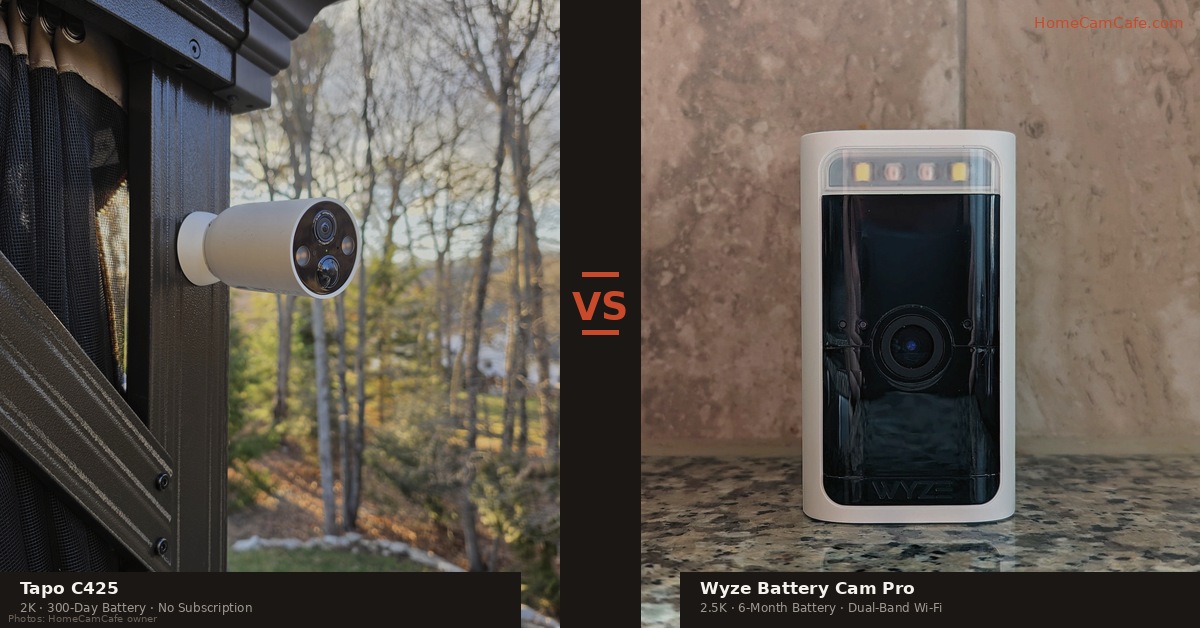
Quick Specs Comparison
| Tapo C425 | Wyze Battery Cam Pro | |
|---|---|---|
| Resolution | 2K QHD (2560×1440) | 2.5K QHD (2560×1440) |
| Battery Life | Up to 300 days | Up to 6 months |
| Night Vision | Color spotlights + IR | Color spotlight + IR |
| Field of View | 150° | 108° |
| Wi-Fi | 2.4 GHz only | Dual-band 2.4 / 5 GHz |
| Storage | microSD up to 512GB | microSD up to 256GB |
| Free AI Detection | Person, vehicle, pet | Person, pet, package |
| Mount Thread | Magnetic + 1/4″-20 | 1/4″-20 |
| Solar Option | Yes — C425 Kit | No |
| Subscription | Not required | Not required (Cam Plus optional) |
Battery Life: C425 Wins Clearly
This is the most significant difference between the two cameras. The Tapo C425 is rated for up to 300 days on a single charge — Wirecutter cited this as a key reason for their best outdoor camera pick. The Wyze Battery Cam Pro is rated for up to six months, which works out to roughly 180 days under standard use. In practice both cameras fall short of their rated maximums in active outdoor locations, but the C425’s larger 10,000mAh battery gives it a meaningful real-world advantage.
For cameras mounted in hard-to-reach locations — high on a wall, under an eave, on a fence post — the difference between charging once or twice a year matters considerably. The C425 also has a solar panel option available as the Tapo C425 Kit, which eliminates charging concerns entirely for cameras with adequate sun exposure. The Battery Cam Pro has no solar option.
Video Quality: Wyze Edges Ahead on Resolution
Both cameras shoot at 2K resolution but the Wyze Battery Cam Pro’s 2.5K (2560×1440) sensor produces slightly sharper footage than the C425’s 2K QHD — though the practical difference is modest at typical monitoring distances. More meaningful is the field of view gap: the C425 covers 150 degrees while the Battery Cam Pro covers 108 degrees. For a front driveway or wide outdoor area, the C425’s wider angle covers more territory with a single camera.
Color night vision quality is comparable on both cameras. Each uses a built-in spotlight that activates on motion to produce full-color footage after dark. The C425’s Starlight sensor handles low-light transitions cleanly; the Battery Cam Pro’s spotlight performance is similarly capable. Neither camera has a meaningful advantage here.
Wi-Fi: Wyze Wins on Connectivity
The Battery Cam Pro supports dual-band Wi-Fi — both 2.4 GHz and 5 GHz. The C425 is 2.4 GHz only. In homes with congested 2.4 GHz networks or where the camera will be placed close to the router, this gives the Wyze a connectivity advantage. For most typical outdoor placements at standard distances from the router, 2.4 GHz is perfectly adequate — but if Wi-Fi reliability has been an issue with other cameras, the Battery Cam Pro’s dual-band support is worth noting.
AI Detection: Effectively Equal
Both cameras offer free AI detection without a subscription. The C425 detects people, vehicles, and pets. The Battery Cam Pro detects people, pets, and packages. Vehicle detection on the C425 is more useful for driveway monitoring; package detection on the Battery Cam Pro is more useful for front door placement. For most buyers neither difference is decisive — both cameras deliver accurate free detection that reduces false alerts meaningfully compared to generic motion detection.
The C425 integrates with the Tapo Care subscription for optional cloud storage. The Battery Cam Pro works with Wyze Cam Plus for the same purpose. Neither is required for the cameras to function fully.
Mounting
Both cameras include a standard 1/4″-20 threaded mount hole, which means the full range of third-party camera mounts — articulating arms, gutter clips, soffit brackets, junction box adapters — all work with either camera. The C425 adds a magnetic base on top of that, which gives it extra flexibility for quick repositioning on any metal surface. The Battery Cam Pro relies on the 1/4″-20 thread only, which is sufficient for virtually all standard mounting scenarios.
Which One Should You Buy?
Buy the Tapo C425 if battery life is the priority — especially for cameras in hard-to-reach locations or anywhere you want the option of solar charging. The 300-day rated battery, wider 150° field of view, and solar kit availability make it the stronger choice for most outdoor installations. It is also the better pick for driveway monitoring where vehicle detection matters.
Buy the Wyze Battery Cam Pro if dual-band Wi-Fi is important for your installation, or if your router is close enough that 5 GHz connectivity would provide a more stable stream. It is also slightly better for front door placement where package detection is more relevant than vehicle detection.
For most buyers the C425 is the right call — the battery life advantage is real and the solar option removes the one ongoing maintenance task that makes battery cameras frustrating over time.
Bottom Line
The Tapo C425 wins this comparison primarily on battery life and solar availability. The Wyze Battery Cam Pro counters with dual-band Wi-Fi and slightly sharper resolution. Both are excellent no-subscription outdoor cameras — the decision comes down to whether battery longevity or Wi-Fi flexibility matters more for your specific installation.
For deeper dives into each camera, see the full Tapo C425 review and the Wyze Battery Cam Pro review.