
The time lapse feature on Wyze cameras is one of those functions that gets overlooked but turns out to be genuinely useful once you try it. Whether you want to capture a plant growing, document a home renovation, or just watch the sun move across a room, the Wyze time lapse handles it well. Setup takes about two minutes. Works on all current Wyze cameras including the Wyze Cam v4, which added 2.5K resolution and a built-in spotlight over the previous generation.
What You’ll Need: A microSD Card
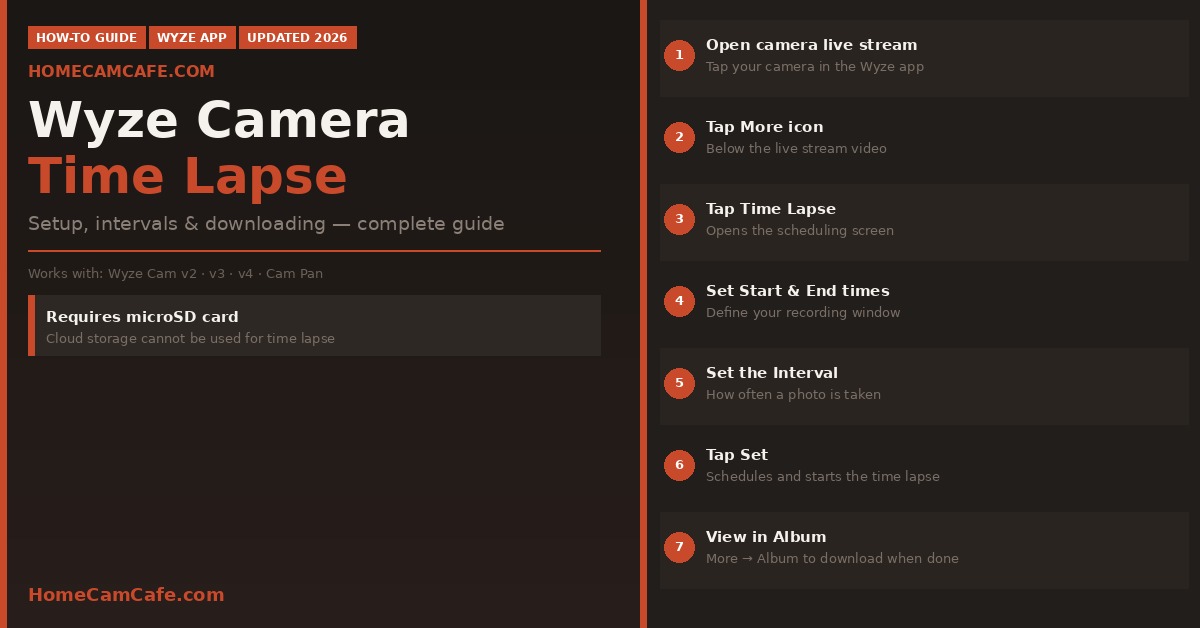
The Wyze time lapse feature requires a microSD card installed in the camera. It saves still images directly to the card rather than to the cloud — so cloud storage won’t help here even if you have a Cam Plus subscription. In addition, the card must be inserted before you schedule the time lapse; you can’t add one mid-recording.
A U-3 microSD card will work. Wyze cameras support cards up to 256GB, though for most time lapse projects a 64GB or 128GB card is more than sufficient. A good option is the Transcend High Endurance 128GB microSD card — it’s rated for continuous recording use, which means it holds up better than standard cards over repeated write cycles.
💡 Before You Start
If you’re using a Wyze Cam Pan, turn off Motion Tracking and Pan Scan before scheduling a time lapse. If the camera moves during recording, the shots won’t line up and the final video will be unusable. Both toggles are found under the More icon in the live stream view.
How to Set Up a Wyze Time Lapse
The setup is handled entirely in the Wyze app. The steps are the same for Wyze Cam v2, v3, v4, and Cam Pan models:
- Open the Wyze app and tap your camera to open the live stream.
- Position the camera exactly where you want it — you won’t be able to adjust the angle after starting the time lapse without ruining the sequence.
- Tap the More icon below the live stream.
- Tap Time Lapse.
- Set your Start Time — the date and time you want recording to begin.
- Set your End Time — when you want recording to stop.
- Set the Interval — how often the camera takes a photo.
- Tap Set to schedule the time lapse.
The app will confirm the scheduled time lapse and show a countdown. If you need to cancel before it starts — or stop it mid-recording — tap End. Any frames already captured will be saved to your album, so you won’t lose what’s already been recorded.
Choosing the Right Interval
The interval setting is the most important decision you’ll make. It controls how often the camera takes a still image, which in turn determines how fast the final video plays back and how much storage it uses.
| Use Case | Recommended Interval |
|---|---|
| Clouds moving across the sky | 2–3 seconds |
| Sunset or sunrise | 5–10 seconds |
| Traffic or street activity over a few hours | 10–30 seconds |
| Construction or renovation over days | 5–15 minutes |
| Plant growing or blooming over weeks | 30–60 minutes |
As a general rule: the slower the subject moves, the longer the interval. A short interval on a slow-moving subject wastes card space and produces a video that barely looks faster than real time. A long interval on a fast-moving subject produces a jerky, hard-to-follow video.
How to View and Download Your Time Lapse
When the time lapse reaches its scheduled end time, the video is compiled automatically and saved to your album. To find it:
- Open the Wyze app and tap your camera.
- Tap the More icon, then tap Album. Alternatively, tap the View Album button from the Time Lapse settings screen.
- Find your time lapse video in the list and tap it.
- Tap the Download icon to save the video to your phone’s photo gallery.
A couple of things to know about downloading. First, the Wyze app needs permission to access your phone’s photo gallery — if you haven’t granted this, go to your phone’s Settings → Apps → Wyze and enable photo access. Second, time lapse files can be large, so stay connected to Wi-Fi during the download. Third, keep the Wyze app open and in the foreground until the download completes — closing or backgrounding the app may interrupt the transfer.
Furthermore, if you prefer not to download via the app, you can remove the microSD card from the camera and read it directly on a computer using a card reader or the adapter that came with the card. The time lapse files are stored in a folder on the card and can be copied directly.
A Few Extra Tips
Power stability matters. If the camera loses power mid-recording, the time lapse will stop and you’ll only have what was captured up to that point. For long time lapses spanning days or weeks, make sure the camera is reliably plugged in — don’t rely on a battery bank or an extension cord that might get unplugged.
Time lapse and continuous recording can run simultaneously. If you have Cam Plus and continuous recording enabled, both will record at the same time. However, this uses significantly more card space and drains battery faster on battery-powered models, so use that combination thoughtfully.
Motion Tracking on Wyze Cam Pan. As mentioned above, always turn off Motion Tracking and Pan Scan before starting a time lapse on a pan/tilt camera. If the camera pans away during the sequence, the resulting video will be disorienting at best and unusable at worst.
The Wyze time lapse is one of the more capable versions of this feature in the budget camera category — it works reliably, the presets are sensible, and the ability to run it alongside continuous recording is a genuine advantage. Additionally, if you’re looking to upgrade your Wyze camera to take advantage of time lapse and other features, see our Best Indoor Security Cameras guide for current recommendations.