
Finding a security camera without WiFi is easier once you identify what kind of connection is actually missing. A temporary internet outage, a camera mounted beyond Wi-Fi range, and a completely off-grid location are three different problems that require different solutions.
After recently testing a solar-powered 4G security camera in an area with only one to two bars of cellular service, I also came away with a better appreciation for where cellular cameras fit. They can solve both the networking and power problems that make remote camera placement difficult, but they also introduce an ongoing data-plan cost that a conventional Wi-Fi camera does not have.
Security Camera Without WiFi: Which Type Do You Need?
There is no single type of camera that solves every no-Wi-Fi situation. The best choice depends on whether cellular service is available, whether electrical power is available, and whether you need remote access or are comfortable retrieving footage later.
| Situation | Best Approach | Remote Access? | Power Needed? | Ongoing Cost? |
|---|---|---|---|---|
| Home internet outage | Camera with local microSD storage | Usually not until internet returns | Usually yes | Usually no |
| No usable Wi-Fi, cellular available | 4G LTE cellular camera | Yes | Not with battery/solar | Usually yes |
| No Wi-Fi and no cellular coverage | Offline SD or trail camera | No | Battery or solar | Usually no |
Scenario One: Your ISP Is Down
This is the most common situation. Your internet service drops because of a storm, ISP outage, router problem or other failure, but the house still has electrical power. In this case, you usually do not need a cellular camera. What matters is whether your existing camera can continue recording locally when its cloud connection disappears.
A camera with onboard microSD storage is the simplest solution. Cloud-dependent functions such as remote live view, push notifications and cloud backup may temporarily stop, but a properly configured camera can still save footage locally while the internet connection is unavailable.
The Wyze Cam OG is one example. It supports local microSD recording in addition to Wyze’s cloud features, so a temporary internet outage does not necessarily mean the camera stops capturing footage as long as it still has power.
The Wyze Cam v3 is another inexpensive option with local storage capability. The larger point is that an ISP outage and a lack of Wi-Fi coverage are not the same problem. If your camera already sits within your home network, local storage may be all the backup you need.
Scenario Two: You Need a Security Camera Without WiFi
This is the scenario where a 4G cellular camera starts to make sense. Some locations are simply too far from the router for reliable Wi-Fi, including detached garages, barns, gates, long driveways, construction sites, vacation properties and remote sections of larger lots.
A mesh Wi-Fi system can solve some coverage problems, particularly around a normal home. Once the location is genuinely outside practical Wi-Fi range, however, extending the network may cost more and create more complexity than simply using a cellular camera.
A 4G security camera without WiFi connects to a cellular network instead of your home router. Some models accept a removable SIM card, while others use an embedded eSIM and require a data plan supplied by the camera manufacturer. That distinction matters because it affects both carrier flexibility and long-term ownership cost.
What I Learned Testing a 4G Cellular Camera
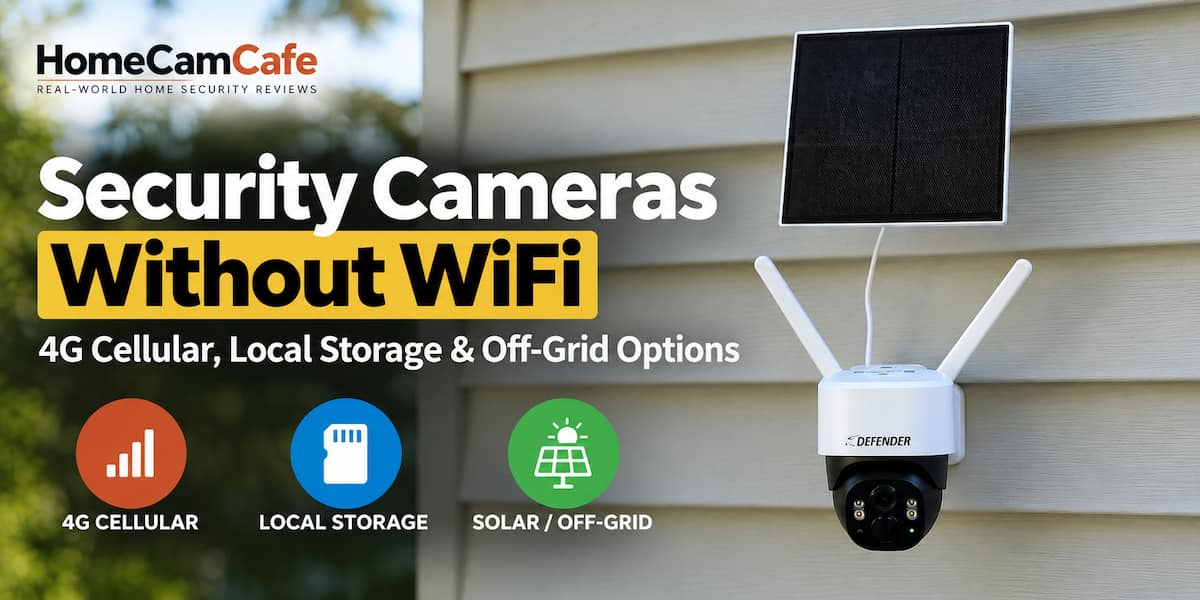
I recently tested the Defender Frontier 4G Solar Security Camera outdoors in an area where cellular strength generally fluctuated between only one and two bars. I expected that weak signal to create problems, but the camera remained surprisingly usable. Live view worked, PTZ controls responded properly, human detection was very accurate, and both infrared and color night vision performed extremely well.
The Frontier combines its 4G connection with a 9,200mAh rechargeable battery and an included 5W solar panel. That combination means it can operate somewhere that has neither home Wi-Fi nor a nearby electrical outlet, which is exactly the kind of location where cellular cameras make the most sense.
It also reinforced an important point about weak cellular coverage: one or two signal bars do not automatically make a camera unusable. What matters is whether live view, notifications and recorded events remain reliable at the actual installation location.
Read our full Defender Frontier review for hands-on testing of the 4G connection, PTZ tracking, human detection, solar system and night vision.
View Defender Frontier on Amazon →
Cellular Cameras Have an Ongoing Cost
The tradeoff for getting remote access without Wi-Fi is cellular service. A 4G camera needs a data plan in much the same way a phone or tablet does. Depending on the camera, that may mean bringing your own SIM or subscribing to a service provided by the manufacturer.
The Defender Frontier uses Defender’s embedded cellular service rather than allowing you to insert a carrier SIM of your choice. That makes the data plan part of the true ownership cost, so I would always check current cellular pricing before choosing any 4G camera.
Cellular live viewing may also feel slightly less immediate than a good Wi-Fi connection. In my Frontier testing, the app established an encrypted connection each time the live feed was opened, and returning to the app after switching away required the channel to be established again. It was more annoying than debilitating, but it is a practical difference worth knowing about.
A 4G Camera Can Keep Working When Your Home Internet Fails
A cellular camera has another advantage: it is independent of your home’s internet connection. If your cable or fiber service goes down, the camera can continue communicating over the mobile network as long as cellular service itself remains available.
That makes a cellular security camera without WiFi particularly attractive for remote property monitoring, where independence from the home network may be just as important as range.
Scenario Three: No WiFi and No Cellular Service
This is the true off-grid problem. If neither Wi-Fi nor cellular service reaches the location, conventional remote live viewing is no longer realistic. The camera must be able to operate and record locally until someone physically retrieves the footage.
This is also where the role of power has changed. A lack of electrical service no longer automatically means you cannot use a sophisticated security camera because batteries and solar panels can solve the power problem. The real cutoff point is often whether any usable communications network reaches the site.
If there is no cellular signal either, look for a camera that can record directly to removable storage without depending on an active network connection during normal operation.
Trail Cameras Still Make Sense Completely Off-Grid
For very remote locations, a traditional trail camera remains one of the simplest approaches. Stealth Cam trail cameras, for example, can operate for long periods on batteries and save photos or video directly to an SD card.
You give up conveniences such as remote live view, push notifications and PTZ controls, but there are situations where simplicity is an advantage. When no practical network connection exists, a camera that records locally whenever motion occurs can be more dependable than trying to force an app-dependent security camera into an environment it was never designed to handle.
What If There Is No Electrical Power?
No electrical outlet used to be one of the biggest obstacles to installing a remote security camera. Solar charging has changed that considerably. A battery-powered camera paired with a correctly positioned solar panel can operate for extended periods without a nearby outlet.
Real-world battery performance still depends on usage. Frequent live viewing, PTZ movement, spotlights, cold weather and heavy motion activity all consume more power. A quieter installation with good sunlight may require very little intervention, while a busy location can place considerably more demand on the battery and solar panel.
If solar operation is central to your installation, see our Best Solar Security Cameras guide for more options.
Can a Security Camera Without WiFi Still Record?
Yes, but the answer depends on the camera. Wi-Fi is primarily a communications method. It is not inherently required to save video if the camera supports independent local storage.
Some cameras can write motion events or continuous footage directly to a microSD card even when internet access is unavailable. Cellular cameras can take this a step further by using 4G for remote access while still retaining local microSD event storage.
That combination is particularly attractive for remote installations because the cellular connection handles live view and notifications while the memory card provides local event storage.
Always verify the behavior of the specific camera you are considering. A microSD slot by itself does not guarantee that every feature continues working without a network connection.
Can a Security Camera Connect to a Phone Without WiFi?
Yes, but there needs to be another communication path. A 4G LTE camera can communicate with your phone through the cellular network instead of through your home Wi-Fi. Your phone does not need to be physically near the camera, and both devices can be using entirely different networks.
That makes cellular cameras one of the best solutions for anyone searching for a security camera that connects to a phone without WiFi. You still need cellular coverage at the camera location and an active data plan, but you retain the features people normally expect from a connected security camera, including live viewing and notifications.
What About Boats, RVs and Other Mobile Locations?
RVs and boats present many of the same problems as remote property. Fixed Wi-Fi may be available sometimes and disappear completely as soon as the vehicle or vessel moves. In those situations, a 4G camera can make considerably more sense than a camera tied to a single router.
For an RV, campsite or marina with cellular coverage, a solar-powered 4G camera can continue operating without depending on campground or marina Wi-Fi. That’s useful because public Wi-Fi can be weak, congested or restricted even when cellular service is good.
Boats require more caution. Cellular service generally works around marinas, harbors and populated coastal areas but can disappear quickly offshore. A 4G security camera is therefore much better suited to dockside monitoring than to vessels traveling beyond reliable cellular coverage.
Marine conditions also introduce a hardware issue that has nothing to do with networking. A camera can be weather resistant without being designed for continuous salt exposure. Fasteners, brackets and connectors should be corrosion resistant, and I would not assume that a standard outdoor camera is automatically suitable for long-term marine installation simply because it carries an IP weather rating.
Local Storage Still Matters With a 4G Camera
My recent cellular-camera testing reinforced something that often gets overlooked: 4G connectivity and local storage are complementary rather than competing features. The cellular connection can provide remote live view and notifications while a microSD card stores motion-triggered footage locally.
For a remote installation, I would generally favor a cellular camera that includes local event storage. If the network temporarily becomes unavailable, you still have the potential for footage to be stored at the camera instead of relying entirely on a remote service.
How to Choose the Best Security Camera Without WiFi
The best security camera without WiFi depends on which connection is actually missing and whether remote access is important to you.
- Your ISP is temporarily down: use a camera with local microSD recording. You probably do not need cellular service.
- Wi-Fi does not reach the installation location, but cellular coverage exists: choose a 4G LTE cellular camera.
- There is no electrical outlet: use a battery-powered camera with a solar panel.
- There is no Wi-Fi or cellular coverage: use an offline SD-recording camera or trail camera and plan to retrieve footage manually.
The important lesson is that “no internet” does not describe one single problem. A temporary ISP outage, a gate with good LTE coverage and a completely off-grid property all call for different solutions.
Bottom Line
For a normal home internet outage, a camera with local microSD storage is usually enough to keep recording. When Wi-Fi does not reach the installation location but cellular service is available, a 4G camera is the most capable option because it preserves remote access without depending on the home network. My Defender Frontier testing also showed that even a weak one-to-two-bar cellular signal can still deliver useful live video, PTZ control and accurate detection. When neither Wi-Fi nor cellular coverage is available, local SD recording or a traditional trail camera remains the most dependable fully off-grid solution.