
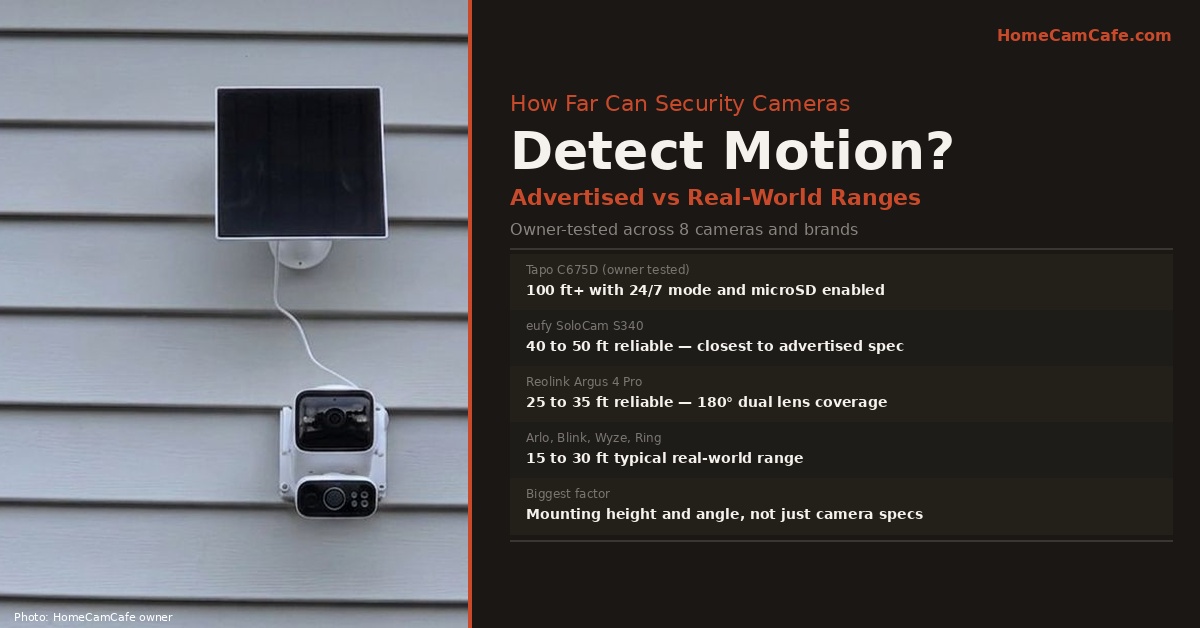
Security camera manufacturers advertise motion detection ranges that rarely match real-world performance. A camera rated for 50-foot detection may trigger reliably at 20 feet and miss events at 40. After testing cameras from Tapo, eufy, Reolink, Arlo, Blink, Wyze, and Ring, here is what we have actually observed and what makes the biggest difference in real-world detection range.
What Motion Detection Range Actually Means
Most outdoor security cameras use a passive infrared sensor, commonly called a PIR sensor, to detect motion. A PIR sensor detects changes in infrared radiation, which in practical terms means the heat differential between a moving person or vehicle and the surrounding environment.
The advertised detection range is the maximum distance at which the manufacturer’s own testing found the PIR to trigger reliably under controlled conditions. Real-world conditions are rarely controlled, and several factors reduce effective range significantly.
Mounting height and angle is one of the biggest factors. A PIR sensor aimed too steeply downward detects a smaller ground area. A camera at 8 feet aimed straight down sees maybe 15 feet of ground, while the same camera at 12 feet with a 30-degree downward angle sees 30 feet or more.
Temperature matters too. PIR sensors detect heat differential. In summer when ambient temperature approaches body temperature, the contrast drops and range decreases. In winter the contrast is higher and range can exceed the rated spec.
Movement direction affects detection significantly. Most PIR sensors detect motion moving across the field of view far better than motion approaching directly toward the camera. A person walking parallel to the camera at 30 feet may trigger it reliably, while the same person walking straight toward the camera from 30 feet may not trigger until 15 feet.
Finally, detection mode plays a role. Some cameras have a standard battery-conserving detection mode and a higher-sensitivity mode that extends range. The advertised range often refers to the higher-sensitivity mode, which consumes more power.
Advertised vs Real-World Detection Ranges
| Camera | Advertised Range | Real-World Range | Notes |
|---|---|---|---|
| Tapo C675D | 29 ft PIR / 60 ft AI mode | 100 ft+ with 24/7 mode | PIR + Radar + AI detection. Best we have tested. Requires microSD + 24/7 enabled. |
| Tapo C425 | ~50 ft | 25-30 ft reliable | Detects at range but may not record until closer. |
| eufy SoloCam S340 | ~50 ft | 40-50 ft reliable | Dual lens with auto-tracking extends effective coverage. |
| Reolink Argus 4 Pro | ~30 ft PIR | 25-35 ft reliable | 180° dual lens covers wide area even at shorter range. |
| Arlo Pro 5S / Pro 6 | ~23 ft PIR | 20-25 ft reliable | Accurate to spec. Compensates with excellent AI filtering. |
| Blink Outdoor 4 | ~20 ft PIR | 15-25 ft reliable | Standard PIR only. Activity zones help reduce false alerts. |
| Wyze Cam v4 | ~20 ft PIR | 15-25 ft reliable | Radar + PIR combo on some models improves accuracy. |
| Ring Stick Up Cam | ~30 ft PIR | 20-30 ft reliable | Motion zones help focus detection on relevant areas. |
Owner testing note: The Tapo C675D real-world range figure of 100 feet is from our own owner testing with 24/7 Continuous Capture enabled and a microSD card installed. We observed consistent detection of people walking on the far side of a residential street from a second-story mounting position. This significantly exceeds the advertised 60-foot AI detection range. See our full Tapo C675D review for the complete setup details.
PIR vs AI Detection: Why These Numbers Differ
Several cameras now supplement their PIR sensors with AI-enhanced detection modes that extend effective range beyond the PIR sensor’s hardware limit.
The Tapo C675D is the most dramatic example we have tested. Unlike every other camera in this comparison, it combines three detection technologies: a PIR sensor, a radar sensor, and on-device AI. The radar component is the key differentiator — it detects motion independently of heat differential, which means it is not affected by the temperature limitations that reduce PIR effectiveness in warm weather. When 24/7 Continuous Capture is enabled, all three systems work together continuously rather than relying on the PIR to wake the camera first. This is why the C675D’s real-world detection range so dramatically exceeds its advertised PIR spec and outperforms every other battery camera we have tested.
The AI detection range is the distance at which the camera’s AI can identify what triggered the PIR, whether it was a person, vehicle, pet, or irrelevant motion like a tree branch. AI detection requires the subject to be large enough in the frame to classify.
This range is typically shorter than the PIR trigger range. The camera may detect motion at 50 feet but the subject is too small in the frame for the AI to confirm it is a person rather than leaves moving. For a camera to be useful at longer ranges, it needs both a sensitive PIR trigger and enough resolution or zoom capability to classify subjects at that distance.
This is exactly what makes the Tapo C675D’s combination of extended detection mode and 4K telephoto zoom so effective: it detects at long range and has the optical capability to identify what it detected.
How Mounting Height Affects Detection Range
Mounting height is one of the most underappreciated variables in motion detection performance. The same camera can have dramatically different detection ranges depending on where it is installed.
A camera mounted at 6 feet on a wall is aimed roughly horizontally. The PIR sensor covers a wide arc at eye level but relatively little of the ground plane in front of the camera. A person approaching the camera is moving directly toward the sensor, which is the least effective approach angle for PIR detection.
The same camera mounted at 10 to 12 feet on a gutter or soffit is aimed downward at an angle. The PIR sensor now covers a large area of the ground plane in front of the camera. A person walking into that area is moving across the sensor’s detection zone rather than toward it, which is the most effective angle for PIR detection.
In our testing, the same camera at gutter height consistently detects motion earlier and at greater distances than when mounted at eye level. For long driveway coverage specifically, gutter or soffit mounting at 10 to 14 feet aimed down the driveway at a 20 to 30-degree angle gets the most out of any camera’s PIR range. See our security camera mount guide for placement guidance by camera type.
AI-Enhanced Detection vs Standard PIR
Several cameras now supplement their PIR sensors with AI-enhanced detection modes that extend effective range beyond the PIR sensor’s hardware limit.
The Tapo C675D’s 24/7 Continuous Capture mode is the most dramatic example we have tested. It shifts the camera from pure PIR trigger to a continuous AI analysis mode that detects and classifies motion far beyond what the PIR alone would catch.
Other cameras approach this differently. Wyze uses a Radar plus PIR combination on select models that detects motion at longer ranges than PIR alone. eufy’s HomeBase models process AI detection locally, allowing faster and more sensitive classification than cloud-dependent systems. Arlo’s AI detection runs in the cloud on motion-triggered clips, which means it refines classification after the PIR has already triggered.
If long-range detection is a priority, look for cameras that offer an enhanced detection mode beyond standard PIR and read the fine print on what that mode requires. In the case of the Tapo C675D, it requires local storage and 24/7 mode enabled, conditions that affect battery life and require a microSD card installation that many buyers skip.
Night Vision Range vs Motion Detection Range
Night vision range and motion detection range are separate specs that are frequently confused. Night vision range is how far the camera can produce a usable image in the dark. Motion detection range is how far the PIR sensor triggers.
These do not always match. A camera may detect motion at 30 feet in the dark but only produce a usable image out to 20 feet with its IR illuminators. Alternatively, a camera with a powerful spotlight may illuminate 50 feet but only detect motion at 25 feet.
For effective nighttime coverage, both ranges need to be adequate for the intended use. A camera that detects motion at 40 feet but cannot produce a usable image beyond 20 feet captures an event but not useful footage of it.
Color night vision cameras with spotlights, such as the Tapo C675D, eufy S340, and Reolink Argus 4 Pro, tend to produce more usable nighttime footage at longer ranges than IR-only cameras because the spotlight actively illuminates the scene rather than relying on passive infrared imaging.
Which Cameras Have the Best Long-Range Detection?
For buyers specifically prioritizing detection range, here is how the cameras we have tested rank based on real-world performance.
The Tapo C675D is in a category of its own for battery-powered cameras. The combination of extended AI detection mode and 4K telephoto zoom produces real-world detection at distances no competing battery camera approaches. The setup requirement of a microSD card and 24/7 mode enabled is worth understanding before purchase, but once configured it significantly outperforms anything else we have tested. You can check the current price on Amazon.
The eufy SoloCam S340 performs closer to its advertised range than most competitors, with 40 to 50 feet of reliable detection and dual-lens auto-tracking that keeps subjects in frame once detected. For buyers who want strong detection range without the C675D’s configuration complexity, the S340 is the most reliable performer among standard battery cameras. Check the current price on Amazon.
For buyers who want maximum detection range without a battery camera’s limitations, a wired camera with a wide-angle lens at proper gutter height will consistently outperform battery cameras. Battery cameras optimize for power conservation, which means detection sensitivity is always a tradeoff against battery life. Wired cameras make no such tradeoff. See the best security cameras without a subscription for the top wired options.
Bottom Line
Advertised detection ranges are best understood as upper limits under ideal conditions, not typical performance. Real-world range depends as much on mounting height, angle, and ambient temperature as it does on the camera’s hardware specs. Among battery cameras, the Tapo C675D with 24/7 mode and a microSD card installed is the standout performer. We observed detection at over 100 feet in owner testing, far exceeding any other battery camera we have reviewed. The eufy SoloCam S340 is the most consistent performer at its rated range. For most cameras, mounting at gutter height and angling the camera to cover the ground plane rather than aiming it horizontally will meaningfully improve real-world detection distance without any hardware change.
See also: Tapo C675D Review · Security Camera Mount Guide · Best Cameras Without a Subscription · Local vs Cloud Storage Guide