
Choosing a reliable baby car monitor is one of the smartest safety upgrades you can make once your infant moves into a rear-facing car seat. Traditional plastic backseat mirrors vibrate out of alignment over potholes, require you to twist your neck or angle your rearview mirror away from traffic, and become completely dark after sunset. A dedicated car baby camera solves all three problems by strapping a compact wide-angle lens to the headrest and feeding live 1080p or 2K video directly to a dashboard screen with automatic infrared night vision, zero Wi-Fi setup, and no monthly subscription fees.
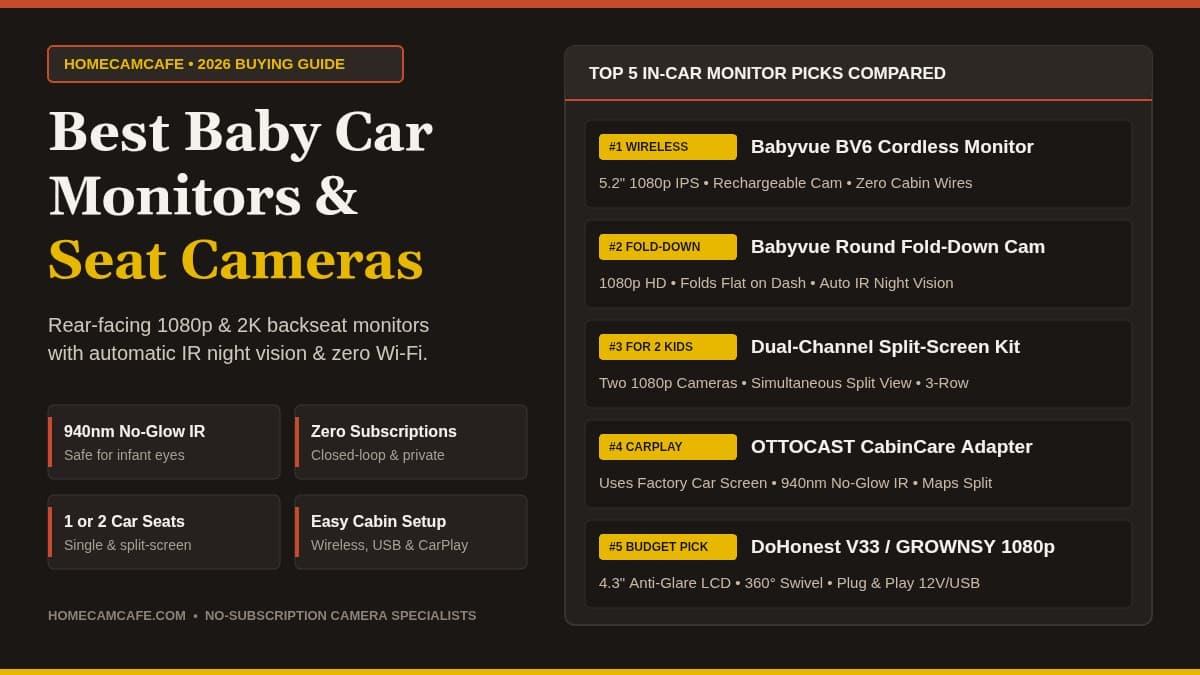
Quick Answer: For a clutter-free cabin with zero front-to-back wiring, the Babyvue BV6 Wireless Baby Car Camera is the top cordless pick, while the Babyvue Round Fold-Down Monitor is best for drivers who want a compact screen that folds flat against the dash. Families watching two car seats at once should choose our Dual-Channel Split-Screen Car Monitor pick, and iPhone drivers who want to skip adding a second dashboard screen altogether should pick the OTTOCAST CabinCare Wireless CarPlay Baby Camera.
Because in-car cameras sit only 18 to 24 inches from a rear-facing infant’s face and bake inside parked vehicles during summer errands, evaluating them requires the same optical and hardware scrutiny we apply to our best home security cameras without a subscription. Below, we compare the eight best baby car cameras across cordless battery systems, fold-down displays, dual-camera split-screen kits for two kids, Apple CarPlay adapters, and simple plug-and-play wired monitors.
Best Baby Car Monitor Comparison Table
Every car seat camera in our lineup runs on a closed, private connection between the backseat lens and the front display. None of these systems require cellular data, smartphone apps, or paid cloud plans.
| Baby Car Monitor | Best For | Display & Resolution | Power & Connection | Night Vision & Key Feature |
|---|---|---|---|---|
| Babyvue BV6 Wireless | Best Wireless (No Cabin Wire) | 5.2-in IPS (1080p HD) | Rechargeable Camera + Wired Monitor | Auto IR, 3x zoom, auto start/stop, adhesive mount |
| Babyvue Round Fold-Down | Best Compact Fold-Down Screen | Round Fold-Down (1080p HD) | USB / 12V Wired Plug-and-Play | Auto IR, folds flat when parked to reduce glare |
| Dual-Channel Split-Screen Car Monitor | Best Dual Camera for 2 Kids | Ultrawide Split-Screen (1080p HD) | USB / 12V Dual-Camera Wired | No-glow IR, simultaneous 2-seat split view |
| Wide-View HD USB Car Baby Monitor | Best Daily USB Plug-and-Play | 5-in IPS (1080p / 2K Clarity) | USB Plug-and-Play Wired | Invisible IR, 360-degree swivel, anti-glare screen |
| OTTOCAST CabinCare CarPlay Cam | Best Factory CarPlay Integration | Uses Factory Car Screen (1080p) | CarPlay USB Port (iPhone iOS) | 940nm no-glow IR, split-screen with Apple Maps |
| DoHonest V33 1080p Car Camera | Best Budget Wired Pick | 4.3-in LCD (1080p HD) | 12V Lighter / USB Wired | 7-LED auto IR, 150-degree wide lens, mirror flip |
| GROWNSY HD Baby Car Camera | Best Anti-Shake Strap Design | 4.3-in Anti-Glare (1080p HD) | USB & 12V Dual Power Wired | Auto IR, 120-degree distortion-free view |
| Shynerk 4.3-Inch Night Vision Monitor | Best Simple 12V Mirror Replacement | 4.3-in HD Display | 12V Cigarette Lighter Socket | Starlight IR sensor, anti-slip dashboard mat |
The 8 Best Baby Car Monitors and Cameras Ranked
1. Babyvue BV6 Wireless Baby Car Camera: Best Cordless Setup
The biggest complaint parents have with standard backseat monitors is routing a 15-foot video cable from the rear headrest under the floor mats, around the center console, and up to the dashboard. The Babyvue BV6 Wireless Baby Car Camera eliminates that front-to-back video cord by pairing a rechargeable battery-powered headrest camera with a 5.2-inch 1080p IPS dashboard monitor over a private point-to-point wireless link.
Because the transmission uses a closed radio signal rather than Wi-Fi or Bluetooth, it pairs automatically when the car starts with zero app login and zero lag. The 5.2-inch IPS panel provides wider viewing angles and better daytime sunlight legibility than older 4.3-inch TFT screens, and it includes 3x digital zoom so you can check whether your infant’s eyes are open or closed without leaning toward the dash. An automatic start-and-stop power circuit wakes the system when your vehicle powers on and puts the camera into standby when you park, preserving battery life between charges.
- Display and Optics: 5.2-inch 1080p HD IPS panel with adjustable brightness, mirror-image flip for rear-facing or forward-facing seats, and 3x zoom.
- Mounting Hardware: Self-adhesive dashboard mount for stable placement alongside dual headrest straps for the cordless rear camera.
- Night Vision: Automatic infrared night vision switches on in low light without waking a sleeping baby.
- Trade-offs to Consider: Because the backseat camera contains a rechargeable lithium battery, you will need to top it off periodically via USB-C and avoid leaving the camera baking in direct windshield sun during extreme summer heatwaves.
2. Babyvue Round Fold-Down Baby Car Camera: Best Low-Profile Dashboard Monitor
Many drivers dislike mounting a rectangular 5-inch or 7-inch screen on top of their dashboard because it blocks lower windshield sightlines and looks like an aftermarket GPS target when parked on city streets. The Babyvue Round Fold-Down Baby Car Camera solves both issues with a circular 1080p HD monitor that hinges flat against its base when not in use.
During daytime errands or night highway drives, you flip the round display up for a crisp 1080p view of your rear-facing infant seat. When you park at work or drive solo without your child, a quick press folds the screen down so your dashboard stays completely tidy and the LCD panel stays shielded from direct overhead sunlight. Its wired connection delivers instant video the moment the vehicle starts, with no camera batteries to recharge.
- Display Design: Compact round 1080p HD fold-down screen that tucks flat on the dash or console.
- Camera Adjustability: Matching circular rear-seat camera with 360-degree pivot adjustment to frame rear-facing infant carriers or convertible seats.
- Night Vision: Built-in automatic infrared sensor shifts from daytime color to nighttime monochrome in tunnels and after dark.
- Trade-offs to Consider: The circular screen crop prioritizes a single car seat rather than an ultrawide view across all three rear seats.
3. Dual-Channel Split-Screen Baby Car Camera: Best for Two Kids and Three-Row SUVs
When you have two children in the backseat, such as an infant in a rear-facing carrier and a toddler in a convertible seat, a single wide-angle lens mounted in the middle headrest rarely works. High-backed car seat shells block the side angle, leaving one child in a blind spot. A dedicated dual-camera baby car monitor solves this by wiring two independent 1080p HD cameras into a single split-screen dashboard display.
You can strap one camera to the driver-side rear headrest and the second camera to the passenger-side or third-row headrest, viewing both feeds side by side in real time or toggling to a single full-screen channel when traveling with one child. Just as dual-lens outdoor security cameras eliminate blind spots around a house, running two separate headrest cameras lets you aim each 360-degree ball joint straight into each child’s seat without fisheye edge distortion.
- Dual-Channel Viewing: Displays two 1080p camera feeds simultaneously on a split screen or switches to a single-camera view on demand.
- Three-Row Reach: Long cabling accommodates second-row and third-row seating layouts in minivans and three-row SUVs.
- Night Vision: Independent automatic infrared night vision on each camera so a dark third row is just as clear as the second row.
- Trade-offs to Consider: Routing two camera cables cleanly to the front console takes a few extra minutes with cable clips compared to a single-camera kit.
4. Wide-View HD USB Plug-and-Play Baby Car Monitor: Best All-Around Wired System
If you want a dependable, everyday wired baby monitor for car trips that runs directly off a standard USB port without occupying your 12V cigarette lighter socket, this wide-view HD USB car baby monitor strikes the ideal balance between screen size, optical sharpness, and plug-and-play simplicity. Many newer EVs, hybrids, and crossovers have removed the front 12V lighter socket entirely in favor of USB ports, making native USB power essential.
Because the video signal travels over a shielded physical cable rather than wireless radio waves, the image never suffers from 2.4 GHz interference, frame drops, or battery depletion on long holiday road trips. The anti-glare display mounts low on the center console or dash, while the 150-degree wide-angle lens and 360-degree swivel collar make it easy to re-aim the camera when your child transitions from rear-facing to forward-facing.
- Power Flexibility: Plugs directly into a vehicle USB port or included car adapter for automatic power-on with the ignition.
- Optical Coverage: Wide-angle lens with full 360-degree rotation covers the car seat head-to-toe with minimal barrel distortion.
- Nighttime Clarity: Invisible infrared illumination lets you check pacifiers, blankets, and head position in total darkness without shining bright light into the seat.
- Trade-offs to Consider: Like all wired car monitors, you will want to tuck the cord along the floor trim or under the floor mat so toddlers cannot tug on it when climbing in.
5. OTTOCAST CabinCare Baby Car Camera with Wireless CarPlay: Best Factory Screen Integration
If your vehicle already has a large 8-inch to 12-inch factory infotainment screen with wired Apple CarPlay, adding a second suction-cup screen on top of the dashboard can feel redundant. The OTTOCAST CabinCare combines a wireless Apple CarPlay dongle with a 1080p rear-seat baby camera, projecting the live backseat video feed directly onto your car’s built-in factory screen.
Better yet, it supports split-screen CarPlay viewing. You can keep Apple Maps, Waze, or Spotify running on one half of your factory display while watching a live 1080p feed of your baby on the other half, or tap once to expand the camera to full screen. It also uses true 940nm invisible infrared LEDs, which produce zero red glow in the dark.
- Zero Extra Dash Clutter: Streams live 1080p rear-seat video directly to your car’s existing factory display while upgrading wired CarPlay to wireless CarPlay.
- 940nm Invisible Night Vision: Uses 940nm no-glow infrared LEDs that are completely invisible to sensitive infant eyes at night.
- Split-Screen Navigation: Lets you view turn-by-turn GPS navigation and your rear-facing car seat side by side on the same screen.
- Trade-offs to Consider: Works exclusively with iPhones (iOS 10 and newer) in vehicles equipped with factory-wired Apple CarPlay; it is not compatible with Android Auto or vehicles like BMW and Tesla that lack wired CarPlay ports.
6. DoHonest V33 HD 1080p Baby Car Camera: Best Budget Wired Pick
The DoHonest V33 is one of the most widely used budget car seat cameras on the road because it keeps the hardware simple, durable, and inexpensive. You get a 4.3-inch 1080p LCD monitor, a 150-degree wide-angle camera with 360-degree rotation, and a double-strap headrest mount that locks horizontally and vertically around movable headrest posts.
On the monitor housing, physical menu buttons let you adjust brightness, contrast, saturation, and toggle between normal and mirror-image views without navigating complex touch menus. Seven infrared LEDs surround the lens to illuminate the backseat automatically when streetlights fade.
- Compact Footprint: The 4.3-inch screen is roughly the width of a standard rearview mirror, making it easy to tuck into a corner of the dash without blocking visibility.
- Physical Button Controls: Dedicated menu, up, and down buttons on the display bezel adjust brightness and flip the image orientation in seconds.
- 360-Degree Ball Pivot: Easily angles downward into deep infant bucket seats or outward across the bench seat.
- Trade-offs to Consider: The 4.3-inch display is smaller than 5-inch and 6.9-inch competitors, and its 850nm infrared LEDs emit a faint dull red ring at night.
7. GROWNSY HD Baby Car Camera: Best Anti-Shake Headrest Mount
On rough pavement and gravel roads, cheap headrest cameras with a tall, spindly neck tend to bob up and down, making the dashboard screen jittery and distracting. The GROWNSY HD Baby Car Camera uses a low-profile, wide-base camera plate held tight by cross-tensioned vertical and horizontal straps, keeping the lens flat against the headrest foam so road vibration does not blur the video feed.
Instead of an ultra-wide 170-degree lens that stretches the edges of the car into a fishbowl, GROWNSY uses a balanced 120-degree field of view that keeps your baby’s face larger and better proportioned in the center of the 4.3-inch anti-glare screen. It also includes both USB and 12V power options in the box.
- Anti-Shake Camera Base: Flush headrest plate design minimizes camera bounce over expansion joints and bumpy streets.
- 120-Degree True-Proportion Lens: Avoids extreme fisheye distortion so your baby’s facial expressions appear larger on the 4.3-inch screen.
- Dual Power Cables Included: Supports both 12V cigarette lighter sockets and USB ports out of the box.
- Trade-offs to Consider: Because the camera sits flush against the headrest, it relies on movable headrest posts for the vertical strap to pass underneath.
8. Shynerk 4.3-Inch HD Night Vision Baby Car Mirror Camera: Best Simple 12V Mirror Replacement
For parents or grandparents who want a basic, zero-learning-curve replacement for a traditional baby mirror in an older sedan or SUV with a 12V cigarette lighter outlet, the Shynerk 4.3-Inch HD Night Vision Monitor has been a category staple for years. Instead of relying on a windshield suction cup that can lose grip when the glass heats up, Shynerk includes a weighted, non-slip silicone dashboard mat that holds the 4.3-inch display steady on flat center consoles.
Plug the adapter into the 12V lighter socket, run the 16-foot video cord to the rear headrest camera, and the display turns on automatically whenever the ignition is running. A starlight night-vision sensor brightens dim cabin light before switching to full infrared mode after dark.
- Non-Slip Dashboard Pad: Sits securely on flat dashboard surfaces without leaving suction-cup rings on your windshield.
- Zero Menu Complexity: Plugs into a 12V socket and displays live video immediately with automatic day-to-night switching.
- Long 5-Meter Video Cable: Reaches rear seats in sedans, crossovers, and midsize SUVs.
- Trade-offs to Consider: Powered strictly via a 12V cigarette lighter plug (not native USB), so check that your vehicle has an accessible 12V outlet before ordering.
How to Choose a Baby Car Monitor: 5 Technical Details That Matter
1. 940nm Invisible Infrared vs. 850nm Red-Glow Night Vision
In our home camera reviews, we frequently explain the difference between 850nm infrared LEDs (which produce a visible red glow in the dark) and 940nm infrared LEDs (which are completely invisible to the human eye). In a car, that distinction matters even more. While a nursery camera sits 6 to 10 feet away on a dresser or wall, a headrest car seat camera sits less than two feet directly in front of your rear-facing baby’s face.
If your baby is distracted or kept awake by glowing red dots in a dark cabin, look for a system with 940nm no-glow night vision (such as the OTTOCAST CabinCare or upgraded invisible-IR car monitors). If you also want a plug-in 2.5K pan-and-tilt camera with a physical one-touch call button on the base and invisible 940nm night vision for a nursery, see our hands-on Aosu IndoorCam P1 Pro review.
2. Why Closed-Loop Car Monitors Beat Wi-Fi Indoor Cameras on the Road
Parents sometimes ask if they can just plug an indoor Wi-Fi baby camera (such as the budget pan-and-tilt model in our TP-Link Tapo C210 review) into a car USB port. While indoor Wi-Fi cameras excel inside a house and include free baby cry detection, they are the wrong tool for a moving car for three reasons:
- No Home Wi-Fi Router: Most Wi-Fi security cameras require an active 2.4 GHz router with internet access to authenticate the app stream, and setting up a phone hotspot before every five-minute grocery drive is impractical.
- Smartphone Distraction Laws: Keeping a camera app open on your phone while driving blocks your navigation screen and violates hands-free driving laws in many states, whereas a dedicated dashboard car baby monitor functions like a secondary rearview mirror.
- Zero Subscription or Cloud Lag: Purpose-built car monitors transmit uncompressed video over a wire or direct 2.4 GHz FHSS radio link, giving you instant zero-latency viewing with none of the recurring fees covered in our security camera subscription plans guide.
3. Wired USB/12V vs. Wireless Battery Cameras in Summer Cabin Heat
Just like choosing between wired vs. wireless security cameras for your home exterior, your climate plays a major role in choosing a car baby monitor. Enclosed vehicle cabins routinely exceed 130 to 150 degrees Fahrenheit when parked in direct summer sun.
Important: If you live in a hot climate such as Texas, Arizona, or Florida and park outdoors daily, choose a wired USB or 12V baby car camera rather than a rechargeable battery-powered wireless camera. Wired cameras contain no lithium-ion battery pack in the rear headrest unit, making them far more resilient to extreme summer cabin heat.
4. Movable vs. Fixed (Integrated) Headrests
Before ordering, check the headrest directly behind your baby’s rear-facing car seat. Most baby car cameras use a two-strap buckle system: one horizontal strap wraps around the width of the headrest, and one vertical strap passes underneath the headrest between the two metal posts to keep the camera from sliding down.
If your vehicle has fixed, single-piece integrated headrests (common in Tesla Model 3 and Model Y seats, Volvo seats, and many third-row bench seats), there is no gap underneath the headrest for a vertical strap. For fixed headrests, use the horizontal strap near the tapered top or choose a camera with an adhesive or clip-on post bracket.
5. Dashboard Mounts vs. Windshield Suction Cups
Where you place the front monitor affects both driving safety and summer durability. Tall suction-cup arms stuck high on the windshield glass bake in direct sun, which softens the rubber cup until it drops off the glass. Mounting your screen low on the center console using a self-adhesive pad, a fold-down base (like the Babyvue Round Fold-Down Monitor), an air-vent clip, or your factory CarPlay screen keeps your forward sightline clear and keeps the display out of windshield heat.
Frequently Asked Questions
Are baby car cameras safer than traditional baby car mirrors?
Yes, in two practical ways. First, a dashboard baby car monitor sits near your normal line of sight next to your infotainment screen, so you can check on your infant with a quick glance rather than twisting your head around or tilting your rearview mirror away from following traffic. Second, plastic mirrors provide zero visibility at night without turning on blinding cabin dome lights, whereas an infrared car seat camera shows a clear image in complete darkness.
Do baby car monitors record video to an SD card or use Wi-Fi?
Almost all dedicated baby car monitors are live-view-only closed systems. They do not connect to Wi-Fi, do not use a smartphone app, and do not record video to a microSD card. This keeps the boot-up time under two seconds when you start the engine, eliminates hacking or privacy concerns, and ensures you never pay a monthly subscription fee.
Will a baby car monitor drain my car battery when parked?
In nearly all modern vehicles, the USB ports and 12V accessory outlets shut off automatically when you turn off the ignition and open the driver’s door, which powers down the monitor immediately. If you drive an older truck or SUV with an “always-on” 12V cigarette lighter socket that stays live 24/7, either plug the monitor into a switched USB port or use an adapter with a physical on/off rocker switch.
Can I use one baby car camera for two kids?
If both children are forward-facing toddlers sitting side by side, a single 150-degree wide-angle camera mounted in the center can capture both seats. However, if either child is in a rear-facing infant or convertible car seat, the high side wings of the car seat shell will block a single camera’s angle. For two rear-facing seats (or one rear-facing infant and one forward-facing toddler), a dual-camera split-screen monitor is much more effective.
Bottom Line: Which Baby Car Monitor Should You Buy?
Replacing a shaky backseat mirror with a dedicated baby car monitor makes solo night drives and daily errands noticeably calmer. Match the system to your cabin layout and seating setup:
- Best Wireless Setup (Zero Cabin Wires): Choose the Babyvue BV6 Wireless Baby Car Camera for a 5.2-inch 1080p IPS display and a rechargeable rear camera with no front-to-back cord.
- Best Low-Profile Dashboard Screen: Choose the Babyvue Round Fold-Down Monitor if you want a clean circular display that folds flat when parked.
- Best for Two Kids: Choose the Dual-Channel Split-Screen Car Monitor to watch two car seats simultaneously without blind spots.
- Best Everyday USB Wired Pick: Choose the Wide-View HD USB Car Monitor or the budget DoHonest V33 for set-and-forget wired reliability that shrugs off summer cabin heat.
- Best for Apple CarPlay Drivers: Choose the OTTOCAST CabinCare to put a 940nm no-glow camera feed right on your vehicle’s factory screen alongside Apple Maps.
Once you get home from your drive and need reliable indoor nursery or playroom monitoring with local microSD recording and free baby cry alerts, explore our TP-Link Tapo security camera reviews, our hands-on Aosu IndoorCam P1 Pro review, and our full security camera buying guides hub.