
A long driveway is one of the hardest locations to monitor well with a standard security camera. Most cameras are optimized for close-range coverage of a front door or porch. At 50, 75, or 100 feet, the combination of limited detection range, shrinking image resolution, and Wi-Fi signal drop-off can leave significant gaps in coverage. This guide covers the cameras that actually perform at driveway distances, based on owner testing and real-world experience with the cameras reviewed on this site.
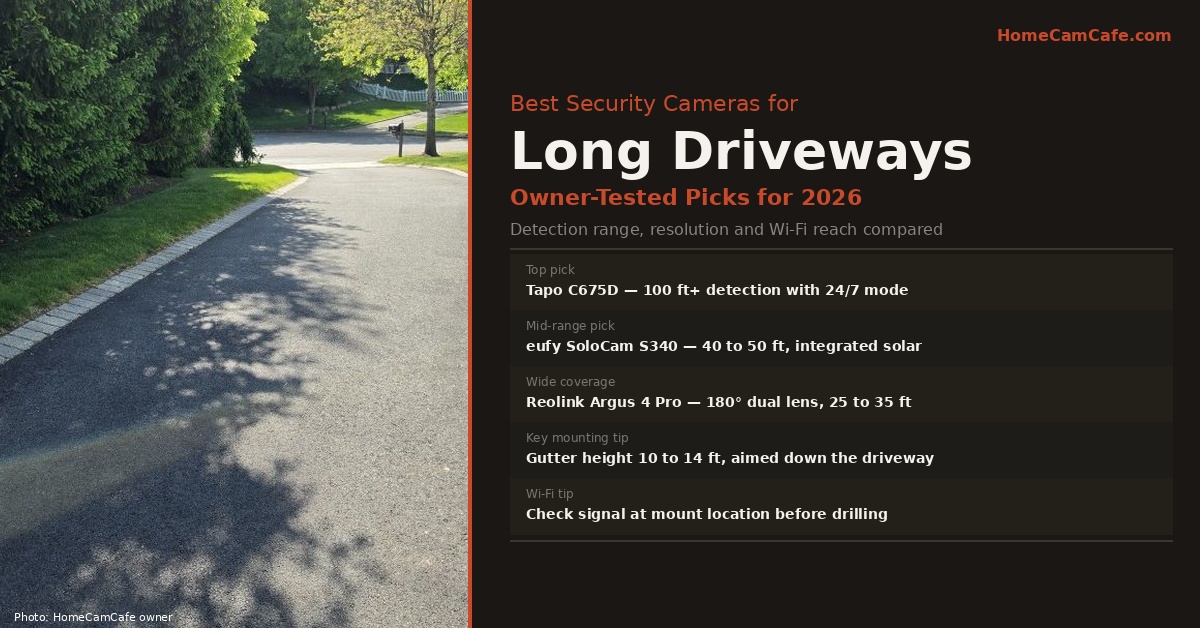
What Makes a Long Driveway Different
Standard camera placement guidance assumes the subject will be within 20 to 30 feet of the camera. A long driveway breaks every one of those assumptions.
Detection range is the first challenge. Most battery-powered cameras use PIR sensors rated for 20 to 30 feet of reliable detection. A person or vehicle at the far end of a 75-foot driveway may not trigger the camera until they are much closer, by which point they are already at the house.
Resolution at distance is the second challenge. A 1080p camera produces a usable image of a face or license plate at 20 feet. At 60 feet the same image may be too small to identify either. Adequate resolution and focal length both matter for coverage at driveway distances.
Wi-Fi range is the third challenge. Most cameras connect via 2.4GHz Wi-Fi with an effective outdoor range of 100 to 150 feet in open space. At the far end of a long driveway, particularly one with trees or structures between the camera and the router, signal strength may be inadequate for reliable streaming and recording.
Field of view is the fourth. A 130-degree wide-angle camera covers a broad scene from a fixed position but captures distant subjects as small specks. A narrower field of view or a telephoto zoom captures more useful detail at distance but covers a smaller area.
One Camera or Two?
For most long driveways, one well-chosen camera at the right mounting position is sufficient. A camera mounted at gutter height at the corner of the house, aimed down the full length of the driveway, with adequate detection range and resolution, covers the entire approach without a second camera.
However, for very long driveways above 100 feet, or driveways with bends or obstructions that block line of sight from the house, a second camera positioned at or near the driveway entrance is the more reliable solution. The entrance camera handles detection and identification at the far end, while a house camera covers the close approach. Both can be battery-powered solar cameras on the same Tapo or Reolink account.
Best Camera for Long Driveways: Tapo C675D
The Tapo C675D is the single best camera we have tested for long driveway coverage. The dual 4K lens system provides both a 169-degree fixed wide-angle view of the full driveway and a 360-degree pan/tilt telephoto lens that automatically tracks and zooms in on anything that moves within that wide view.
The standout feature for driveway use is the extended detection range. Unlike every other camera in this guide, the C675D combines three detection technologies: a PIR sensor, a radar sensor, and on-device AI. The radar component works independently of heat differential, which means it is not limited by the temperature constraints that reduce PIR effectiveness in warm weather. With 24/7 Continuous Capture mode enabled and a microSD card installed, all three systems work together continuously and we observed reliable detection of people at over 100 feet in owner testing — well beyond the 60-foot advertised range. This is the only battery camera we have tested that provides genuine long-range detection rather than short-range PIR that triggers too late for a long driveway.
The 4K telephoto lens captures license plates and faces at distances where most cameras produce an unusable blur. The auto-tracking follows a vehicle or person the full length of the driveway without any manual pan/tilt adjustment. The A202 solar panel is included in the box, eliminating battery maintenance for installations with adequate sun.
The one limitation is the mounting system, which requires separate brackets for the camera and solar panel. The installation takes longer than a single-bracket system but is not difficult. Check the current price on Amazon.
Setup note: To get the full extended detection range on the C675D, enable 24/7 Continuous Capture in the Tapo app and install a microSD card. Without this configuration, detection falls back to the standard PIR range of approximately 29 feet, which is inadequate for a long driveway.
Best Mid-Range Pick: eufy SoloCam S340
The eufy SoloCam S340 is the most consistent performer at its rated range among the cameras we have tested. The dual-lens design combines a wide-angle overview lens with a 3x optical zoom telephoto lens that auto-tracks subjects across the coverage area. Reliable detection extends to 40 to 50 feet, which covers most residential driveways from a gutter-height mounting position at the corner of the house.
The S340 is simpler to configure than the C675D — no special mode is required to achieve its rated detection range. Solar power is built into the camera housing with no separate panel to mount. For buyers who want strong driveway coverage without the C675D’s configuration requirements or dual-bracket installation, the S340 is the right choice. Check the current price on Amazon.
Best Wide-Coverage Pick: Reolink Argus 4 Pro
The Reolink Argus 4 Pro takes a different approach to driveway coverage. Rather than extending detection range with a telephoto zoom, it uses a dual-lens 180-degree wide-angle design that covers the full width of a driveway from a single mounting position without any pan or tilt. The trade-off is detection range — the Argus 4 Pro is rated for around 30 feet of reliable PIR detection — but the 4K dual-lens captures a wide, detailed view of everything within that zone.
For driveways up to 50 feet long, or for covering the final approach to the house where width matters more than depth, the Argus 4 Pro’s 180-degree coverage is genuinely useful. For driveways over 50 feet, the limited detection depth makes it a better choice for the close-approach position in a two-camera setup rather than a standalone solution. Check the current price on Amazon.
Mounting Position Makes as Much Difference as Camera Choice
The best camera in the wrong position underperforms a good camera in the right position. For long driveways specifically, mounting position is as important as any spec on the camera.
Gutter height at 10 to 14 feet, at the corner of the house where the driveway enters the property, is the starting point. This position provides elevation for wider detection coverage, an outward and downward angle that covers the full driveway approach rather than just the area directly below the camera, and enough height to keep the camera above easy reach.
Aim down the length of the driveway rather than across it. A camera aimed along the driveway axis captures subjects approaching for a longer time, providing more opportunities for the AI to classify the subject and more recorded footage of the approach. A camera aimed across the driveway captures a brief cross-frame movement that may not trigger detection at all.
For driveways with bends or significant trees, the direct line of sight from the house may not cover the full approach. In these cases, a second camera positioned at the driveway entrance — typically a battery solar camera that requires no wiring at the far end — handles the far portion while the house camera covers the final approach.
See the security camera mount guide for mounting hardware recommendations by camera brand.
Wi-Fi Range at the End of a Long Driveway
Wi-Fi signal strength at the mounting position is a practical constraint that is easy to overlook until after installation. A camera at the far end of a 100-foot driveway may be 80 to 120 feet from the nearest router or access point, possibly with walls, trees, and other obstructions in between.
The 2.4GHz band has better range than 5GHz outdoors but is more prone to interference. Most battery cameras support 2.4GHz only, which is the right choice for outdoor long-range installations. The Tapo C675D supports both 2.4GHz and 5GHz, giving it more flexibility in environments with strong 5GHz coverage outdoors.
Before installing any camera at the far end of a driveway, check the Wi-Fi signal strength at that location using a phone. If signal is weak or intermittent, a Wi-Fi range extender positioned between the house and the camera location resolves the issue before it becomes a problem after the camera is mounted.
Quick Comparison: Best Cameras for Long Driveways
| Camera | Detection Range | Best For | Solar Included |
|---|---|---|---|
| Tapo C675D | 100 ft+ (with 24/7 mode) | Long driveways over 50 ft | Yes — A202 |
| eufy SoloCam S340 | 40-50 ft reliable | Medium driveways, simpler setup | Yes — built in |
| Reolink Argus 4 Pro | 25-35 ft reliable | Close approach, wide coverage | Sold separately |
Bottom Line
For long driveways over 50 feet, the Tapo C675D is the only battery camera we have tested that provides genuine long-range detection. With 24/7 mode and a microSD card enabled, it detected movement at over 100 feet in owner testing. For driveways up to 50 feet, the eufy SoloCam S340 delivers reliable coverage with a simpler setup and integrated solar. For wide close-approach coverage, the Reolink Argus 4 Pro’s 180-degree dual lens covers everything within 30 to 35 feet. Mounting position matters as much as camera choice: gutter height at 10 to 14 feet, aimed down the driveway axis, will meaningfully improve detection distance on any camera in this guide.
See also: How Far Can Security Cameras Detect Motion? · Security Camera Mount Guide · Tapo C675D Review · eufy SoloCam S340 Review