
If you are shopping for a google nest solar panel, the first thing worth knowing is that Google does not build one itself. Instead, Nest Cam (Battery) and Nest Doorbell (Battery) owners get their solar option through Wasserstein, Google’s certified “Made for Google” accessory partner. As a result, buying the wrong panel is easier than it sounds, since older wired Nest models cannot use solar power at all and the connector is proprietary rather than USB-C. This guide covers which Nest devices support solar charging, which panel fits each model, how to confirm the panel is working once it is installed, and whether a cheaper third-party alternative is worth the tradeoff.
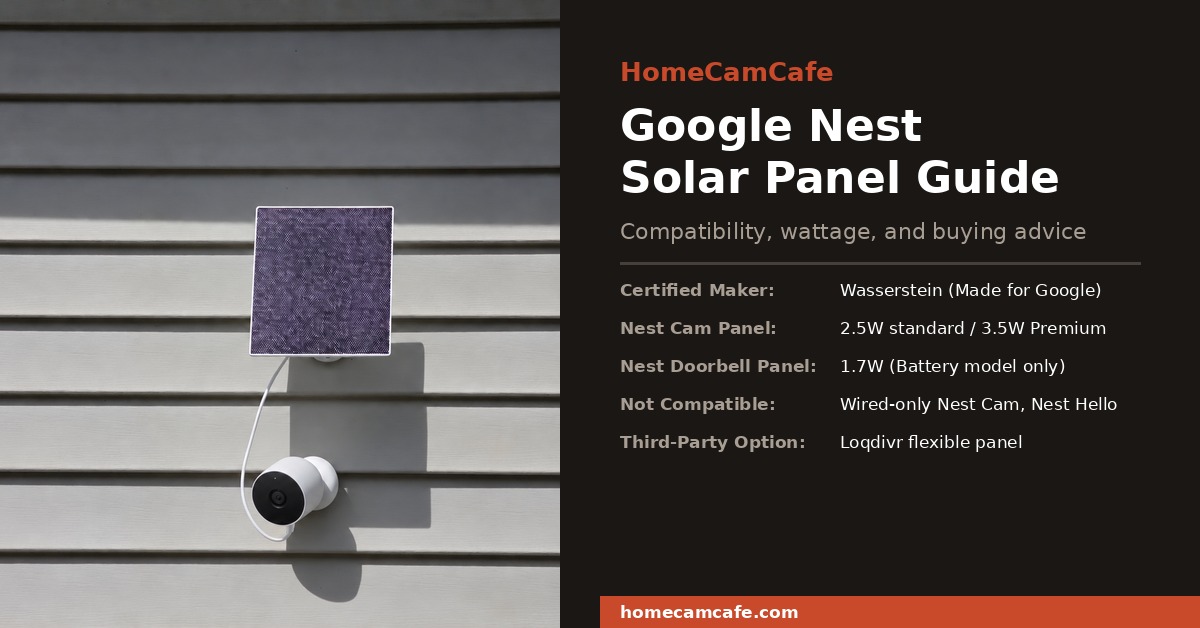
Does Google Make an Official Google Nest Solar Panel?
No. Google has never sold a solar panel under its own Nest branding. Instead, Wasserstein holds the “Made for Google” certification for Nest solar accessories, which means its panels are tested and approved to work safely with Nest hardware. In contrast, brands like Wyze and Tapo use a standard USB-C or Micro USB connector, so almost any panel with the right plug will work. Nest uses a proprietary connector on both the camera and the doorbell, which is why Wasserstein remains the only fully certified option for either device.
Which Nest Cameras and Doorbells Support Solar Charging?
Solar charging only works on battery-powered Nest devices. Wired models have no battery to top off, so a solar panel would have nothing to charge. Additionally, a couple of older Nest models predate the current battery connector entirely, which rules them out even though they look similar to current hardware.
| Model | Power Type | Solar Compatible |
|---|---|---|
| Nest Cam (Battery), outdoor or indoor | Rechargeable battery | Yes |
| Nest Cam Indoor (Wired, 3rd Gen) | Wired only | Not applicable |
| Nest Cam Outdoor or Nest Cam IQ Outdoor (older, wired) | Wired only | No |
| Nest Doorbell (Battery) | Rechargeable battery | Yes |
| Nest Doorbell (Wired, 2nd Gen) or Nest Hello | Wired only | No |
In short, if your camera or doorbell has “Battery” in its model name, solar charging is an option. If it does not, a solar panel will not help, and you should look at a standard power adapter instead.
| Panel | Wattage | Works With | Made for Google Certified |
|---|---|---|---|
| Wasserstein Solar Panel | 2.5W | Nest Cam (Battery) | Yes |
| Wasserstein Premium Solar Panel | 3.5W | Nest Cam (Battery) | Yes |
| Wasserstein Solar Panel for Doorbell | 1.7W | Nest Doorbell (Battery) | Yes |
| Loqdivr Solar Panel | Not independently rated | Nest Cam (Battery) | No |
Best Solar Panel for the Nest Cam (Battery)
For most installations, the Wasserstein 2.5W Solar Panel is the right starting point. It ships with a 13 foot cable, a 360 degree rotating mount, and the official Made for Google certification, so there is no guesswork about whether it will damage the camera or charge improperly. Furthermore, it works identically on both the outdoor and indoor versions of the Nest Cam (Battery), since they share the same physical hardware.
However, if your camera sits in a high-motion area or a climate with limited direct sun, the standard 2.5W panel may struggle to keep pace with battery drain. In that case, the Wasserstein Premium 3.5W Solar Panel delivers roughly 30 percent more charging power, which makes a meaningful difference for driveways, front yards, or any spot that triggers frequent recording. For placement ideas beyond the included wall bracket, our Google Nest Cam mount guide covers anti-theft and no-drill options that pair well with a solar setup.
Best Solar Panel for the Nest Doorbell (Battery)
The Nest Doorbell (Battery) uses a smaller, lower-capacity battery than the Nest Cam, so its dedicated solar panel is rated at just 1.7W. The Wasserstein Solar Panel for Nest Doorbell (Battery) connects through the same screw terminals used for the doorbell’s optional wired charging, rather than a DC barrel plug. Additionally, there is no polarity on those terminals, so it does not matter which wire lands on which screw. Installation is otherwise simple: mount the panel with the included bracket, angle it toward the sun, and connect the two leads to the doorbell’s terminal block.
Is a Third-Party Nest Solar Panel Worth It?
Budget alternatives do exist. For example, the Loqdivr Solar Panel for Google Nest Camera is a flexible, IP65-rated panel built specifically for the Nest Cam (Battery) connector, and it typically costs less than the certified Wasserstein option. In addition, it includes the same style of long charging cable and adjustable mount.
That said, it lacks Google’s Made for Google certification, which means there is no independent verification of voltage output or long-term connector durability. Most owners report that it charges normally, but because Nest uses a proprietary connector rather than an open standard like USB-C, a poorly made third-party plug carries more risk of a loose fit or inconsistent charging than it would on a Wyze or Tapo camera. Therefore, the Wasserstein panel is the safer default, and the Loqdivr option is best treated as a budget backup rather than the first choice.
How to Install and Confirm the Panel Is Charging
Installation is straightforward on both the Nest Cam and the Nest Doorbell, but confirming that the panel is doing its job takes an extra step, since the Google Home app does not show a live wattage reading. Follow these steps to get a clean install and verify it is working correctly.
First, fully charge the camera or doorbell battery indoors before connecting the solar panel. Wasserstein and Google both recommend this, since connecting a solar panel to a battery that is already low can slow the initial charge considerably. Second, mount the panel within reach of the included cable, typically 13 feet for the Nest Cam panels and a shorter run for the doorbell version, and angle it using the 360 degree rotating bracket toward the direction that gets the most direct sun during peak hours. In most climates, a south-facing angle works best, though east-facing placement can be a reasonable compromise if morning sun is more reliable than afternoon sun at your location.
Third, connect the cable to the camera or doorbell and check the Google Home app. For the Nest Cam, a successful connection shows a “Solar” label in the battery section of the device settings rather than “Plugged In.” If the app shows “Plugged In” instead, unplug the connector and reseat it, since a partial connection can register incorrectly. For the Nest Doorbell, there is no separate solar indicator in the app, so the most reliable check is simply watching whether the battery percentage holds steady or climbs during a sunny stretch rather than dropping the way it normally would.
Finally, give the system a few full days of typical weather before judging performance, since a single cloudy day is not enough to tell whether the panel is undersized for your situation.
Does a Solar Panel Eliminate the Need to Charge the Battery?
In most cases, yes, though a few quirks are worth knowing ahead of time. First, Google restricts 24/7 recording while a Nest Cam or Nest Doorbell runs on battery power, even with a solar panel attached, so you will still see the same event-based recording behavior rather than continuous video. Second, the Google Home app shows a “Plugged In” status rather than a battery percentage while the solar panel is actively charging, which can make it hard to check the actual charge level during the day.
Most owners simply check again after sunset to see the real battery percentage. Finally, in freezing temperatures below 32°F, the battery stops accepting a charge, whether from a solar panel or a wall outlet, and the camera or doorbell simply runs down on whatever charge is already stored until it warms back above freezing. Notably, this affects even wired Nest Cam installs if a solar panel is attached, since the panel only trickle-charges the battery rather than powering the camera directly the way a wired connection does on its own.
Common Nest Solar Panel Questions
Can I use one solar panel for both a Nest Cam and a Nest Doorbell?
No. The connectors and cable lengths differ between the two devices, and the Nest Doorbell panel attaches to screw terminals rather than a DC plug. In addition, the wattage is tuned to each device’s battery size, so a panel built for the Nest Cam would overpower or underpower the doorbell depending on which direction you tried to swap it.
Will a solar panel work on an indoor Nest Cam (Battery)?
Yes, as long as the camera can be positioned near a window or another spot that receives direct sunlight for at least part of the day. Indoor placement behind glass does reduce charging efficiency somewhat compared to an outdoor mount, so an indoor installation may lean more heavily on the 3.5W Premium panel than a shaded outdoor spot would.
Does the solar panel void the Nest Cam’s warranty?
No, provided you use a certified Made for Google panel like Wasserstein’s. Using an uncertified third-party panel is less likely to void the warranty on the camera itself, since the panel is a separate accessory, but any camera damage traced to a faulty non-certified connector could complicate a warranty claim. Therefore, sticking with the certified option removes that uncertainty entirely.
Bottom Line
A google nest solar panel is only available through Wasserstein, Google’s certified accessory partner, and only works with battery-powered Nest Cam and Nest Doorbell models. For most Nest Cam (Battery) installs, the standard 2.5W Wasserstein panel is enough. However, high-motion or low-sun locations do better with the 3.5W Premium version. Nest Doorbell owners should stick with the dedicated 1.7W panel built for the doorbell’s terminal connection. A third-party panel like the Loqdivr can save money, but the lack of official certification means the Wasserstein panel remains the more reliable long-term choice.
For the full individual reviews see the Nest Doorbell (Battery) review and the Best Outdoor Security Cameras roundup. For brand-specific guides see the Google Nest hub page.