
A security camera only works if it stays where you put it. Battery-powered wireless cameras are particularly vulnerable — they are easy to install, which also means they are easy to remove. A thief who spots an outdoor camera has two options: avoid the area entirely, or grab the camera on the way out. The strategies below make the second option significantly harder, without requiring expensive hardware or complicated installation.
Mount It High
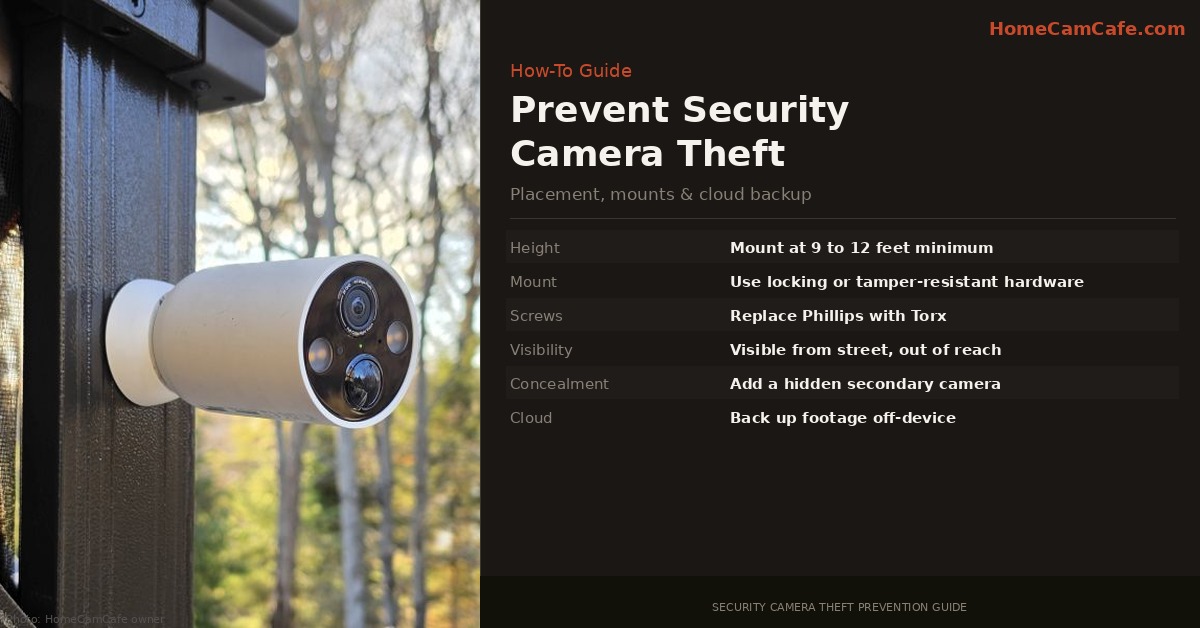
Height is the single most effective theft deterrent for an outdoor camera. A camera mounted at 9 or 10 feet requires a ladder to reach — and a thief carrying a ladder to steal a camera is an unusual and conspicuous combination. Most opportunistic theft is exactly that: opportunistic. If the camera cannot be grabbed by hand, most people will not bother.
The practical limit is your own ability to access the camera for maintenance — battery-powered cameras need periodic recharging, and a camera mounted at 15 feet becomes a hassle to service. Aim for 9 to 12 feet as the sweet spot: high enough to deter casual theft, low enough to reach with a standard step ladder. A gutter or soffit mount at roofline height is ideal for most homes. For mount options across major camera brands, see our security camera mount guide.
Use a Locking Mount
Most wireless cameras ship with a magnetic or twist-lock dome mount that can be defeated in seconds. Replacing the default mount with a locking alternative adds meaningful friction. Locking mounts typically use a standard 1/4″-20 thread — the same thread found on most security cameras — and require a tool to remove rather than a simple pull or twist.
Some manufacturers sell anti-theft accessories specifically for their cameras. The Wasserstein anti-theft security chain for Nest is one example — a chain and band system that connects the camera to the mount and requires a tool to defeat. Similar solutions exist for Ring, Wyze, and eufy cameras.
Security screw tip: Replace the standard Phillips head screws on any wall mount with Torx or other tamper-resistant screws. A thief without the right bit cannot remove the mount even with a screwdriver in hand. Tamper-resistant screw sets are inexpensive and available at any hardware store.
Hide the Camera
A camera that cannot be seen cannot be targeted. Concealing a camera — behind a porch post, inside a birdhouse, within a dense plant, or flush-mounted in a soffit — eliminates the theft risk entirely while maintaining full surveillance coverage. This is particularly effective for indoor cameras monitoring entry points from inside a window.
The tradeoff is that a hidden camera loses its deterrent value — a visible camera discourages people from approaching an area in the first place. The best setups use both: a visible camera in a prominent position to deter, and a concealed camera in a secondary position that continues recording if the visible one is taken. For brand-specific hiding guides see our articles on hiding an Arlo camera and hiding a Wyze Cam.
You can also use an appliance such as Wasserstein Alarm Clock Enclosure which is designing for hiding a Wyze Cam. The camera is seated inside the digital alarm clock. A clever idea from a company that typically sells a variety of mounts for cameras.
Use Cloud Storage
If a camera is stolen, locally stored footage goes with it. A microSD card inside the camera or a hub stored in the same location is vulnerable to the same theft. Cloud storage survives because the footage is already offsite before the camera is taken. In many cases, the cloud-stored footage captures the theft itself — a clear image of the person who took the camera.
This is particularly relevant for outdoor cameras in exposed locations. Even a basic cloud plan on one or two key cameras provides meaningful evidence protection. For cameras that offer free local storage as a baseline — such as Tapo, Wyze, and eufy models — adding even a minimal cloud tier on the most exposed camera is worth the cost. For full breakdowns of cloud plan options by brand see our Blink subscription guide, Arlo Secure breakdown, and Ring Protect guide.
Make the Camera Visible — But Hard to Reach
Visibility and accessibility are separate things. A camera mounted at roofline height, clearly visible from the street, deters people from approaching the property but cannot be grabbed without a ladder and a significant amount of visible effort. This is the ideal combination for a primary outdoor camera: prominent enough to act as a deterrent, positioned high enough to be inaccessible without equipment.
Signage helps too. A visible “Video Surveillance” sign near the camera reinforces the deterrent effect and may discourage attempts before they start. Furthermore, most camera manufacturers sell branded deterrent signs as Arlo, Ring, and Blink all offer them. An inexpensive addition that costs nothing in installation effort.
If a Camera Gets Stolen
If a camera is taken despite precautions, a few steps are worth taking immediately. First, pull any cloud-stored footage from the period leading up to and including the theft — most cloud plans store clips for 14 to 30 days, so act before the window closes. Second, file a police report with the footage attached if it captured the theft. Third, note the camera’s serial number if you have it — some manufacturers can flag stolen devices and prevent them from being registered to a new account.
Additionally, review the placement of remaining cameras after a theft. If one camera was targeted, others in similar positions may be next. Consider relocating exposed cameras to higher or more concealed positions following an incident.
Bottom Line
No mount or placement strategy is completely theft-proof — a determined person with tools and time can take any camera. The goal is to make theft difficult, conspicuous, and time-consuming enough to deter opportunistic attempts. Mount high, use locking hardware, replace Phillips screws with tamper-resistant alternatives, and back up footage to the cloud on any camera in an exposed outdoor location. The combination of height, friction, and cloud backup covers most realistic theft scenarios.
Frequently Asked Questions
How high should a security camera be mounted to prevent theft?
9 to 12 feet is the practical sweet spot. High enough that the camera cannot be grabbed by hand or knocked down easily, but low enough to access with a standard step ladder for battery changes and maintenance. Roofline or soffit mounting at 10 to 12 feet is ideal for outdoor cameras.
Can a thief disable a wireless security camera?
Yes, by physically removing it, by blocking its field of view, or in some cases by jamming the Wi-Fi signal. Physical removal is by far the most common method. Wi-Fi jamming requires specialized equipment and is rare in residential theft. The most practical defense against all three is cloud storage — footage already uploaded before the camera is disabled or taken cannot be recovered by a thief.
Do visible cameras deter theft or just get stolen?
Both, depending on placement. A visible camera at eye level on a fence post is easy to grab and may attract attention from someone who wants to avoid being recorded. A visible camera mounted at roofline height deters without being reachable. The visibility provides deterrence value; the height provides physical security. Used together they complement each other effectively.
What happens to footage if a camera is stolen?
If footage is stored only on a microSD card inside the camera, it is gone with the camera. If footage is stored on a local hub in the same location, it may also be taken. Cloud-stored footage is safe regardless — it was uploaded before the camera was taken and remains accessible through the app. This is the strongest practical argument for cloud backup on outdoor cameras in exposed locations.
This guide is part of our Security Camera Accessories guides.