
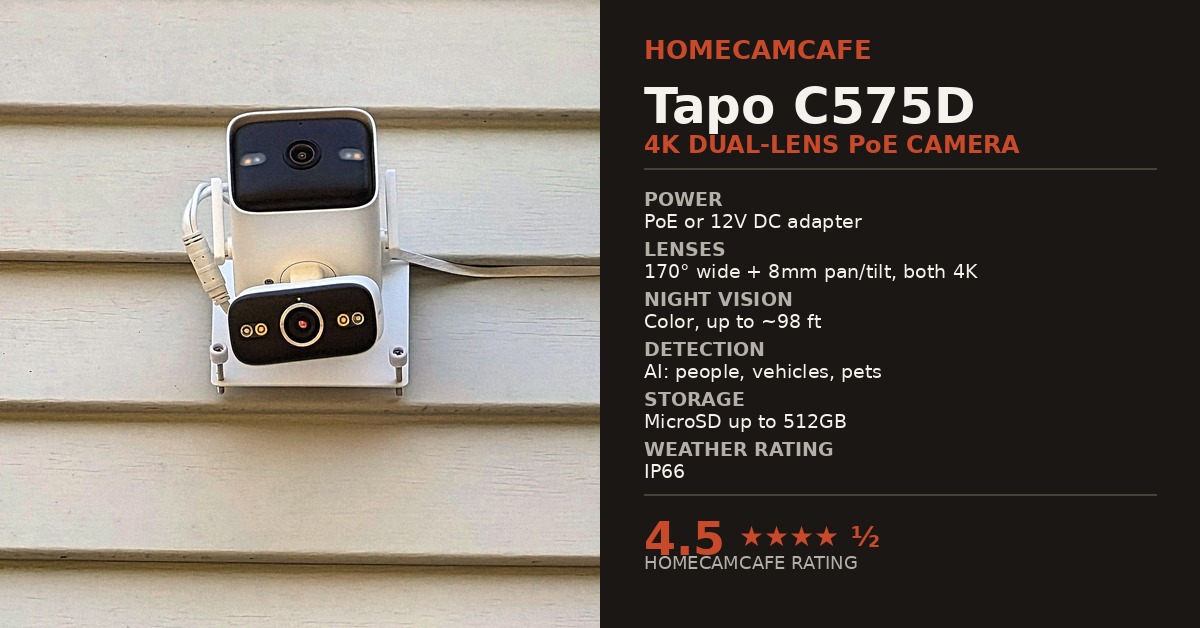
The Tapo C575D takes the dual 4K lens system we praised in the Tapo C675D review and moves it to a wired platform. Instead of a battery and solar panel, the C575D runs on Power over Ethernet or a standard DC adapter, and after installing it above the garage and running it exclusively on PoE, the short version of this review is simple: everything that made this dual-lens security camera excellent in its solar form carries over here, and the wired connection actually improves on it in a few meaningful ways.
Check the current price on Amazon
Specs at a Glance
| Spec | Detail |
|---|---|
| Lens 1 (fixed) | 4K 8MP · 170° wide-angle field of view |
| Lens 2 (pan/tilt) | 4K 8MP · 8mm telephoto · 360° pan / 120° tilt coverage |
| Digital zoom | 18x on both lenses |
| Night vision | Color and infrared, up to roughly 98 ft |
| AI detection | People, vehicles, pets, line-crossing · free, no subscription |
| Power | PoE (802.3af/at) or included 12V DC adapter |
| Local storage | MicroSD up to 512GB (sold separately) |
| Weather rating | IP66 |
| Wi-Fi (DC power mode) | 2.4GHz and 5GHz |
| Smart home | Alexa, Google Assistant, Samsung SmartThings |
| App | Tapo (iOS / Android) |
Design and Build
Physically, the C575D shares the same dual-lens layout as the C675D: a fixed wide-angle lens on top and a pan/tilt telephoto lens below, both housed in a single IP66-rated shell. However, there is no solar panel or separate mounting bracket to deal with here, since this is a wired camera through and through. As a result, installation is a single bracket, a single set of drill holes, and one cable run, which is a real improvement over the two-bracket setup the C675D requires.
The PoE side of the camera is thoughtfully done. The Ethernet port sits behind a weatherproof cap, and the included cable seal keeps water out of the connection point once everything is buttoned up. In addition, TP-Link includes a DC power jack as a fallback, so the same camera works over Wi-Fi and standard power if you ever move it to a spot without Ethernet access.
That dual power path is worth calling out on its own, since it effectively makes the C575D two cameras in one. Run it over PoE, as we did, and you get the snappier response and rock-solid connection described below.
However, if a given mounting location does not have Ethernet access yet, or you are not ready to run a cable, the same camera drops onto Wi-Fi and the included 12V DC adapter with no compromise to the video or detection features. This matters most for anyone who is still deciding whether to wire a property for PoE. There is no need to wait: the C575D can go up on Wi-Fi today and switch to PoE later if a cable run gets added down the line, without buying a different camera.
Overall build quality feels consistent with what we have come to expect from the higher-end Tapo lineup. The housing is solid, the lens covers show no distortion at the seams, and the mounting bracket allows for a reasonable range of tilt adjustment once it is screwed into place. Furthermore, the weatherproof cable attachments included in the box make it straightforward to route the Ethernet cable in whatever direction makes the most sense for a given mounting location, whether that is straight down from a soffit or along the surface of a wall toward a nearby junction point.
PoE Power: Snappier Than the Wi-Fi C675D
Powering the C575D over PoE instead of Wi-Fi produces a noticeably snappier camera. App load times are quicker, live view starts with less delay, and pan/tilt commands respond a beat faster than they do on the C675D. This lines up with what you would expect: a wired connection removes Wi-Fi as a variable entirely, and the camera no longer has to negotiate a wireless handshake before every action.
For the PoE injector itself, a TP-Link injector was used for this install, and we go into great detail about this in our TP-Link PoE Injector review. Setup was just as smooth as it was with a Ubiquiti injector on a previous PoE camera, and in both cases the process amounted to plugging in two cables and confirming a link light.
For a single-camera installation using standard 802.3af or 802.3at PoE, we found no meaningful performance difference between the less expensive injector and the more premium one. Most of the extra cost with pricier injectors appears to go toward build quality, warranty length, and ecosystem integration rather than faster or more reliable camera performance. As a result, the less expensive injector options are a perfectly reasonable place to start for a single-camera install like this one, and that has held true across more than one PoE camera installed on this property.
Once the injector was in place, pairing the camera with the Tapo app took only a couple of minutes. The app detected the wired connection automatically and skipped the Wi-Fi credential step entirely, which is a small but welcome shortcut compared to setting up a battery camera from scratch. Additionally, because the camera draws continuous power over the Ethernet cable, there is no battery percentage to monitor and no seasonal concern about winter sunlight being enough to keep a solar panel topped off.
Video Quality and the Dual-Lens System
Video quality mirrors the C675D closely, since both cameras share the same dual 4K sensor pairing. As a 4K PoE camera, the C575D benefits from the stable bandwidth of a wired connection when streaming that resolution, with none of the occasional compression artifacts a Wi-Fi camera can introduce on a congested network. The fixed wide-angle lens covers the full scene at 170°, while the 8mm telephoto pan/tilt lens handles close-up detail and automatically tracks whatever the wide lens flags as motion. Both lenses display simultaneously in the Tapo app, so you get the full-scene context shot and the zoomed-in tracking shot at the same time, from a single camera.
Color night vision holds up to roughly the same range as the C675D as well, and the 18x digital zoom on both lenses is available for reviewing footage after the fact. If you have already read our C675D coverage, none of this will come as a surprise. Furthermore, that consistency is exactly the point: TP-Link built one dual-lens imaging system and offered it across both a battery-solar model and a wired PoE model, rather than compromising the wired version to fit a smaller power budget.
In fact, the continuous power supply arguably helps the video pipeline a little. Since the camera is not managing battery consumption in the background, there is no need to throttle frame rate or downshift resolution to preserve charge. Instead, the C575D can run 24/7 continuous capture without a second thought about how many days that leaves before the battery needs a recharge, which is a real consideration on the solar-dependent C675D during long stretches of overcast weather.
Motion Detection at Range
Mounted above the garage, the C575D is picking up motion at roughly 100 feet, matching the real-world range we saw from the C675D. However, it gets there differently. On the C675D, that extended range comes from 24/7 Continuous Capture, a low-power snapshot mode built specifically for battery cameras, and TP-Link requires local microSD or Tapo Hub storage for that feature to work. TapoCare cloud storage does not support it at all.
The C575D does not even have that 24/7 Continuous Capture menu option. Since it runs on constant power instead of a battery, there is no need for a workaround designed to stretch a limited power budget, and confirming this in the app shows no 24/7 Continuous Capture option present on this camera. The C575D here is running on TapoCare cloud storage, not a microSD card, with no special detection settings changed from default. Despite that, it is still hitting the same 100-foot range the C675D needed a specific configuration to reach. That suggests a continuously powered camera can process detection well without the battery-saving trick a solar camera relies on, though confirming the exact reason would take further testing.
In practice, that range is more than enough to flag a vehicle turning into the driveway or a person walking up from the street well before they reach the door, which is exactly the kind of early warning a garage-mounted camera should provide. Since the mounting position sits above the garage and looks down the length of the driveway, the wide-angle lens catches the full approach while the telephoto lens locks onto whatever triggered the alert, mirroring the same spotter-and-tracker behavior we described in the C675D review.
A fox crossing the driveway one night gave a clear example of both lenses working together in real conditions, with the wide-angle view and the pan/tilt tracking lens recording the same motion event side by side.
Who the C575D Is For
The C575D makes the most sense for anyone who already has, or is willing to run, an Ethernet cable to the mounting location. A garage, a soffit near an existing network run, or a new-construction home wired with Cat6 during the build are all good candidates. In contrast, a detached shed or a far corner of a property with no nearby cabling is still better served by a battery or solar camera like the C675D, simply because running a new Ethernet drop that far is a bigger project than most homeowners want to take on for a single camera.
For anyone already leaning toward a wired setup, however, the C575D is an easy recommendation as a PoE outdoor camera. It combines the same excellent dual-lens video and detection performance as its solar sibling with the reliability and simplicity that a wired security camera provides, and it does so without asking for a second mounting bracket on the wall.
How the C575D Compares to the C675D
| Category | Tapo C575D | Tapo C675D |
|---|---|---|
| Power | PoE or DC adapter | Battery with included solar panel |
| Mounting | Single bracket | Separate camera and solar panel brackets |
| Responsiveness | Faster over PoE | Solid, but Wi-Fi introduces a small lag |
| Best for | Locations with Ethernet access | Locations without power or data runs |
| Video and detection | Same dual 4K lens system | Same dual 4K lens system |
App and Smart Home
The app experience is identical to the C675D, which is a good thing. Both feeds display at once, switching between them is instant, and AI detection filters can be set independently per lens. Activity zones work on both lenses, and the camera integrates with Alexa, Google Assistant, and Samsung SmartThings for anyone building out a broader smart home setup.
Storage and Subscription
This unit is running on TapoCare cloud storage rather than a local microSD card, which made setup simple: no card to buy or format, and footage is available from the app immediately. Local microSD storage remains an option for anyone who prefers to avoid a subscription, with support for cards up to 512GB, and the C575D supports both storage types independently of which power method you choose.
Bottom Line: 4.5 / 5.0The Tapo C575D delivers everything that made the C675D one of the best dual-lens cameras we have tested, and then improves on it by removing the split solar bracket entirely. Response over PoE is noticeably snappier than Wi-Fi, the weatherproofing around the Ethernet connection is well executed, and the extended motion detection continues to outperform its advertised range once properly configured. The tradeoff is simply that you need Ethernet access at the mounting location. For anyone who already has that, or is willing to run a cable, the C575D is the easier camera to live with day to day.
For the full C675D details see the Tapo C675D review, and for more on PoE hardware see the PoE vs WiFi Guide. For brand-specific guides see the Tapo camera reviews hub. For the full PoE cluster see the PoE security cameras hub.