
The Tapo C660 (sold as the TP-Link Tapo C660 KIT) is a solar-powered outdoor pan-and-tilt security camera that covers a lot of ground both literally and figuratively. It combines native 4K 8MP video, 360° horizontal AI motion tracking, a 10,000mAh battery kept topped off by an included 4W solar panel, and free on-device person, vehicle, and pet detection out of the box. No monthly subscription is required, no proprietary hub is needed, and an onboard microSD card slot (up to 512GB) handles local recording without any recurring cost.
Having installed and tested the Tapo C660 KIT alongside competing solar pan-and-tilt models like the eufy SoloCam S340 and TP-Link’s dual-lens Tapo C675D KIT, the Tapo C660 stands out as the best single-lens 4K solar camera I have used. It pairs sharp 4K clarity and dual-band 5 GHz Wi-Fi with a unified single-bracket solar mount that makes exterior installation much cleaner than two-bracket competitors.
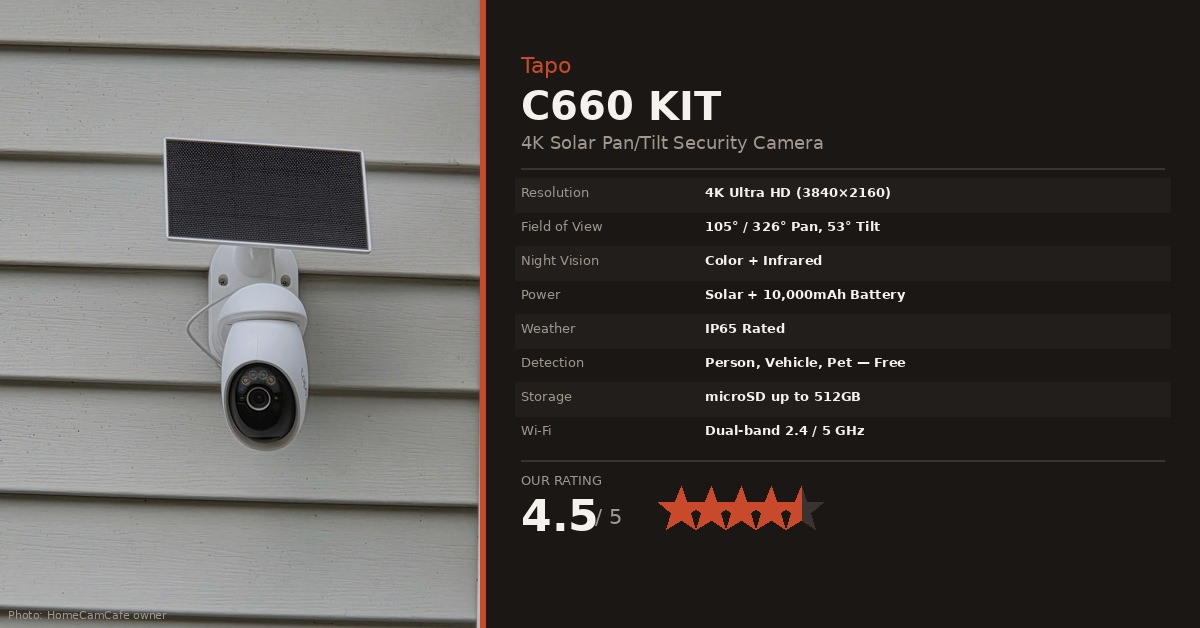
Tapo C660 KIT Review: The Short Version
HomeCamCafe Rating: 4.5 / 5.0
Bottom line: The Tapo C660 KIT is the best single-lens 4K solar pan/tilt camera for homeowners who want subscription-free local storage, accurate AI subject tracking, and maintenance-free solar charging. Its 4K Starlight sensor, 10,000mAh battery, 4W detachable solar panel (which mounts cleanly on the same unified bracket as the camera or remotely via a 4-meter cable), dual-band 2.4/5 GHz Wi-Fi, and 24/7 Continuous Capture mode beat the eufy SoloCam S340 on resolution, battery reserve, and onboard storage capacity. My only real caveats are the 15fps frame rate at 4K and a downward-oriented tilt range that favors mounting at 8 to 10 feet rather than high second-story peaks.
Tapo C660 Specifications
| Spec | Detail |
|---|---|
| Video Resolution | 4K 8MP (3840 × 2160) at 15fps |
| Lens & Sensor | Starlight sensor · F1.6 aperture · 105° diagonal FOV · up to 18x digital zoom |
| Pan / Tilt Coverage | 360° horizontal visual coverage (326° mechanical pan) / 90° vertical coverage (45° mechanical tilt) |
| Night Vision | Starlight color night vision (built-in spotlights) + 850nm IR up to 40 ft (12m) |
| Free AI Detection | Person, vehicle, and pet detection + AI auto-tracking (no subscription required) |
| 24/7 Continuous Capture | Supported (low-power interval snapshots every 1 to 60 seconds, switching to full clip on motion) |
| Battery Capacity | 10,000mAh rechargeable lithium-ion battery |
| Included Solar Panel | Tapo A201 solar panel (4W) · ~45 min direct daily sunlight rated · 4m (13 ft) extension cable |
| Local Storage | Onboard microSD slot up to 512GB (~379 hours of 4K footage, card sold separately) |
| Wi-Fi Connectivity | Dual-band 2.4 GHz and 5 GHz Wi-Fi |
| Audio & Deterrence | Two-way audio + customizable sound and spotlight alarm |
| Weather Rating | IP65 weatherproof (-4°F to 113°F / -20°C to 45°C operating range) |
| Smart Home Integration | Amazon Alexa, Google Assistant, and Samsung SmartThings |
4K Starlight Video Quality and Color Night Vision
The 4K 8MP (3840 × 2160) resolution at 15 frames per second is the standout feature on the Tapo C660, and it makes a clear difference in this use case. A pan/tilt camera that tracks subjects across a large outdoor area benefits heavily from 4K because the person or car is rarely filling the entire frame. At 4K, faces and license plates remain identifiable when you pinch to zoom even when the subject is at a significant distance within the field of view. This is where 1080p and 2K outdoor cameras often fall short for identification purposes.
Color night vision is supported via the F1.6 aperture lens, Starlight sensor, and built-in spotlights, and it performs very well when the spotlight activates on motion. Without the spotlight, the camera falls back to 850nm infrared night vision, which produces clean black-and-white footage out to roughly 40 feet. In my testing, the spotlight-driven color night vision is considerably more useful for identifying clothing colors and vehicle details after dark, making it well worth keeping enabled in most outdoor placements.
The one technical limitation to keep in mind is the 15fps recording rate at 4K. While 15fps is standard across almost all battery-powered 4K solar cameras (including the Tapo C675D KIT) to conserve battery life and wireless bandwidth, fast-moving vehicles passing perpendicular to the street will show slightly more motion blur when paused frame-by-frame than a wired 25fps or 30fps PoE camera. For residential driveways, yards, and walkways, the extra pixel detail of 4K easily outweighs the 15fps frame rate.
AI Motion Tracking, True 360° Coverage, and 24/7 Continuous Capture
Motion tracking is where the Tapo C660 separates itself from fixed battery cameras. The AI motion tracking is fast, accurate, and smooth. When a person or vehicle enters the frame, the camera identifies the subject and follows it continuously as it moves, panning and tilting to keep it centered in the shot. In my experience, the tracking handles people walking across a driveway, vehicles turning into a yard, and even pets moving at close range without losing the subject or jerking the camera erratically. The onboard AI distinguishes people from vehicles from pets with high accuracy at zero monthly cost, minimizing false alerts from swaying branches or shadows.
Is It Really 360 Degrees? (326° Mechanical Pan vs. Visual Coverage)
TP-Link advertises 360° horizontal coverage on the Tapo C660 KIT, while the hardware spec sheet lists a 326° mechanical pan range (and 45° mechanical tilt for 90° vertical coverage). Both numbers are accurate once you understand how the lens and gimbal work together. The motorized neck rotates 326° left-to-right before hitting a physical stop that protects the internal wiring. Because the lens itself has a wide 105° diagonal field of view, those extra degrees of lens width bridge the remaining 34° gap, giving you a full 360° circle of visual coverage if you mount the camera underneath a soffit overhang or on a pole.
Of course, if you mount the C660 flat against an exterior wall (vinyl siding, stucco, or brick), the house wall itself blocks the 180° behind the camera. Even on a flat wall, however, that 326° mechanical pan range is a major advantage because it lets the camera turn a full 180° side-to-side to look straight down your siding line in both directions and track someone walking all the way up to the wall without running out of rotation.
How 24/7 Continuous Capture Catches What PIR Sensors Miss
The 24/7 Continuous Capture mode is another standout addition on the C660. When enabled with an installed microSD card, the camera takes low-power images at regular intervals (every 1 to 60 seconds) around the clock and uses onboard AI to analyze them for motion that standard event-based PIR sensors would miss, automatically switching to full-frame 4K video recording when activity is detected.
This catches gradual movement, distant activity, or subjects that enter the frame slowly without triggering a standard heat-based motion sensor. It is one of the most useful battery camera features available and works without requiring a wired power connection. For more on how PIR and AI detection distances work across brands, see our security camera motion detection range guide.
Solar Power and 10,000mAh Battery Performance
The included Tapo A201 solar panel (4W) keeps the C660’s 10,000mAh battery continuously charged. Tapo rates 45 minutes of direct daily sunlight as sufficient to power the camera through a full day’s operation. In my outdoor testing, mounting the unit on a south-facing or west-facing wall with regular sun exposure keeps the battery pinned at or near 100% without manual intervention, even with daily motion tracking, spotlight triggers, and live-view check-ins.
The 10,000mAh battery also provides a deep buffer during cloudy stretches or winter months with reduced sunlight, giving you nearly double the solar wattage and almost 50% more battery capacity than the eufy SoloCam S340 (which uses a 2.2W panel and 6,700mAh battery). In prolonged low-light conditions, the C660 continues operating without needing to be pulled down for a recharge, and it can also be topped off via USB-C if ever mounted in full shade.
Hardware, Unified Single-Bracket Installation, and Placement Height
The Tapo C660 mounts to any flat exterior wall surface—vinyl siding, stucco, brick, or wood—using the included bracket and screw hardware. What I really like about the C660 KIT’s hardware design is that the solar panel attaches directly above the camera on the exact same bracket for a tidy, single-mount installation. By contrast, when I installed the dual-lens Tapo C675D KIT, I had to drill two separate brackets for the camera and the solar panel. If your camera spot is shaded by an eave, the C660’s solar panel can also be separated from the bracket on the included 4-meter (13-foot) extension cable to optimize its sun angle independently of the camera position.
Installation takes about 20 minutes from unboxing to aiming. The IP65 weatherproof rating covers rain, dust, and outdoor temperatures, while the built-in microphone, speaker, and loud siren alarm handle two-way audio and active deterrence. For specialized siding clips, corner mounts, or pole straps, check our best mounts for Tapo cameras guide and our Tapo solar panel guide.
Practical placement note (8 to 10 feet is the sweet spot): The C660’s motorized tilt is designed to pan downward from horizontal rather than looking upward. Installing it too high on a second-story wall limits how far down it can look directly beneath the mount, while mounting it too low can cut off the horizon if your siding angles downward. Eight to ten feet above the ground is the practical sweet spot for most residential placements.
Tapo App Experience, Dual-Band 5 GHz Wi-Fi, and Smart Home Support
Setup through the Tapo app is quick and painless: pair the camera via the QR code, connect to Wi-Fi, and you are done. Having tested dozens of security apps, the Tapo app remains one of the cleaner experiences in the home security camera space. The interface is well-organized, the detection settings are accessible without digging through nested menus, and the live view loads quickly. Configuring detection zones, setting up preset patrol positions, and adjusting the motion tracking behavior all take a few minutes and work reliably.
The Tapo C660 supports both 2.4 GHz and 5 GHz dual-band Wi-Fi, which is a notable advantage over competitors that are 2.4 GHz only. When connected to my 5 GHz network, the C660 is noticeably more responsive for 4K live view loading and manual pan/tilt control. It is great to see manufacturers finally support the 5 GHz band on solar battery cameras. Amazon Alexa and Google Assistant integration are supported for voice control and smart display viewing, and the Tapo app also integrates with Samsung SmartThings for broader smart home automation.
Local MicroSD Storage vs. Optional Tapo Care Cloud Plans
No subscription is required for full camera functionality on the Tapo C660 KIT, making it a top contender in our best security cameras without a subscription guide. An onboard microSD card (up to 512GB, sold separately) handles local storage with no ongoing cost; motion events and 24/7 Continuous Capture footage save directly to the card and are accessible remotely via the Tapo app timeline. A 512GB card stores approximately 379 hours of 4K footage, providing ample retention for most households. Because 24/7 Continuous Capture writes snapshots to the card constantly, use a high-endurance card rated for security cameras; see our guide on selecting the right microSD card for a home security camera.
For most users, the microSD card setup is completely sufficient. If you want off-site backup in case an outdoor camera is stolen or damaged, optional Tapo Care cloud subscriptions are available in three US tiers: Tapo Cloud ($3.49/mo for 30-day history up to 2K), Tapo Cloud Advanced ($11.99/mo for unlimited cameras and up to 180-day history at full 4K resolution), and Tapo Cloud Advanced AI ($19.99/mo, which adds the Aireal AI search and summary suite). You can also pair the camera with an indoor Tapo H200 or H500 hub to keep local recordings inside your home; see our Tapo Care vs. Tapo Hub vs. microSD comparison.
Tapo C660 Pros and Cons
Pros
- Sharp 4K 8MP resolution with an F1.6 Starlight sensor and spotlight color night vision for identifying faces and license plates
- Fast, smooth AI motion tracking across a 326° mechanical pan range (360° visual coverage) with free person, vehicle, and pet alerts
- 24/7 Continuous Capture mode takes interval snapshots all day and catches gradual activity missed by standard PIR sensors
- Included 4W Tapo A201 solar panel and 10,000mAh battery mount cleanly on a single unified bracket (or separately via the 4m cable)
- Supports responsive 5 GHz (and 2.4 GHz) Wi-Fi plus local microSD storage up to 512GB with no monthly fee
Cons
- 4K video records at 15 frames per second rather than 30fps
- Downward-oriented tilt range requires thoughtful placement height (8 to 10 feet off the ground is best)
- Single-lens design cannot show wide context and zoomed close-ups simultaneously like the dual-lens Tapo C675D or eufy S340
How the Tapo C660 Compares to Top Alternatives
Having tested the main solar and battery contenders side-by-side, here is where the Tapo C660 KIT fits in the lineup:
- Tapo C660 KIT vs. eufy SoloCam S340: As covered in our head-to-head Tapo C660 vs. eufy S340 comparison, the C660 beats the eufy SoloCam S340 on resolution (native 4K vs. 3K wide + 2K tele), local storage (512GB microSD slot vs. non-removable 8GB eMMC), solar power (4W panel + 10,000mAh vs. 2.2W + 6,700mAh), and 5 GHz Wi-Fi. Pick the S340 only if you specifically need simultaneous wide and 3x telephoto split-screen viewing or HomeBase S380 integration.
- Tapo C660 KIT vs. Tapo C675D KIT: The Tapo C675D KIT upgrades to dual 4K lenses (a fixed 169° 4K wide lens plus a 4K pan/tilt telephoto lens) and adds radar-assisted motion detection that reached ~100 feet in our testing. However, the C675D costs more and uses two separate brackets for the camera and solar panel, whereas the C660 mounts cleanly as a single unit.
- Tapo C660 KIT vs. Tapo C615F KIT: The C660 KIT sits above the Tapo C615F KIT in the Tapo lineup; the C615F adds a bright floodlight but tops out at 2K resolution, while the C660 delivers 4K clarity and 24/7 Continuous Capture.
- Tapo C660 KIT vs. Wyze Battery Cam Pro: For wire-free battery cameras without pan/tilt, the Wyze Battery Cam Pro is a budget alternative, though it lacks an included solar panel, 4K resolution, and 360° tracking.
| Feature | Tapo C660 KIT (Tested) | Tapo C675D KIT (Tested) | Tapo C615F KIT (Tested) | eufy SoloCam S340 (Tested) |
|---|---|---|---|---|
| Resolution | 4K (single PTZ lens) | Dual 4K (fixed + PTZ) | 2K QHD (single PTZ) | 3K wide + 2K tele |
| Battery & Solar | 10,000mAh + 4W panel | 10,000mAh + 4.5W panel | 10,000mAh + solar panel | 6,700mAh + 2.2W panel |
| Local Storage | microSD up to 512GB | microSD up to 512GB | microSD up to 512GB | 8GB built-in (or HomeBase 3) |
| Wi-Fi Bands | 2.4 GHz & 5 GHz | 2.4 GHz & 5 GHz | 2.4 GHz | 2.4 GHz only |
| Solar Mount Style | Unified 1-bracket (or remote) | 2 separate brackets | Unified floodlight mount | Unified or detachable |
Frequently Asked Questions
Does the Tapo C660 KIT require a monthly subscription?
No. Live 4K viewing, AI motion tracking, person/vehicle/pet notifications, 24/7 Continuous Capture, and local recording to a microSD card (up to 512GB, sold separately) all work with zero monthly fee.
Does the Tapo C660 really rotate a full 360 degrees?
The motorized gimbal physically pans 326° horizontally (and tilts 45° vertically). Combined with the camera’s 105° diagonal lens field of view, that 326° rotation provides a full 360° horizontal visual view when mounted under an overhang or pole, and full 180° side-to-side wall-line coverage when mounted flat against exterior siding.
Can the Tapo C660 KIT record 24/7 on solar power?
While no battery camera records full-frame 4K video continuously without draining its battery, the Tapo C660 includes 24/7 Continuous Capture. This feature captures low-power interval snapshots every 1 to 60 seconds around the clock to an installed microSD card and automatically switches to full-frame 4K video recording whenever motion is detected.
Can the Tapo A201 solar panel be mounted separately from the camera?
Yes. You can mount the solar panel directly on top of the camera bracket as a clean single unit, or detach the panel and use the included 4-meter (13-foot) extension cable to place the solar panel in direct sunlight while mounting the camera under a shaded eave.
Verdict: 4.5 / 5.0
The Tapo C660 KIT is one of the best wire-free outdoor cameras available at its price. Solar power eliminates the maintenance burden that makes most battery cameras frustrating over time. Pairing native 4K resolution with smooth AI motion tracking and 24/7 Continuous Capture creates a highly capable combination that follows subjects accurately, captures identifiable detail, and stores everything locally to a microSD card without a subscription or a hub. The unified single-bracket solar mount, 5 GHz Wi-Fi support, and clean Tapo app experience make it a pleasure to own. The only real limitations are the 15fps recording rate at 4K and the downward tilt range, which rewards mounting at 8 to 10 feet. For most outdoor locations, neither is a meaningful constraint.
For more hands-on comparisons and buying guides, explore our TP-Link Tapo Security Camera Reviews hub, our Best Solar Security Cameras roundup, and our Best Security Cameras Without a Subscription guide.