
Comparing Eufy vs Ring comes down to one core decision in home security: do you want free local video storage and onboard AI with zero mandatory monthly bills, or are you willing to pay an annual cloud subscription for Amazon’s polished Alexa and alarm ecosystem? Whether you are weighing Ring vs Eufy for outdoor solar cameras, a hardwired floodlight, indoor room monitors, or a front-door video doorbell, we have owner-tested cameras and doorbells from both brands across real residential setups to show exactly where each platform wins.
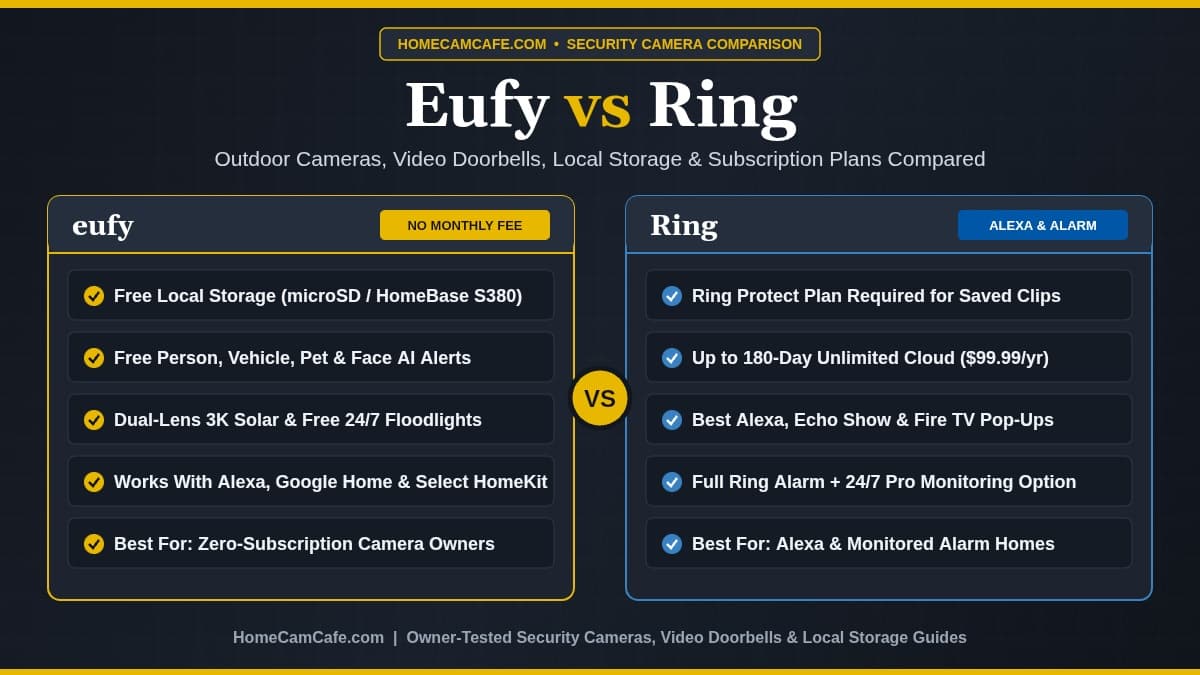
Quick Answer: Choose Eufy if you want sharp local recording on microSD cards, built-in memory, or an expandable HomeBase S380 with free AI detection, dual-lens outdoor cameras, Google Assistant support, and zero mandatory monthly fees. Choose Ring if you want the tightest Amazon Alexa and Echo Show integration, up to 180 days of cloud video history across unlimited cameras for $99.99 per year, or a full Ring Alarm system with optional 24/7 professional monitoring in one app.
Eufy vs Ring at a Glance
We have installed and tested multiple Eufy devices (including the SoloCam S340, Floodlight Camera E340, SoloCam S40, Video Doorbell C30, HomeBase S380, and Eufy smart locks) alongside Ring hardware (including the Ring Outdoor Cam Plus, Spotlight Cam Plus, Pan-Tilt Indoor Camera, and Ring Battery Doorbell 2K). Before breaking down individual camera categories, here is how both ecosystems stack up side by side.
| Category | Eufy | Ring |
|---|---|---|
| Subscription Required? | No (free local recording and onboard AI alerts) | Yes (required for any saved video clips or AI alerts) |
| Local Storage Options | Built-in eMMC, microSD card, or HomeBase S380 (expandable up to 16TB SATA) | None on standard cameras (Ring Edge requires Ring Alarm Pro plus a Ring Pro plan) |
| Free AI Detection | Person, vehicle, and pet alerts free (plus local BionicMind facial recognition via HomeBase S380) | Unfiltered motion alerts only; Person, Vehicle, and Package Smart Alerts require Ring Protect |
| Cloud Subscription Pricing (US) | Optional: $3.99/mo ($39.99/yr) per cam Basic; $13.99/mo ($139.99/yr) unlimited Plus | Required for clips: $4.99/mo ($49.99/yr) Solo; $9.99/mo ($99.99/yr) unlimited Multi |
| Cloud Retention Window | 30 days rolling (motion events only) | Up to 180 days across Solo, Multi, and Pro (14 days for paid 24/7 add-on) |
| 24/7 Continuous Recording | Free locally on compatible hardwired and plug-in cameras (such as Floodlight E340) | Paid add-on ($3/mo per eligible wired camera on top of Ring Protect) |
| Smart Home Support | Amazon Alexa, Google Assistant, and select Apple HomeKit models (1080p stream limit) | Deep Amazon Alexa and Echo Show integration (no Google Home live video, no HomeKit) |
| Home Alarm & Monitoring | Sensors, smart locks, and optional higher-cost ExpertSecure monitoring | Mature DIY Ring Alarm with 24/7 professional monitoring via Ring Pro ($199.99/yr) |
The Core Divide: Free Local Storage vs. Ring Protect Subscriptions
The single biggest difference in Ring vs Eufy hits on day 31 after setup. Eufy designs its cameras to work completely without a monthly fee. Depending on the model, clips record directly to built-in flash memory, an onboard microSD card, or an indoor Eufy HomeBase S380 (HomeBase 3) hub. Even better, Eufy includes person, vehicle, and pet detection at zero ongoing cost, and pairing compatible cameras with HomeBase S380 unlocks local BionicMind facial recognition and up to 16TB of expandable 2.5-inch SATA drive storage safely inside your house.
Ring takes the opposite path. As we documented in our guide on whether Ring works without a subscription, a standard Ring camera or video doorbell saves zero recorded clips once the 30-day free trial expires. Without a paid plan, you keep Live View, two-way talk, customizable Motion Zones, Privacy Zones, and basic motion alerts, yet you cannot go back and review who walked up your driveway five minutes ago. Most Ring cameras have no microSD slot at all. Even Ring Edge (which writes footage to a microSD card inside a Ring Alarm Pro base station) requires an active Ring Pro subscription, so it does not provide fee-free local recording.
That said, if off-site cloud backup across three or more cameras is a requirement for your household, the subscription math shifts in Ring’s favor. As covered in our eufy Cloud Storage plans breakdown, Eufy’s optional Cloud Backup costs $3.99 per month ($39.99 per year) per camera on Basic or $13.99 per month ($139.99 per year) for unlimited compatible cameras on Plus, and every tier caps cloud history at 30 days. By contrast, Ring Protect Multi covers unlimited compatible Ring cameras and doorbells at one address for $9.99 per month ($99.99 per year) and keeps cloud event history for up to 180 days. You can model your exact camera count with our 5-year security camera subscription calculator.
| Storage Scenario | Eufy 5-Year Subscription Cost | Ring 5-Year Subscription Cost |
|---|---|---|
| Local Recording (No Monthly Fee) | $0 (uses built-in memory, microSD, or HomeBase S380) | Not available for saved clips |
| 1-Camera Cloud Plan (Annual Billing) | $199.95 (Basic, 30-day history) | $249.95 (Ring Protect Solo, up to 180-day history) |
| Unlimited Cameras Cloud Plan (Annual Billing) | $699.95 (Plus, 30-day history) | $499.95 (Ring Protect Multi, up to 180-day history) |
| 24/7 Continuous Recording (2 Wired Cams) | $0 locally on microSD or HomeBase S380 | $859.95 (Ring Multi plus two $3/mo 24/7 add-ons, 14-day cloud cap) |
Important: Ring renamed its subscription tiers from Ring Home back to Ring Protect (Solo, Multi, and Pro). If you want AI Video Descriptions or Familiar Faces on Ring, you must subscribe to Ring Protect Pro ($19.99/month or $199.99/year) or pay $5/month extra for the Pro Intelligence add-on on Solo or Multi. Eufy includes local facial recognition free with HomeBase S380.
Eufy vs Ring Camera Lineups: Outdoor, Floodlight, and Indoor Matchups
When buyers compare Eufy vs Ring camera hardware, both companies cover every residential angle, yet their engineering philosophies look very different once you mount them outside.
Outdoor Battery and Solar Cameras
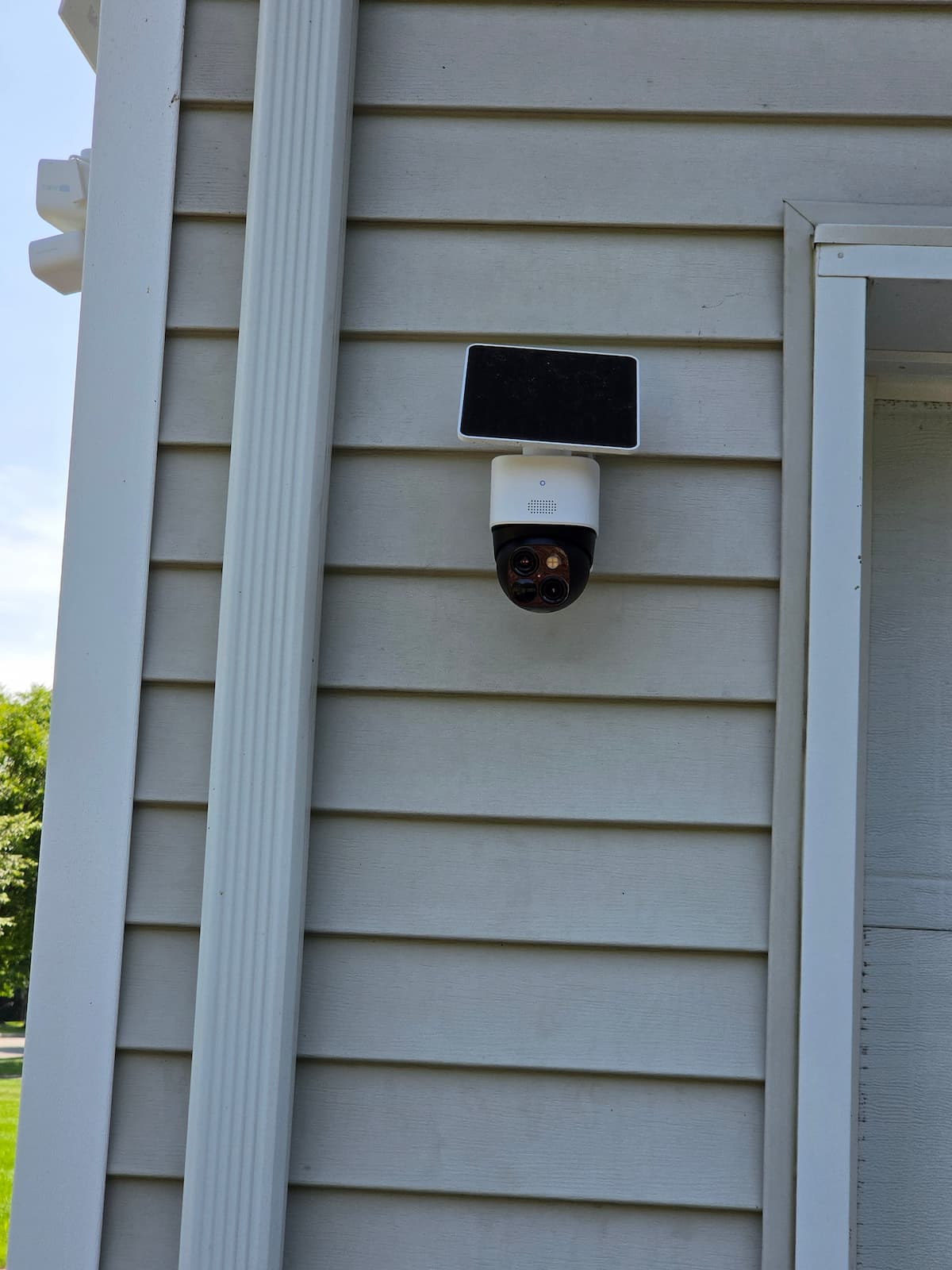
Eufy has carved out a clear lead in self-contained solar and dual-lens outdoor cameras. In our hands-on Eufy SoloCam S340 review, we liked how Eufy packed a 3K wide-angle lens, a 2K telephoto lens (up to 8x hybrid zoom), 360-degree motorized pan-and-tilt tracking, 8GB of onboard local storage, and a solar panel into a single wire-free unit. In sunny spots, the solar panel keeps the battery topped off reliably, and we also saw simple wire-free solar performance during our Southwest Florida testing of the older Eufy SoloCam S40. The main trade-off from our S340 testing is motion tuning: dialing in alert sensitivity took patience to avoid excessive notifications without missing real activity.
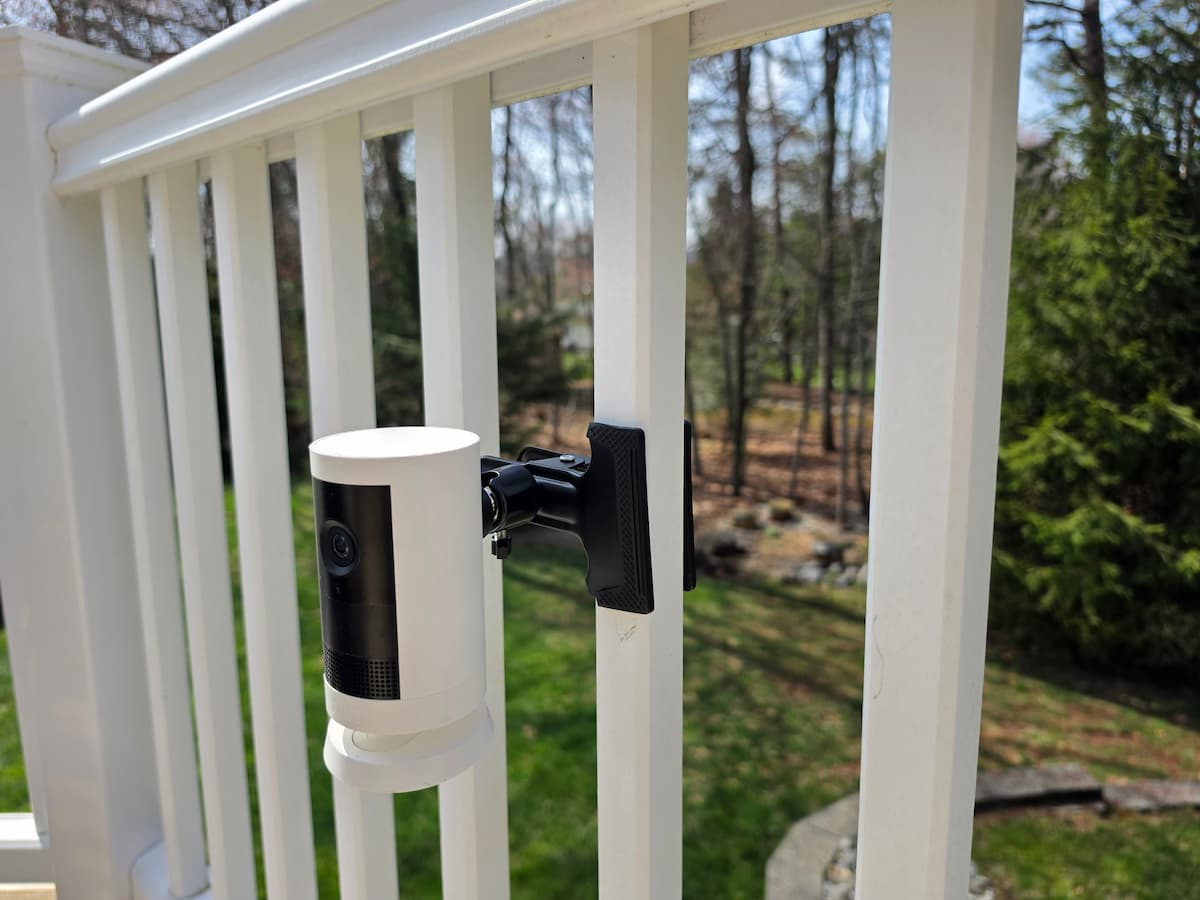
Ring counters with modular power flexibility and strong low-light tuning. Our owner-tested Ring Outdoor Cam Plus (4.0 / 5.0) stands out for crisp 2K Ring Vision video, Low-Light Sight color night vision that holds color in dim ambient street lighting, dual-band Wi-Fi 6, and four power choices (Quick Release battery pack, plug-in adapter, PoE, or a separate Ring solar panel). If you want active deterrence lighting in a wireless body, our tested Ring Spotlight Cam Plus (4.0 / 5.0) adds dual motion-activated LED spotlights and a 105dB siren, though it records at 1080p rather than 2K. Ring does not offer a dual-lens solar pan-and-tilt tracker like the SoloCam S340, and every Ring outdoor camera requires a subscription to keep footage.
View Eufy SoloCam S340 on Amazon → View Ring Outdoor Cam Plus on Amazon →
Hardwired Floodlight Cameras and 24/7 Continuous Recording
Over a driveway or backyard junction box, Eufy’s hardware and recording economics are hard to beat. In our hands-on Eufy Floodlight Camera E340 review (4.0 / 5.0), the E340 combined dual 3K wide and 2K telephoto lenses, 360-degree pan and 120-degree tilt auto-tracking, 2,000-lumen adjustable LED panels, dual-band Wi-Fi, and a 95dB siren. Most importantly, inserting a microSD card (up to 128GB) or pairing it with HomeBase S380 unlocks free 24/7 continuous local recording with zero monthly bill. One small technical caveat from our test: when active AI tracking or dual-view mode is engaged, maximum recording resolution drops from 3K to 2K.
Ring makes polished hardwired floodlight cameras with bright LEDs and tight Alexa routines, and Ring now offers 24/7 Continuous Recording on eligible wired cameras. However, Ring’s continuous recording requires both an active Ring Protect subscription and an extra $3 per month per camera add-on, capped at 14 days in the cloud. If round-the-clock driveway recording matters to you, Eufy saves hundreds of dollars over the life of the camera (and for buyers who want even deeper wired PoE and NVR options beyond Eufy’s newer S4 PoE lineup, see our Reolink vs Eufy comparison).
View Eufy Floodlight Camera E340 on Amazon →
Indoor Security Cameras
Indoors, Ring’s signature strength is physical privacy control. Our owner-tested Ring Pan-Tilt Indoor Camera adds 360-degree room coverage with a manual swivel privacy cover that blocks the lens and cuts the microphone in one flick, while the fixed-lens Ring Indoor Cam Plus (also sold as Ring Indoor Cam 2K) steps up to Retinal 2K video with a removable slide lens cover. If you already pay for Ring Protect Multi on your exterior cameras, adding a Ring indoor camera costs nothing extra per month.
For buyers who do not want a monthly plan, Eufy’s indoor lineup delivers stronger camera hardware and free local recording. Eufy’s plug-in models (ranging from compact 2K pan-and-tilt cameras up to the dual-lens 4K wide plus 2K telephoto Indoor Cam S350 with 8x hybrid zoom and motorized privacy positioning) store 24/7 or motion footage on a microSD card or HomeBase S380 with free human and pet AI detection.
View Ring Indoor Cam Plus on Amazon →
Eufy vs Ring Doorbell: C30 and E340 vs. Ring Battery Doorbells
Video doorbells are where most shoppers start comparing Eufy vs Ring, and our hands-on front-door testing uncovered real trade-offs on both sides that spec sheets gloss over.
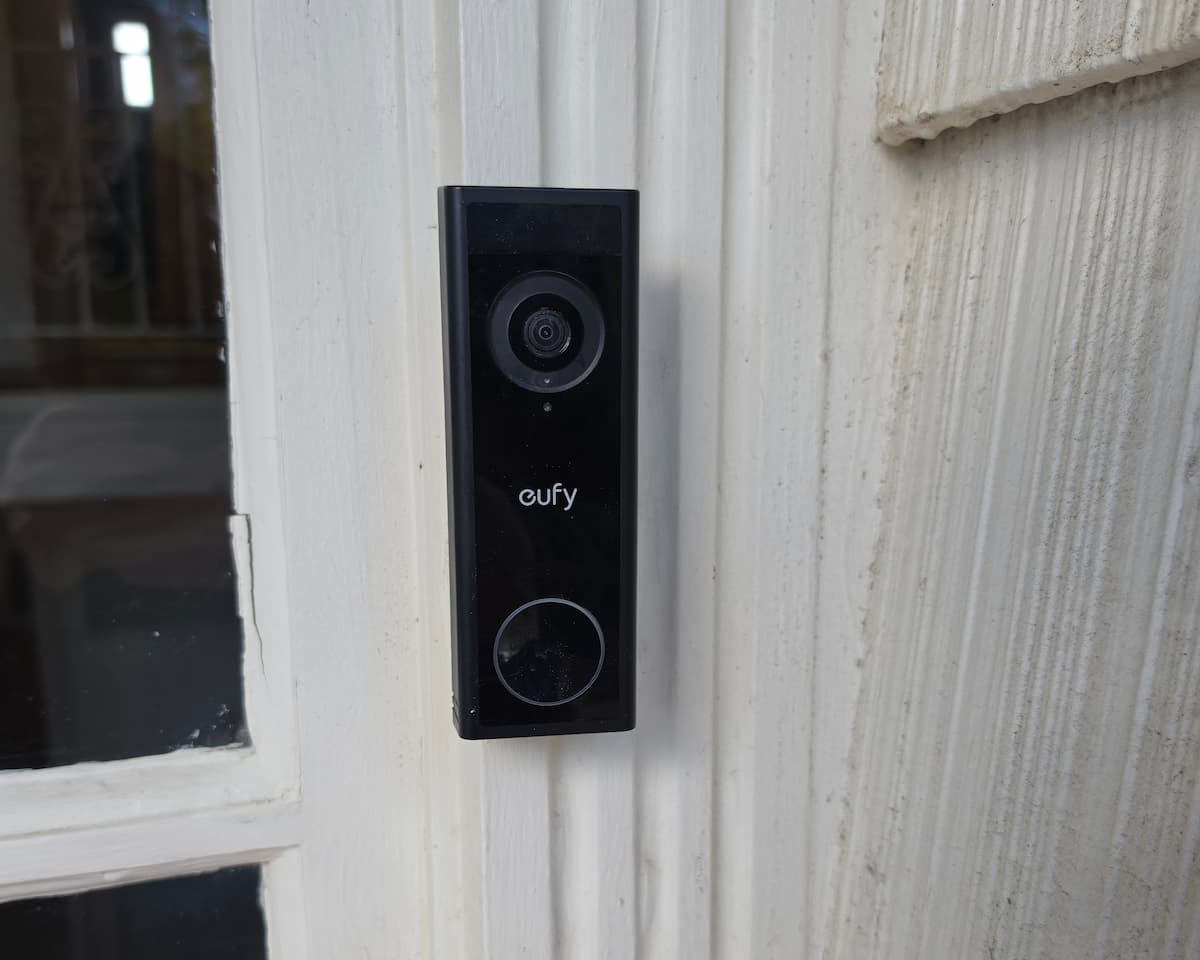
On the Eufy side, we owner-tested the budget-minded Eufy Video Doorbell C30, a wire-free 2K doorbell with a 5,000mAh battery, free onboard AI detection, and a local microSD card slot (up to 128GB). Its Live View performance and real-time notifications worked well without any monthly subscription, yet we ran into one frustrating flaw: retrieving recorded clips directly from the onboard microSD card was noticeably slow. Buyers who want Eufy’s stronger front-door experience should look at the step-up Eufy Video Doorbell E340, which adds dual cameras (one front-facing 2K lens for faces plus a downward-facing lens for doorstep packages), 8GB of built-in local storage, a removable quick-release battery pack, optional hardwiring to existing doorbell chimes, and HomeBase S380 compatibility.
On the Ring side, choosing the right tier matters tremendously. In our hands-on Ring Battery Doorbell 2K review (2.5 / 5.0), Ring’s entry-level 2K doorbell had a polished app and clever software features like Motion Warning and Alexa+ Greetings, yet the hardware disappointed on our front door just 20 feet from an eero 7 mesh puck. It struggled with a weak -62 dBm 2.4 GHz Wi-Fi signal, triggered repeated infinite Live View loading spins, suffered daytime bitrate compression drops, stripped out manual night vision toggles, and omitted both an indoor chime and a USB-C charging cable from the box. If you buy a Ring doorbell, skip that base 2K model and step up to the Ring Battery Doorbell Plus (2nd Gen, Retinal 2K) for a removable Quick Release battery, dual-band Wi-Fi 6, and Low-Light Sight color night vision, or the flagship Ring Battery Doorbell Pro (Retinal 4K) for 4K clarity, radar-powered 3D Motion Detection, and theft replacement protection.
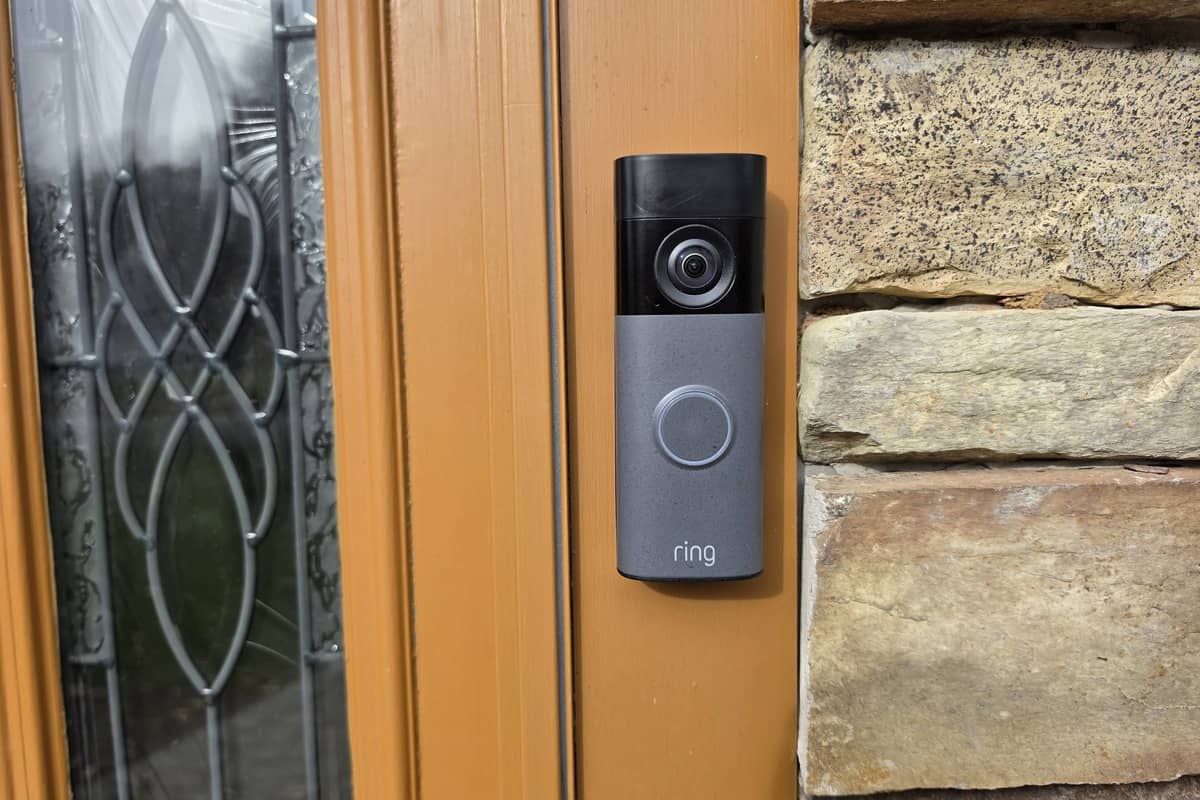
| Doorbell Feature | Eufy Video Doorbell C30 / E340 | Ring Battery Doorbell 2K Plus / 4K Pro |
|---|---|---|
| Video & Package View | 2K single lens (C30) or dual 2K front + package camera (E340) | Retinal 2K head-to-toe (Plus) or Retinal 4K 1:1 with 10x zoom (Pro) |
| Battery & Wiring | Built-in battery on C30; removable battery or 8-24V wired on E340 | Removable Quick Release battery pack or 8-24V trickle charge |
| Local Clip Storage | Free microSD up to 128GB (C30) or 8GB built-in (E340); HomeBase 3 ready | None (Ring Protect subscription required to save recordings) |
| Smart Alerts & Replies | Free human/package AI (model-dependent) and Quick Replies | Person/Package Alerts, Motion Warning, and Alexa+ Greetings (paid plan) |
| Smart Display Streaming | Amazon Alexa and Google Assistant | Amazon Alexa and Echo Show only (automatic pop-up on press) |
View Eufy Video Doorbell E340 Doorbell on Amazon → View Ring Battery Doorbell 2K Plus on Amazon → View Ring Battery Doorbell 4K Pro on Amazon →
App Polish, Geofencing, Smart Home, and Whole-Home Security
Both apps rank among the easiest to live with in consumer home security, yet each one excels at different household habits.
App Polish and Geofencing: The Ring app feels slightly cleaner and more uniform across every camera generation, with smooth timeline scrubbing, Multi-Cam Live View on Ring Multi, linked device triggers, and the Neighbors safety feed. However, Ring locks Device Modes behind an active Ring Protect plan. Eufy’s Security app gives you one of the best built-in multi-user geofencing implementations we have tested for free automatic Home and Away switching (see our automatic camera arming and geofencing guide), though the app interface can feel busier when juggling HomeBase, smart locks, and standalone cameras together.
Smart Home Ecosystems: Ring is owned by Amazon, so its Echo Show automatic doorbell pop-ups, Fire TV live feeds, and Alexa Routines remain unmatched. The downside is strict lock-in: Ring cameras do not stream live video to Google Nest Hub displays and do not support Apple HomeKit. Eufy works natively with both Amazon Alexa and Google Assistant. On Apple HomeKit, Eufy has a narrow edge over Ring because select Eufy cameras (such as the eufyCam S3 Pro bridged through HomeBase S380) support HomeKit at up to 1080p, though buyers should verify each model carefully because popular standalone units like the SoloCam S340 and Floodlight Camera E340 do not support HomeKit.
Whole-Home Security and Smart Locks: Both companies expand far beyond standalone cameras. We have used Eufy’s smart locks and appreciate how cleanly they pair with Eufy doorbells and HomeBase S380 inside one subscription-free app. Where Ring pulls ahead is monitored home alarm protection: Ring Alarm offers affordable contact sensors, motion detectors, glass-break sensors, cellular backup, and 24/7 professional emergency dispatch bundled with unlimited camera cloud storage under Ring Protect Pro ($19.99/month or $199.99/year). While Eufy offers entry sensors and its newer ExpertSecure professionally monitored system, Ring Alarm remains the more mature and cost-effective path if professional emergency dispatch is your top priority.
View Eufy HomeBase S380 (HomeBase 3) on Amazon →
Who Should Buy Eufy vs. Who Should Buy Ring?
Choose Eufy if:
- You refuse to pay a mandatory monthly subscription just to watch recorded motion clips and use AI person or vehicle alerts.
- You want centralized, expandable local storage up to 16TB inside your home with free BionicMind facial recognition via HomeBase S380.
- You want dual-lens solar tracking (SoloCam S340) or free 24/7 continuous local floodlight recording (Floodlight Camera E340).
- Your household uses Google Assistant displays, wants free multi-user geofencing, or plans to pair cameras with Eufy smart locks.
Choose Ring if:
- You want a unified Ring Alarm system with door sensors, cellular backup, and 24/7 professional emergency monitoring under Ring Protect Pro.
- Your home revolves around Amazon Echo Show screens, Fire TVs, Alexa Routines, and paid smart features like Motion Warning and Alexa+ Greetings.
- You specifically prefer off-site cloud storage across three or more cameras, where Ring Protect Multi ($99.99/year, 180-day history) beats Eufy Cloud Plus ($139.99/year, 30-day history).
- You want modular battery-or-wired outdoor cameras like the Ring Outdoor Cam Plus or theft replacement coverage on Ring doorbells.
Frequently Asked Questions
Is Eufy better than Ring?
For most homeowners who want to own their security footage without a recurring monthly bill, Eufy is better than Ring. Eufy includes free local storage, free onboard AI alerts, free 24/7 continuous local recording on compatible wired cameras, and Google Assistant support. Ring is better if you want deep Amazon Alexa integration, 180-day unlimited cloud history on Ring Multi, or a professionally monitored Ring Alarm system.
Does Eufy work without a subscription compared to Ring?
Yes, and this is the biggest gap between the two brands. Eufy cameras record clips locally to built-in memory, a microSD card, or a HomeBase S380 hub with zero monthly fee. Standard Ring cameras only offer Live View and basic motion alerts without a paid Ring Protect plan, saving zero video history once the 30-day trial ends.
Which is better for a video doorbell, Eufy or Ring?
Eufy is the stronger choice if you want zero monthly fees, dual-camera package viewing on the E340, and Google Assistant plus Alexa support. Keep in mind that our tested budget Eufy C30 had slow microSD clip retrieval, so the E340 or HomeBase pairing is smoother. On Ring’s side, skip the entry-level Battery Doorbell 2K (which struggled with Live View spins and video compression in our test) and step up to the Battery Doorbell 2K Plus or 4K Pro if you want Echo Show pop-ups and already plan to pay for Ring Protect.
Which brand is cheaper if I want cloud storage for multiple cameras?
Ring is cheaper for multi-camera cloud storage and keeps clips six times longer. Ring Protect Multi costs $99.99 per year for unlimited compatible Ring devices at one home with up to 180 days of event history. Eufy’s optional Cloud Backup Plus costs $139.99 per year for unlimited compatible cameras with 30 days of rolling event history. For one camera, Eufy Cloud Basic ($39.99/year) is cheaper than Ring Protect Solo ($49.99/year), though most Eufy owners skip cloud fees altogether.
Do Eufy or Ring cameras work with Apple HomeKit and Google Home?
Ring works natively with Amazon Alexa only, with no Google Home live video streaming and no Apple HomeKit support. Eufy works with both Amazon Alexa and Google Assistant, and select Eufy models (including specific HomeBase-bridged eufyCam units) support Apple HomeKit at up to 1080p, though newer standalone models like the SoloCam S340 and Floodlight Camera E340 do not support HomeKit.
Is Eufy or Ring better for a full home alarm system?
Ring is the stronger choice for a full monitored home alarm system. Ring Alarm pairs door and window sensors, keypads, sirens, and cellular backup with all your Ring cameras in one app, and 24/7 professional monitoring is included in Ring Protect Pro ($199.99/year). Eufy shines for self-monitored security hubs, smart locks, and cameras, while its professionally monitored ExpertSecure plans carry a higher ongoing cost.
Final Verdict: Eufy vs Ring
Bottom Line: In the Eufy vs Ring showdown, Eufy wins for buyers who want strong camera hardware, dual-lens solar or 24/7 floodlight coverage, expandable HomeBase S380 local storage, free multi-user geofencing, and $0 monthly bills. Ring wins for Amazon Alexa households that want automatic Echo Show pop-ups, 180-day multi-camera cloud history at $99.99 per year, or a unified Ring Alarm system with 24/7 professional monitoring.
Want to explore more owner-tested cameras and brand matchups before you buy? Browse our Eufy security camera reviews hub, our Ring security camera reviews hub, our Aosu vs Eufy guide, our Aosu vs Ring comparison, our Ring vs Blink breakdown, and our best security cameras without a subscription roundup.